Neukölln (German:[nɔʏˈkœln]ⓘ), formerly Rixdorf (German:[rˈɪksdɔɾf]), from 1899 to 1920 an independent city, is a large inner-city quarter of Berlin in the homonymous borough of Neukölln, and evolved around the historic village of Rixdorf. With 162,548 inhabitants (2025) the quarter has the second-largest population of Berlin after Prenzlauer Berg. Since the early 13th century, the local settlements, villages and cities down to the present day have always been a popular destination for colonists and immigrants. In modern times, it was originally shaped by the working class and gastarbeiters, but western immigration since the turn of the millennium has led to gentrification and a rejuvenation of the quarter's culture and nightlife.
This article may be too long to read and navigate comfortably. When this tag was added, its readable prose size was 14,746 words. (December 2025)
Landwehr Canal with Neukölln and the quayside bar Ankerklause on the right
Location
Neukölln forms the lower east side of Berlin's city center within the Ringbahn, and is the northernmost quarter in the homonymous borough of Neukölln, with the borough stretching all the way to Berlin's southern border with Brandenburg. The quarter, administratively abbreviated Neukö, is officially an Ortsteil, and the borough a Verwaltungsbezirk (administrative district), in Berlin designated Bezirk (district).[note 4] Different from the borough, the smaller quarter of Neukölln has no mayor or representative assembly of its own. To distinguish the quarter from the borough, the latter is sometimes informally called Groß-Neukölln ("Greater Neukölln"), while the quarter is also called Berlin-Neukölln[note 5] or Nord-Neukölln.[note 6]
In the south, the quarter Neukölln is adjacent to the quarter Britz, which is also part of greater Neukölln, and to Späthsfelde in the quarter Baumschulenweg east of Britz. In the north and north-west, it borders on the quarter Kreuzberg in the Friedrichshain-Kreuzberg borough, namely the southern part of the historical Luisenstadt district in the SO 36 neighborhood, and the Graefekiez and Bergmannkiez in the Kreuzberg 61 neighborhood, which were once part of the historical Tempelhofer Vorstadt district. Neukölln's northernmost tip is also adjacent to Kreuzberg's neighborhood Wassertorplatz in the southern part of the historical Friedrichstadt district. In the west and south-west, Neukölln borders on the quarter Tempelhof in the Tempelhof-Schöneberg borough. In the north-east to south-east, Neukölln borders on the quarters Alt-Treptow, Plänterwald and western Baumschulenweg, which, together with Späthsfelde, are all part of the Treptow-Köpenick borough in former East Berlin.
Neukölln is separated from Kreuzberg by the park Volkspark Hasenheide, the Landwehr Canal, and the streets Kottbusser Damm and Hasenheide as far as the city square Südstern, which conforms to Berlin's historical Weichbildgrenze (1861–1919). With Tempelhof, Neukölln shares the Tempelhofer Feld, the vast field of the former Tempelhof Airport, now a popular recreation area. The Britz Canal, the green corridor Heidekamppark with the trench Heidekampgraben, the Kiefholzstraße and several urban streets in the Harzer Kiez separate Neukölln from the quarters of Treptow-Köpenick in former East Berlin. Finally, the Stadtring motorway with the Carl-Weder-Park, streets like Britzkestraße, Juliushof and Grenzallee, as well as the southern end of the Neukölln Ship Canal, form the administrative border with the Britz quarter.
The Teltow Canal, on the other hand, forms the geographical and demographic border within the borough Neukölln. The canal separates the dense urban areas of Neukölln and northern Britz with their higher share of immigrants and lower-income citizenry from the borough's southern residential areas, which, with the exception of Gropiusstadt, are mainly characterized by a larger number of family homes and middle-class households.[note 7]
Subdivisions
Neighborhoods
Primary neighborhoodsLifeworld-oriented regions
Neukölln has nine primary neighborhoods (Kieze), administratively called Ortslagen,[2] among them the historical sites of Neukölln's foundation south-east of the quarters's geographical center,
to the north and north-west, which together are commonly referred to as Rixdorf or Alt-Rixdorf ("Old Rixdorf").[note 10] The other primary neighborhoods are (from north to south):
Several commonly recognized secondary neighborhoods exist in Neukölln. The most important and oldest central urban community is the Donaukiez along Donaustraße between Sonnenallee and Karl-Marx-Straße, including Hermannplatz at its western end.[note 18] The oldest suburban community is the historically important Dammwegsiedlung just south of the Weiße Siedlung, an early modern housing estate from the 1920s.[note 19] A recently evolved neighborship of cultural importance is the Weserkiez with its famous party mile around Weserstraße north of Sonnenallee.[note 20] Due to urban development and expansion, many other kiez communities have formed over the decades, sometimes distinguished in the city's official LOR framework (see below) or the focus of current or former neighborhood management,[note 21] while an outlier is Kreuzkölln, which is a meta-neighborhood and loosely defined cultural sphere, described by a modern jocular toponym,[note 22] which since the mid-2000s has often been used for the northern parts of the quarter and the surrounding regions of Kreuzberg.[note 23]
Urban planning
Berlin's official urban planning framework, on the other hand, divides Berlin's boroughs and quarters into so-called Lebensweltlich orientierte Räume ("lifeworld-oriented regions"). In this LOR framework, the quarter of Neukölln, non-administrative district 10 in borough 08, as of 2025, is divided into five regions, each of them further compartmentalized into a total of 21 LORs, also called Planungsräume (planning areas).[3]
More information Region, Region number ...
Overview: regions, planning areas, neighborhoods and other areas of Neukölln
Region
Region number
Planning area (LOR)
Area number
Primary neighborhoods
Secondary neighborhoods
Neighborships
Other areas
Industry
Other localities
Schillerpromenade
01
Hasenheide
01
Hasenheide
Volkspark Hasenheide
Tierpark Neukölln
Schillerpromenade Nord
02
Schillerkiez
Tempelhofer Feld
Schillerpromenade Süd
03
Wartheplatz
04
Warthekiez
Werner-Seelenbinder-Sportpark
Silbersteinstraße
05
Silbersteinkiez
Emmauswald, Carl-Weder-Park
Neuköllner Mitte/Zentrum
02
Flughafenstraße
06
Flughafenkiez
Rollberg
07
Rollberg
Lessinghöhe
Körnerpark
08
Körnerpark
Thomashöhe
Körnerpark
Glasower Straße
09
Glasower Kiez
Kranoldkiez
Industrial park Lahnstraße
Reuterstraße
03
Maybachufer
10
Reuterkiez
Friedelkiez
Kreuzkölln
Reuterplatz
11
Weserkiez
Weichselplatz
12
Bouchéstraße
13
Harzer Straße
Donaustraße
14
Donaukiez
Hermannplatz
Rixdorf
04
Ganghoferstraße
15
Ganghoferstraße
Alt-Rixdorf
16
Böhmisch-Rixdorf
Richardplatz-Süd
Richardplatz
Braunschweiger Straße
17
Hertzbergplatz
18
Weserkiez
Wohnanlage Ossastraße
Treptow freight yards, industrial park Ederstraße, Neukölln Docklands
Wildenbruchplatz
Treptower Straße Nord
19
Harzer Straße
Treptow freight yards, industrial park Treptower Straße
Köllnische Heide
05
Weiße Siedlung
20
Weiße Siedlung
Dammwegsiedlung
Neukölln Docklands
Heidekamppark, suburban garden allotments
Schulenburgpark
21
High-Deck-Siedlung
Schulenburgpark
Neukölln Harbor, industrial parks Köllnische Heide (Nobelstraße) & Lahnstraße
Heidekamppark, Von-der-Schulenburg-Park
Close
Remove ads
Nature
Summarize
Perspective
Tempelhofer Feld
Hasenheide
Körnerpark
Emmauswald
Neukölln Ship Canal
Rixdorfer Teich, Hasenheide
Red fox, Tempelhofer Feld
Common kestrel, Tempelhofer Feld
As of 2024, Berlin ranks among the greenest cities in Germany with only 44.5% of sealed ground, an average of 4.24m3/m2 (4.64cuyd/sqyd) of vegetation, and a 50.6% share of surface area with green space (44%) or water bodies (6.6%), which provides a cooler urban climate and many options for natural habitats and urban recreation.[note 24] Similarly, the borough of Neukölln has only 45.6% of sealed ground, mainly due to its extensive recreational parks, which, together with other nature areas, have a share of ca. 43%, with green spaces at 35%, of which 19.9% are parks and meadows, and up to 8% of water surfaces. However, due to the absence of large-scale true forests (see below), the borough only has an average of 3.0m3/m2 (3.3cuyd/sqyd) of vegetation. Nevertheless, from 2019 to 2024 this was still enough to ensure an average maximum summer midday surface temperature of 36.01°C (96.82°F), more than one degree Celsius (two degrees Fahrenheit) lower than Berlin's hottest borough of Friedrichshain-Kreuzberg, which measured 37.22°C (99.00°F). Together with Pankow, this makes Neukölln one of the coolest boroughs in Berlin's inner city, and places it slightly below the class of boroughs that is categorized by an above-average risk of heat exposure for its residents.[4] However, average estimates for the northern quarter of Neukölln with 72.5% sealed ground and only 15% green areas would result in a much higher heat exposure compared to the borough's southern quarters, even though at approximately 7.5%, the quarter Neukölln (including Kreuzberg's Landwehr Canal) has a rather high share of water surface area.
Parks and forests
The borough of Neukölln, and especially its homonymous quarter, is densely populated and urbanized, and only has 3.1% (2019) of original natural land and true forests left, second to last before the borough Tempelhof-Schöneberg.[5] However, the lack of true forests, which in Neukölln are only 0.1% of the overall surface area, is offset by many green plazas, parks and other vegetated recreational areas at an overall share of 35%, not counting active cemeteries,[note 25] which actually make Neukölln one of the greenest of all Berlin boroughs, even taking the city's top spot with 19.9% of parks and meadows.[note 26]
Green space in the quarter Neukölln has a relatively low share of approximately 15% and is dominated by small to medium-sized parks, but the two major parks in the western part of Neukölln, the Volkspark Hasenheide and the Tempelhofer Feld, more than make up for the lack of large green areas in other spots. Smaller parks are found in all neighborhoods, many of which are among Neukölln's historical garden monuments,[6] for example the Anita-Berber-Park (Schillerpromenade), a former cemetery, and the stadium park of the Werner Seelenbinder sporting grounds, both of which connect to the Tempelhofer Feld, the recently decommissioned cemetery Neuer St. Jacobi Friedhof (Schillerpromenade), now mostly used as a park, with parts under management by the Prinzessinnengärten gardening project, Lessinghöhe and Thomashöhe (Körnerpark), the Körnerpark itself, a former gravel quarry, with the Rübelandpark connecting Thomashöhe and Körnerpark, the Comenius Garden (Rixdorf), Herbert-Krause-Park and Von-der-Schulenburg-Park near High-Deck-Siedlung, and extensive stretches of garden allotments like Helmutstal and Märkische Schweiz close to the quarter's eastern border, including the Heidekamppark, a long green corridor adjacent to the trench Heidekampgraben. On the southern and south-western borders to the quarters Britz and Tempelhof respectively is the Carl-Weder-Park, a stretched park above the underground Stadtring autobahn west of the Britzer Damm. Immediately adjacent to the north is the Emmauswald, often called Emmi by Berliners, a former cemetery and Neukölln's only true natural forest, with the Emmauskirchhof, a still active graveyard, connecting to the east. Furthermore, several inner-city squares and building complexes have been designed with green stretches.[note 27]
Water bodies
In the borough Neukölln, water bodies are up to 8% of the whole surface area, with the northern quarter at approximately 7.5% trailing behind Rudow and especially Britz, two of Neukölln's four other quarters. Like its parks and forests, with the exception of the Emmauswald, all of Neukölln's water bodies are man-made. Several of the quarter's parks contain artificial lakes and ponds, for example the Volkspark Hasenheide (Rixdorfer Teich), the Comenius Garden (Weltenmeer), the Karma Culture Garden in Rixdorf, and the Von-Der-Schulenburg-Park (High-Deck-Siedlung). Neukölln's prominent waterway is the Neukölln Ship Canal, which connects the Teltow and Britz Canals with the Landwehr Canal and (through Kreuzberg) the river Spree. The Neukölln Harbor, consisting of an upper and lower basin and connected via the Neukölln Watergate, was built in tandem with the Britz Harbor north of the Teltow Canal. Smaller landing stages are located along the Neukölln Ship Canal until Kiehlufer, and these Neukölln Docklands are currently subject to extensive redevelopment.
Wildlife
Like all of inner-city Berlin, Neukölln, despite its high level of urbanization, has a diverse and thriving population of urban wildlife.[7] The quarter's sufficient share of vegetation, parks and other green areas (see above) not only provides a cooler urban climate, but also promotes the settlement of wildlife. Wild species in Neukölln have usually found their safe retreats along the waterways and in the bigger parks and cemeteries, while using migration routes into the central neighborhoods along train tracks and through the interconnected park and cemetery areas, for example from Tempelhofer Feld to Lessinghöhe. Greener quarters adjacent to Neukölln in the south and east also promote migration into the quarter.
Neukölln's nature and wildlife are primarily managed by rangers from Berlin's Stiftung Naturschutz (Charity for Nature Conservation). Political measures over the past years have improved natural habitats and the ecological component of Berlin's path toward a more sustainable development. Among them are a strict urban tree planting and replacement policy, an emphasis on discreetly controlled rank growth, both in parks and on median strips, protected nature areas in larger parks, and more neighborhood-oriented action like roof gardens, for example the Kranichgarten at the Neukölln Arcaden, vegetated and partially fenced Baumscheiben around road trees instead of tree grates, as well as vegetated parklets. The Tempelhofer Feld is home to several protected and endangered plant and animal species like the Italian locust and the wood white butterfly. Almost half of the vast park's bird species are on the list of highly endangered species, among them the whinchat and the wheatear.[8]
Generally, Neukölln's wildlife is no different from that of other inner-city quarters of Berlin, so red foxes, rabbits and smaller rodent species like the red squirrel and several muroidea as well as urban birds like doves, crows and (on the quarter's canals) swans, geese and ducks are almost ubiquitous. Less noticeable species include the badger, the beech marten, the hedgehog, bats, the true toad and other species of frog. In recent years, otters and beavers have also made a comeback in Neukölln, for example at the Landwehr Canal.[9] To date, no sightings of wild boar have been recorded for the quarter Neukölln.[note 28]
While the plain and unadorned surfaces of modern architecture have all but pushed out traditional urban bird species like the common swift and the house martin, Berlin, unlike other German cities, is still a safe haven for many others. A prominent example is the sparrow, and Berlin is now regarded as the "sparrow capital" of Germany.[10]Predatory birds, though common to Berlin,[11] are not native to the quarter of Neukölln, but sometimes intrude from other peripheral areas, for example the common kestrel from the borough's southern quarters. Rank growth and gardening policies have been the basis for a slight revival of the urban insect population, including endangered or almost extinct species like the vine weevil, which also reattracts bird species to the urbanized areas. Furthermore, Neukölln is now home to 300 species of wild bees.
Like all cities in today's globalized world, Berlin and Neukölln are also home to several invasive species like the raccoon or the Himalayan balsam.[12] Neukölln in particular has a fairly large population of nutria and muskrat. Several foreign species of fish and crustaceans have settled in Berlin's waterways, and have markedly shifted the balance of indigenous species. Especially the population of red swamp crayfish has risen sharply in the past decade, including in the Landwehr Canal, and the reintroduction of eels into Berlin's waterways is planned as a countermeasure.[13]
The quarter's history begins with its foundation as a Knights Templar stronghold during the Ostsiedlung era in the late 12th to early 13th century. Following its demilitarization and rededication as an agricultural Templar estate around 1245, its ownership was transferred to the Knights Hospitaller in 1318. The estate was legally elevated to the status of village in its foundational charter of 1360, which is the earliest source for its original toponym, Richardsdorf, which was later contracted to Ricksdorf.
In the 15th century, Ricksdorf became a shared treasury village of the Cölln and Alt-Berlin magistracies, a status that lasted for three centuries through the breakup and reunification of Cölln and Berlin. In the 18th century, its official modern name Rixdorf emerged, and the village was expanded with a large colony of Bohemian refugees. In the 19th century, the colony Böhmisch-Rixdorf eventually united with the historical Deutsch-Rixdorf, and the new village grew into the largest town of Prussia, becoming an important industrial center of the region. In 1899, Rixdorf was granted the status of an independent and free city. In 1912, the city was renamed to Neukölln.
With the 1920 Greater Berlin Act, Neukölln merged with the city of Berlin and, together with the former villages and towns of Britz, Buckow and Rudow, formed Neukölln, a large borough of Germany's capital, which stretches all the way from the city center's lower east side to the southern border with Brandenburg. Since the Weimar Republic, Neukölln's fate has been closely intertwined with the history of Berlin. Over its long history, the quarter Neukölln has always been a popular destination for colonists, migrant workers, refugees and immigrants.
Demographics and social statistics
Summarize
Perspective
As of 2025,[14] Neukölln with its 162,548 inhabitants has the second-highest population of Berlin's quarters after Prenzlauer Berg. The borough's current budget deficit stands at €10.2million ($11,39million), and in 2024 Neukölln's district office declared the third spending freeze in a year.[15] In 2023, the unemployment rate in Neukölln was at 14.1%. The poverty rate was at 29%, more than a third of Neukölln's children and adolescents were poor or at risk of poverty,[16] and the borough is currently the only German district with its own poverty commissioner.[17]
As of 2025, 58.3% of residents in the quarter Neukölln are German or foreign first or later-generation immigrants, up from 46% in 2019[18] and 48% in 2021, with roots in more than 155 countries.[19] The overall share of foreigners in the quarter currently stands at 36%, and has continued to rise in the past years due to western immigration and the ongoing European migrant crisis,[20] while the number of Ukrainians in the borough Neukölln increased by 11.9% in 2023 after the Russian invasion of Ukraine.[21] Due to the quarter's dense urban character, only far less than five percent of Berlin's refugees can be accommodated in Neukölln.[note 29] As of 2025, the percentage of foreigners without German citizenship is 21.6% on the low end in Bouchéstraße (LOR 100313), and as high as 42.9% in Treptower Straße Nord (LOR 100419), while the highest share in the quarter's historical center stands at 40.3% in the Donaustraße neighborhood (LOR 100314).[22] The bulk of the most recent migration originated in Islamic countries,[note 30] and over the years this development, coupled with a strong local grassrootsradical left counterculture, has led to a significant increase in antisemitism[note 31] and pro-Palestinian propaganda,[note 32] also fueled by the politicians of Neukölln's chapter of Die Linke.[23]
Crime, police and fire safety
Revolutionary 1st of May demonstration, Sonnenallee, Neukölln, 2021
Two out of Berlin's seven so-called "crime-burdened locations" (kriminalitätsbelastete Orte, kbOs) are in Neukölln, Hermannplatz with Donaukiez including Sonnenallee, and Hermannstraße around Hermannstraße Station,[24] with the local U-Bahn lines connecting to four of Berlin's five other kbOs.[note 33] Especially in these two kbOs and their surrounding city blocks, Neukölln is also characterized by social and religious conflicts, manifesting in educational challenges,[25] violent felonies[note 34] including occasional gun violence,[26] organized crime by Islamicclans, ranging from recurring gang and drug violence[27] to protection racketeering,[28] and occasional rioting and arson, transphobia and homophobia.[note 35] Among the critical annual events for the Berlin Police are the so-called Revolutionary 1st of May Demonstration, which usually takes place in Kreuzberg and Neukölln as part of the local May Day, and the New Year's Eve festivities, which in recent past have often resulted in rioting and arson.[29] Since 2022, Neukölln has had the highest garbage pollution of all Berlin boroughs.[30]
Neukölln, together with the borough Neukölln, is part of the Directorate 5 of the Berlin Police. The quarter Neukölln is patrolled by Precinct 54 (Sonnenallee) and Precinct 55 (Rollbergstraße), while the S-Bahn and intercity trains and stations are patrolled by the German Federal Police. For Berlin's and Neukölln's kbOs, the police have been granted special authorities, specifically identity verification and searches of persons or their belongings without a warrant, probable cause or reasonable suspicion, which is embedded in a general weapons ban including the right to warrantless searches for Berlin's public transport system, enacted by the Berlin Senate in July 2025 after amendments to Berlin's ASOG law and constitution.[note 36] Additional continuous AI-assistedvideo surveillance of all kbOs is to commence in 2026.[31]
As with the police, Neukölln is part of the Directorate 5 of the Berlin Fire Brigade. It is served by the Fire Stations 5000 and 5001, whereas the latter is part of Berlin's volunteer fire department. Both stations are in the center of Neukölln on Kirchhofstraße in Rixdorf, so the neighborhoods of Neukölln are often served by stations in adjacent quarters, for example the Reuterkiez by Fire Stations 1600 and 1601 on Wiener Straße in Kreuzberg nearby.
Religion
The old village of Rixdorf had been part of the Holy Roman Empire as a Knights Templar and Hospitaller settlement, so it was historically a Roman Catholic village. However, the Reformation in the 16th century changed the religious makeup of many German regions, especially in the northern and eastern parts of the empire. Furthermore, in the early 18th century, Rixdorf came under Prussian political and cultural hegemony, which included Protestantism as the effective church of the state, so the Christian affiliative distribution gradually shifted away from the Roman faith. Rixdorf in particular was a prominent example of this development, because it eventually obtained a strong Protestant community, descended both from the early 18th century Moravian colonists and the industrial immigrants from the Eastern parts of the German Empire (1870–1910).[note 37] In the course of the 20th and 21st centuries, the Christian parishes of Berlin, and in particular of Neukölln, hemorrhaged a significant share of their members. Following the secularization in the age of Enlightenment after the Reformation, many of the 20th century's global secular, atheist and sometimes downright antireligious political ideologies like communism, socialism and national socialism flourished (and clashed) in Berlin (see above), and a Marxist-Leninist regime eventually ruled over the Eastern parts of Germany and East Berlin for many decades. For this reason, a large part of Germany's population today is not affiliated with any religion, and Berlin in particular is often called the "atheist capital of the world".[32] Beyond that, Neukölln had always been a left-leaning working class district, and a home to progressive voices from social reformists to Biblical critics like Bruno Bauer, so the effects with regard to irreligion are visible to this day.
German statistics offices are not required to gather information on the religious affiliations of the citizenry. The German church tax system, however, offers insight into the membership strength of at least the two primary Christian denominations in the borough of Neukölln. As of 2025, only 19.02% of Neukölln's residents are Christian, of which 7.18% are Catholic, while 11.84% belong to one of Germany's associated mainstream Protestant denominations (EKD). At roughly 72%, the vast majority of Berlin's residents, however, is irreligious, while 1.5% are of other faiths, not counting Islam, with similar numbers to be expected for Neukölln.[note 38] Due to the quarter's ethnic makeup and history of Ottoman, Turkish and modern Muslim immigration, a significant minority adheres to the Islamic faiths, of which the Sunni branch forms the majority. Statistics for the quarter itself do not exist, but based on reliable, but partially outdated numbers for the whole of Berlin (4%) and the borough Neukölln (7–9%), the share of the Muslim population in the quarter Neukölln would be at least twice as high as the borough's overall share. In 2012, residents of Turkish descent made up 45% of the immigrant and 12% of the overall population, accounting for two thirds of the quarter's Muslim population, which at the time stood at a share of 18%.[33] Increasing immigration from Islamic countries since 2015 therefore suggests that unofficial estimates of at least 20% and up to 25% (2024) are not false.[note 39] Either way, Islam and (more precisely) Sunni Islam forms the largest religious cohort in the quarter Neukölln, dwarfed only by the number of irreligious residents at approximately 50–60%.
Within Neukölln's cosmopolitan citizenry, many other religions and denominations are present and thriving. The borough of Neukölln is home to several thousand Hindus, mainly from India, Sri Lanka and Bangladesh, and especially the number of Indian expats has been rising steadily since the 2022 enactment of the Deutsch-indisches Migrationsabkommen (German-Indian Treaty on Migration). Still, the religious and cultural diversity of German society, not least in Berlin, has suffered greatly in the past 90 years, namely from the loss of Jewish culture due to the Shoa and Jewish exodus from Germany. Jewish life cautiously resurged in the 1990s with the immigrating late repatriates from Eastern Europe, and the trend continued with the 21st century influx of young people from all around the world, many of whom come from Israel. However, in 2022 only 1% of Berlin's residents had been Jewish.
Remove ads
Transport
Summarize
Perspective
The latest modal share data, based on a 2023–24 survey,[34] shows that Neukölln's residents have changed their behavior significantly since the previous 2018 study. Pedestrian traffic rose to 33.3% of all routes, while automobile use fell to 21.3%, which roughly corresponds to citywide figures and is mainly due to altered work and mobility patterns since the COVID-19 pandemic. While bicycle use in Berlin is stagnating at 18%, it rose significantly to 21.8% in Neukölln, and is now slightly more prevalent than motorized individual transport, especially in the highly developed northern quarter. Public transport use has fallen from 24.9% to below 24%, and remains lower than the citywide share of 26%, which is also due to Neukölln's dense urban character with a high variety of retail and service options in close proximity, not least in the north, which reduces the need for longer trips. The main factor is the size of the Neukölln borough: many southern areas like the Buckow quarter and parts of Britz are not connected to the S- or U-Bahn network, so in many of Berlin's suburbs beyond the Ringbahn, using a private car is therefore still more attractive than riding a bus.
Three U-Bahn stations just outside of the quarter offer quicker access to certain neighborhoods of Neukölln: Südstern (U7) to the western parts of Hasenheide, Schönleinstraße (U8) to the Reuterkiez, and Grenzallee (U7) to the southern and south-eastern industrial parks including the Neukölln Harbor.
During workday nights, approximately between 1:00 and 4:00, Berlin's subways are not operational, but are replaced by buses. In Neukölln, the U7 and U8 are replaced by the bus lines N7 and N8 respectively. During nights before Saturdays, Sundays and public holidays, the U-Bahn lines operate continuously.
Due to sufficient access to U- and S-Bahn for most areas of Neukölln, the quarter is currently not served by any of Berlin's ExpressBus lines. Still, Neukölln has several regular bus lines, connecting for example Marzahn (194) and Marienfelde (277). There are also four MetroBus lines, the most important ones being the M29 connecting via Checkpoint Charlie and the southern Potsdamer Platz area to the western city center including Kurfürstendamm, the M41 to Berlin Central Station via Potsdamer Platz, and the southbound M44 via Britzer Garten to Buckow-Süd, the terminus of a potential extension of the U-Bahn line U8 (see below). In addition to the U-Bahn replacement bus lines during night hours, Neukölln is served by several regular night bus lines, for example the N8 and N7 (see above), and the N94 connecting Hermannplatz and Lichtenberg railway station via Ostkreuz.
Airport connections
Since the closing of the airports Tegel and Tempelhof, whose airfield was partially situated in Neukölln, Berlin only has one remaining international airport, Berlin Brandenburg Airport (BER), the former (and greatly extended) Berlin Schönefeld Airport just outside of Berlin.[note 43] Since the 2025 timetable change, which included the cancellation of the S-Bahn line S45, the quarter Neukölln has no direct daytime connection to the BER anymore.
When exclusively using the U-Bahn, an interchange between subway and the airport express bus lines X7 and X71 is necessary at the current U7 terminus Rudow.[note 44] If the S-Bahn is the primary mode of transport, BER passengers to and from Neukölln can use interchanges at Südkreuz station between S-Bahn and the FEX airport express train or the regional express train RE20, which both connect to the BER, and are usually the fastest routes between Neukölln and the airport.[note 45] A slightly longer alternate route is possible with an interchange at Schöneweide station between the S-Bahn lines S46 or S47 and the regional express trains RE24 or RE32.[note 46] When exclusively using the S-Bahn, BER passengers to and from Neukölln need to use interchanges at Baumschulenweg station between the S46 or S47 (to and from Hermannstraße, Neukölln and Köllnische Heide) and the southern lines S85 and S9.[note 47] During the night, the service on the U-Bahn line U7 is replaced by the night bus line N7, which directly connects Neukölln and the airport.[note 48]
Ferry
The Rixdorf at Kottbusser Brücke landing
Neukölln does not offer any regular ferry transport, but several landing stages for a variety of charter tours exist in Neukölln. Berlin shipping company Stern und Kreisschiffahrt, which is based at the Treptow Harbor, operates a landing at the Estrel Hotel on the Neukölln Ship Canal, with one route through Neukölln along the Landwehr Canal. Former Kreuzberg shipping company Reederei Riedel, which is now based at the Rummelsburg Harbor in Oberschöneweide, operates two landings, the Kottbusser Brücke at the Landwehr Canal, and the Wildenbruchbrücke at the Neukölln Ship Canal. One of their ships is the 1962 Rixdorf, which has been in their service since 1987 and is authorized for 250 passengers and crew.[note 49]
Future
U-Bahn
There are concrete medium-term plans to extend the U7 south beyond Rudow to directly connect the airport BER to Neukölln and the rest of Berlin via U-Bahn, adding a minimum of two and up to seven additional stations inbetween, with Schönefeld also functioning as an S-Bahn interchange.[note 50] In 2024, two performance audits for the extension began, with the Berlin audit still under way,[35] while the audit by the Schönefeld municipality ended with a positive result in April 2025.[36] The U7 would then be the first of Berlin's U-Bahn lines to reach beyond the city's borders. The planned extension will not open before 2035.[37]
As Greater Berlin has been steadily growing since German reunification to now almost 4.8million inhabitants, with extensive residential construction happening in Berlin's immediate surrounding regions, public transport extensions to the city's periphery are propagated frequently. With regard to Neukölln, an internal 2023 BVG feasibility study on long-term U-Bahn network expansion included a southbound extension of the U8 beyond Hermannstraße, terminating in the south of Buckow on the border to Brandenburg's Gartenstadt Großziethen,[38] which would tilt southern Neukölln's modal share toward public transport, and away from private car use (see above).
S-Bahn
The borough administrations of Treptow-Köpenick and Neukölln have often pushed for an additional station on Berlin's Ringbahn, primarily at the Kiefholzstraße on the border of the two boroughs. However, the Berlin transport providers aim at one Ringbahn revolution every 60 minutes. Under this guideline, only one station can be added to the lines S41/42 for the whole of Berlin. The Kiefholzstraße therefore competes against four other proposed stations, one of them in Neukölln as well, namely Oderstraße at the south-eastern corner of the Tempelhofer Feld.[note 51]
Bus and DRT
Two new MetroBus and ExpressBus lines are planned, the M94 to Friedrichsfelde-Ost via Treptow and Ostkreuz station, and the X77 from Hermannstraße to Marienfelde via Alt-Mariendorf.[39]
Mainly two neighborhoods of Neukölln are insufficiently connected to the Berlin public transportation system, either because they were never developed (Schillerpromenade), or because the old and narrow streets prevent the establishment of bus lines (Alt-Rixdorf). Therefore the Berlin Senate and the BVG plan to create a network of DRT bus lines (Rufbus) for large parts of Neukölln, from the western neighborhoods at the Tempelhofer Feld to the Sonnenallee in the east, covering Schillerpromenade, Flughafenstraße, Rollberg, Körnerpark and both Rixdorf neighborhoods.[40]
Tram
Despite Rixdorf's and Neukölln's important role in the historical development of Berlin's tramway, the quarter currently has no connection to the city's modern MetroTram system. Due to the Teltow slopes and narrower streets in places like Flughafenstraße, only Neukölln's northern neighborhoods in the glacial valley are immediately suitable for tram expansion. A long-gestating plan proposes to extend Berlin's so-called "party tram"[41] line M10 by the year 2031[note 52] from Kreuzberg (SO 36) through the Görlitzer Park and crossing the Landwehr Canal into Neukölln, with stations in the Reuterkiez planned at Framstraße, Pannierstraße and U Hermannplatz on Urbanstraße via Sonnenallee.[note 53] This would create a direct public transport connection from Neukölln (Reuterkiez) to Kreuzberg, Friedrichshain, Prenzlauer Berg, Mitte, Moabit via Berlin Central Station, and Jungfernheide station in Charlottenburg-Nord.[42]
The Berlin Senate's forthcoming mobility program for the year 2035 is expected to contain plans for urban transit maglev trains, with one line to connect Berlin's ICC and exhibition grounds with the BER airport. One already proposed potential route would lead along the A100 autobahn and through the southern parts of the Neukölln quarter.[44] The proposal has been met with harsh rejection and criticism by public transport experts, who stated that the chances of this technology being used as part of Berlin's public transport network were slim.[45] They emphasized that maglev trains would merely strengthen something that is already covered by the city's traditional public transport infrastructure, without increasing efficiency, and that the technology would neither provide the necessary last-mile and suburban extensions nor give more residents access to the city's existing network.[46]
Individual transport
Motorized individual transport
Columbiadamm
Since Neukölln is densely populated and highly urbanized, most of its streets come with a speed limit of 30km/h (19mph) for motorized vehicles, including more aggressive urban planning measures in recent years aimed at reducing traffic with one-way roads and concepts like the Spielstraße ("play street"), modal filters or larger-scale neighborhood blocks (Kiezblock, LTN).[note 55] Furthermore, in 2024 the Senate of Berlin and the borough's administration have begun to monetize public parking space in the northern neighborhoods to steer away some of the excess traffic.[47]
Nevertheless, several main roads function as important arterial connections to other parts of Berlin: Columbiadamm, Urbanstraße and Hasenheide connect to the western parts of Berlin south of the city center via Tempelhof and the western neighborhood of Kreuzberg 61 respectively, while Sonnenallee, Karl-Marx-Straße and Hermannstraße connect to southern and south-eastern parts of Berlin via Britz and Baumschulenweg respectively. The Kottbusser Damm is the main road to the SO 36 neighborhood of Kreuzberg in the north, but traffic calming measures have reduced its importance in recent years. Except for the Columbiadamm, all of the above arterial roads converge at Hermannplatz.
The A100autobahn at Neukölln's border with Britz connects to the western parts of Berlin, and via its most recent extension through parts of eastern Neukölln to Alt-Treptow. The A100 offers three exits and on-ramps in the Britz and Neukölln quarters, Britzer Damm with Hermannstraße, Buschkrugallee with Karl-Marx-Straße, and Sonnenallee. A highly contended final extension[48] is planned to extend the A100 further into Friedrichshain and Lichtenberg via Ostkreuz. At the interchange Autobahndreieck Neukölln, the A100 connects to the A113 autobahn, which leads south to BER airport and the A10, Berlin's orbital autobahn. At the interchange, the A113 also has a direct on-ramp from Grenzallee, and an indirect exit to Grenzallee via Bergiusstraße.
Neukölln is part of Berlin's tight inner-city network of taxi and ridehailing services. Furthermore, free-floating carsharing is relatively widespread in urban Berlin. Still, the quarter Neukölln alone has more than ten dedicated carsharing stations, several of them also for transport vans.
Bicycle traffic
Bicycle lane, Hasenheide
Most of Neukölln's one-way streets are two-way for cyclists. In 2017, the western parts of Weserstraße opened as Neukölln's first bicycle boulevard, and in the following years, several side streets have been rededicated as such, at first especially in the trendier districts of Reuter- and Schillerkiez, but now slowly expanding into other neighborhoods.[note 56] Larger main roads have been reconstructed to include properly separated bike lanes, for example Kottbusser Damm and Hasenheide, with plans for more reconstruction in the coming years. Neukölln's most ambitious project is the 20.2km (12.55mi) "Y route" (Y-Trasse), a forked dual bicycle highway (Radschnellverbindung) from south-eastern Berlin through Neukölln to Kreuzberg.[note 57] Berlin and Neukölln have several bicycle-sharing systems with a large fleet of standard and electric bicycles, as well as cargo bikes and e-scooters.
Pedestrian traffic
Heidekamppark
Due to Berlin's usually broad sidewalks, extensive speed limits, especially on side streets, and other measures like play streets and an increasing number of one-way streets, Neukölln has become a rather safe environment for pedestrians. However, compared to other German cities, very few pedestrian zones exist in Neukölln, currently only the "youth street" Rütlistraße (Reuterkiez) and the Tempelhofer Feld. There are proposals and concrete plans to rededicate certain locations as either pedestrian zones or mixed zones for pedestrians and cyclists, for example the Elbestraße and Weichselstraße in the Reuterkiez.
Several hiking trails exist along the waterways within or bordering Neukölln, primarily the Landwehr Canal, parts of the Neukölln Ship Canal, the Britz Canal, and the Heidekampgraben in the east, which is part of Berlin's Mauerweg. Other green trails are limited to Neukölln's parks, especially the Hasenheide, the Tempelhofer Feld, the Carl-Weder-Park, and the eastern garden plots. However, due to Neukölln's highly urbanized and partially industrialized character, few of the trails are sufficiently interconnected, as it is often found in the suburban quarters of Berlin. Still, Trail 18 of Berlin's officially designated Grüne Hauptwege (main green trails) leads from the Tempelhofer Feld through Neukölln's western cemeteries and parks, Alt-Rixdorf and along the Neukölln Ship Canal via Trusepark into Kreuzberg and beyond.[49]
Freight transport
Neukölln Harbor and Watergate
Freight yards, Neukölln station
Neukölln–Mittenwald industrial railroad
Treptow freight yards, Neukölln, 1986
Industrial through track, Lahnstraße, Neukölln Harbor
Almost all of Neukölln's industrial parks are situated in the southern and eastern parts of the quarter. Both the A100 and A113 highways function as vital access ways, not least for connecting to the BER airport's freight terminals. Especially the A113 exit and on-ramp to and from Grenzallee and Bergiusstraße respectively connect the autobahn directly to both the Neukölln Harbor area and the industrial park Nobelstraße.
The Neukölln Harbor itself, alongside Berlin's other waterways, also plays a prominent role in the transportation of goods, because all major canals of Berlin are part of the network of German Federal Waterways, which connects many German industrial regions, all important international maritime and inland ports, the North and Baltic Sea, and all of Germany's neighboring countries. The infrastructure of Neukölln's harbor sans railways (see below) is managed by the state-owned Berliner Hafen- und Lagerhausgesellschaft (BEHALA). The Neukölln Ship Canal, together with Neukölln Harbor and the Neukölln Watergate, is owned by the state of Berlin and managed by Neukölln's district office. All of Neukölln's other waterways, including many rivers and canals outside of the quarter and borough, are managed by the Neukölln branch of the federal Wasserstraßen- und Schifffahrtsamt Spree–Havel (Office of Spree–Havel Waterways and Shipping), which is situated in the eastern Britz docklands south of Neukölln Harbor.
Besides S-Bahn services, the stations Hermannstraße, Sonnenallee with its northern terminals along the western shore of the Neukölln Ship Canal into the freight terminus Güterbahnhof Treptow,[note 58] and especially Neukölln offer additional capacities for freight traffic via railways. The main lines connect eastbound via Köllnische Heide and westbound alongside Berlin's orbital S-Bahn infrastructure, continuing either westbound via Südkreuz or southbound and southwestbound via Tempelhof.
A smaller and mainly single-track historical railroad, whose northern parts within Berlin are still in operation for industrial transport, is the Neukölln–Mittenwald railroad (NME). It originates at Berlin Hermannstraße freight station[note 59] and branches off in the Tempelhof quarter south of the Tempelhofer Feld and traverses the Teltow Canal to connect other industrial areas in the south of Berlin, with the first (and primary) freight station Berlin Teltowkanal located in Tempelhof near Saalburgstraße south of the canal, which also services Neukölln's Britz quarter via auxiliary through tracks along Gradestraße. The railroad leads further south back into the Neukölln borough via the decommissioned station Berlin-Britz at Mohriner Allee[note 60] and the non-operational terminal Berlin-Buckow at Kölner Damm, ending at the small dual-track freight yards Berlin-Rudow Nord[note 61] west of Wutzkyallee.[note 62] An adjacent secondary freight line is still in operation, the Rudow industrial through track (Industriestammgleis Rudow) east of Gropiusstadt, which branches off at the NME's Berlin-Rudow Nord yards and leads north-east via Zwickauer Damm and Stubenrauchstraße to a diesel fuel facility at the Teltow Canal near Massantebrücke.
Furthermore, industrial through tracks, which are managed by the Industriebahn Berlin, connect Neukölln station via the Treptow freight yards north of Sonnenallee to several industrial plants in the Neukölln quarter, which are mainly located within the industrial park Nobelstraße north of the Britz Canal near High-Deck-Siedlung. They connect through the eastern parts of the Neukölln Harbor, with several auxiliary tracks currently or permanently decommissioned.[note 63] Due to Neukölln's dense urban development and its inner-city industrial areas, the quarter's freight trains always needed to be switched and shift directions several times.[note 64]
Remove ads
Culture and notable sights
Summarize
Perspective
Main sights
Neuköllner Oper: opera house that hosts a wide range of performances including musicals, baroque opera, operetta, or experimental music theatre. Famous for its aim to bring elitist culture to a wider audience.[50]
Stadtbad Neukölln, the local swim hall which consists of antique thermal baths inspired by Greek temples and basilicas.
Körnerpark: park in neobarock style with fountains, orangerie, exhibition rooms and a cafe, founded 1910.
Places of worship
Even though the quarter's number of Christians has been steadily decreasing in the past decades (see above), Neukölln has a diverse Christian heritage, on the one hand as a historically Roman CatholicKnights Templar and Knights Hospitaller village, and as the seat of the Holy See's Apostolic Nunciature, and on the other hand as a prominent Protestant center of Germany, not least due to Moravian immigration in the 18th century. Furthermore, Neukölln is also an important place for the Islamic faiths due to the decades-long Muslim immigration. Most of the major religions are well represented in Neukölln today. Generally, most of Neukölln's places of worship have converged around the quarter's historical neighborhoods of Reuterkiez, Flughafenstraße, Schillerpromenade and especially Rixdorf.[note 65]
The youngest original Roman church is St. Christopher at the Reuterplatz, built between 1929 and 1930 in the new objective style, while postmodernistSt. Richard in Rixdorf was technically constructed in 1975, but replaced an older chapel at the same location. Overall, together with St. Edward in the Silbersteinkiez, Neukölln has five Roman Catholic churches.
The only church in Neukölln belonging to one of Berlin's Roman Orthodox denominations is Saint Boris the Baptist Cathedral of the Bulgarian Orthodox parish, which is located near Hermannstraße on the grounds of the cemetery Jerusalem und Neue Kirche.[note 66] Finally, the church on Rollberg's Roland-Krüger-Straße near the park Lessinghöhe is home to the freeCatholic Apostolic community.
Mainstream Protestantism
Bethlehem Church
Church of Mary Magdalene
Genezareth Church
Martin Luther Church
Phillipp Melanchthon Church
Tabitha Church
Nicodemus Church
The most famous Protestant church, while also the oldest church in Neukölln, is the historical village chapel of Rixdorf, which had originally been built in late Gothic Margraviate style around the year 1400, but might actually be at least a century older, preceded by a smaller field chapel (see above). It was partially destroyed in the 1639 Rixdorf firestorm and reconstructed the same year, but only the nave's plinth and three choir walls could be saved. It was renamed Bethlehem Church in 1912 and discretely renovated and expanded in the 1930s. Originally a Catholic chapel, it was later also used by both the Catholic and one of the three Protestant Bohemian parishes of Rixdorf, before eventually becoming a purely Protestant place of worship of the Bohemian-Lutheran denomination.
In addition to Bethlehem Church, Neukölln has six other mainstream Protestant churches. The most prominent is the Church of Mary Magdalene, which was constructed between 1877 and 1879 in Rixdorf on Karl-Marx-Straße. Two other notable ones are the 1903 Genezareth Church in the Schillerkiez on Herrfurthplatz, and the 1909 Martin Luther Church in the Reuterkiez on Fuldastraße, both of them Gothic revivalist buildings. Philipp Melanchthon Church on Kranoldstraße, constructed between 1914 and 1916 in a mixed style of early modernism, classicism and Jugendstil, has been using two of the three old church bells of the original Kaiser Wilhelm Memorial Church, which were transferred and installed there on 24 December 1960.[51] The only Christian church in the problematic neighborhoods of south-eastern Neukölln is the modernist Protestant Tabitha Church (Tabeakirche) between High-Deck-Siedlung and Weiße Siedlung, whose main building was inaugurated in 1957. The seventh Protestant church of Neukölln is Nicodemus Church in the central Reuterkiez, which was constructed in 1912/13 in a mixed style of Renaissance revivalism and Jugendstil with special emphasis on acoustics, and is today recognized as a Kulturkirche ("culture church") for exhibitions, concerts and professional music recordings.
Other Protestant denominations
Reformed Bethlehem parish hall
Hussite parish hall
St. Paul
Salem Church
Baptist church
As a denominational counterpoint to the original Rixdorf chapel, the second Bohemian community had founded the Reformed Bethlehem Church on Richardstraße, which is the parish of Germany's President Frank-Walter Steinmeier. In turn, the traditional Moravians (Herrnhuter Brüdergemeine) had settled in their own oratory on the Kirchgasse. The historical Moravian oratory had already been built there in 1771, but was destroyed during World War II and rebuilt in 1962 as a late-modernist oratory and parish hall.
Some of Neukölln's churches house additional denominations, faiths and associations. The Martin Luther Church not only serves as the home to the Romanian Orthodox parish of Neukölln, but also to five other minority Protestant faiths, for example the EvangelicalBlood of Jesus Foundation Ministry, the Indonesian Reformed Evangelical Church, the House of Prayer of the Evangelical Lutheran Church of Ghana, and the free Evangelical Missionaria da Paz Mundial association. The Genezareth Church is also home to the PentecostalPrecious Blood of Jesus Christ Ministries. The Church of Mary Magdalene is shared with the Evangelical United Brethren in Christ, and the Reformed Bethlehem Church on Richardstraße with the Evangelical Presbyterian Church of Iran and the Free Evangelical Bible association, one of Neukölln's two Baptist communities.
The Haus Gotteshilfe on Rollberg's Werbellinstraße belongs to the Evangelical Landeskirchliche Gemeinschaft (state church association), an independent member of Germany's Protestant churches. St. Paul at the Kranoldplatz in the Silbersteinkiez is home to the independent Evangelical-Lutheran community. Right beside it is the Salem Church of the Evangelical Methodist community. Neukölln's nameless Baptist church is on Herzbergstraße, informally called Kiezkirche Rixdorf (neighborhood church), and it belongs to the Evangelical free church parish of Neukölln. The quarter has two Seventh-day Adventists parishes, one in the Schillerkiez on Lucy-Lameck-Straße, the Adventgemeinde an der Hasenheide, the other in the Flughafenkiez on Isarstraße. Finally, Jehovah's Witnesses maintain a Kingdom Hall on the Naumburger Straße in southern Rixdorf.
Other major religions
Synagogue Isarstraße, 1910
Synagogue Isarstraße commemorative plaque
Fraenkelufer Synagogue, ca. 1917
Şehitlik cemetery
Şehitlik Mosque
Şehitlik Mosque
Al-Nur Mosque
Sri Ganesha Temple
Judaism
All Jewish places of worship in Berlin were destroyed or severely damaged during the National Socialist reign over Germany. In Neukölln, the synagogue on Isarstraße (Flughafenkiez) was demolished during the Kristallnacht of 1938, and only a commemorative plaque remains. There are no plans to reintroduce a new Jewish house of prayer in Neukölln, even though the number of Jewish citizens is rising. However, the Fraenkelufer Synagogue, an important center for Berlin's former Orthodox and now conservative Judaism, still exists. It is situated at the Landwehr Canal near the Reuterkiez just beyond the border to Kreuzberg. Construction to augment the remaining historical building is planned to begin in 2027,[52] which will again elevate it to one of the most important synagogues and Jewish cultural centers of Berlin beside the New Synagoge in Mitte and the Rykestraße Synagogue in Prenzlauer Berg.
Islam
Neukölln has a large number of Sunni mosques, most of them founded originally for Neukölln's Turkish Muslims. Almost all of them exist as nondescript Vereinsheime (club houses) in smaller associations and with different ideologies, from moderate like the mosque of the Zentrum für Religion, Mensch und Gesellschaft (ZRMG, Center for Religion, Man and Society) on Rixdorf's Finowstraße, to mainstream conservative like the Hamidiye mosque on Sonnenallee or the Dar Assalam mosque on Flughafenstraße,[note 67] to fundamentalist like the Al-Nur mosque near High-Deck-Siedlung, which together with the Furkan association in southern Körnerpark is one of Berlin's main Salafi centers under surveillance by the German domestic intelligence agency.[53] Three mosques are home to specific national or ethnic branches of Sunni Islam, Isa Beu on Karl-Marx-Straße (Rixdorf) for the Albanian Muslim community, Baitul Mukarram Masjidis for the Bengali Muslims on Fontanestraße in the Schillerkiez, and Mizgefta Navenda Mezopotamya for the Kurdish Muslims on Karl-Marx-Allee in the Körnerkiez.
The largest mosque, and one of the most important in Germany, is the Şehitlik Mosque[note 68] on Columbiadamm at the edge of the Tempelhofer Feld. The mosque derives its name from the surrounding Islamic graveyard next to the historical Tempelhof military parade ground and exercise area. The cemetery was especially meant for the Ottoman military şehitler ("martyrs", "fallen") of the Prussian Army. It was laid out between 1863 and 1866,[note 69] and was also a successor to a smaller diplomatic burial ground on the Tempelhof lot (modern-day Kreuzberg near Urbanstraße), which had been acquired from Frederick William III and established in 1798 for Ottoman politicians and luminaries.[note 70] After the foundation of a small makeshift mosque in 1985, the new building was constructed between 1999 and 2005 in grand Ottoman style by Hilmi Şenalp and can house up to 1,500 people.
The Shia branch of Islam is less represented in Germany than Sunni Islam, but Neukölln nevertheless has several Shiite places of worship, for example the mosques Markaz Al-Qaim on Flughafenstraße in the Schillerkiez, or Imam Riza on Reuterstraße in the Flughafenkiez. The Lebanese Shiites have a home at the mosque Al-Mustafa on Kienitzerstraße in the Schillerkiez.
Furthermore, many of Berlin's and Neukölln's residents with Turkish roots are Alevi, who in Neukölln are organized through associations like Sivasli Canlar in the Donaukiez. The prominent German Sufi Rabbaniyya association left Neukölln for Eigeltingen in 2014. Still, the Sufi community in Neukölln remains organized, for example in the Turkish Sufi order Tekke-i Kadiriyye Mescidi in Rixdorf.
Hinduism
The borough of Neukölln is home to several thousand Hindus, mainly from India, Sri Lanka and Bangladesh, and especially the number of Indian expats has been rising steadily since the 2022 enactment of the Deutsch-indisches Migrationsabkommen (German-Indian Treaty on Migration). 2025 estimates for the borough of Neukölln range from 6,000 to 30,000 Hindu residents.
In order to relieve the mainly Sri Lankan Sri Mayurapathy Murugan Temple in Britz, and to also provide a home for Neukölln's Indian Hindus, the new Sri Ganesha Temple at the edge of the Volkspark Hasenheide opened in 2024, with further construction still underway, which will eventually make it the largest Hindu temple in continental Europe. Construction of the temple's first stage is planned to finish in October 2025.[54]
Minority religions
Other religions, denominations and belief systems are represented marginally at best, but have found ways to organize, for example at the Buddhist centers on Neckarstraße (Flughafenkiez) or the Yun Hwa Dharma Sah on Nannsenstraße (Reuterkiez), the Turkish Mormon chapel and the RosicrucianLectorium Rosicrucianum, both on Rixdorf's Richardstraße, and the Baháʼí prayer rooms on the Sonnenallee.
Interfaith dialog
Many of Neukölln's interfaith associations have achieved citywide to sometimes national prominence, for example the Islamic ZMRG (see above) or the Neuköllner Begegnungsstätte (NBS, Neukölln Meeting Place) at the Dar Assalam mosque, the Protestant Interkulturelles Zentrum Genezareth (IZG, Intercultural Center Genezareth) on Herrfurthplatz, formerly known as the Treffpunkt Religion und Gesellschaft, the Jewish–Islamic Salaam-Schalom Initiative, the Protestant–Muslim ecumenical working group, run by the Rixdorf parishes and the Gazi Osman Paşa mosque, the Jewish outreach project Schalom Rollberg! on Morusstraße (Rollberg), the Protestant city missionRefugio on Lenaustraße in the Reuterkiez, and a branch of the MennoniteFriedenszentrum (Center for Peace) with their Café Abraham–Ibrahim at the Roman Catholic International Pastoral Center on Kranoldstraße in the Silbersteinkiez.
Secular outreach projects exist as well, like the private German–Arabic language school Ibn Khaldun with four facilities across Neukölln, which also runs a Jewish exchange project together with Hillel Berlin. The prominent Werkstatt Religionen und Weltanschauungen (Working Group for Religions and Worldviews), which was originally part of the transculturalWerkstatt der Kulturen, continues to operate after the latter's closure.
Agriculture and livestock farming
Neighborhood garden, Schillerkiez
The borough of Neukölln has 40ha (0.400km2) or 99 acres (0.15mi2) under cultivation, but only very few areas of the highly urbanized northern quarter of Neukölln are officially designated as agricultural land. Agriculture and livestock farming are usually found on small lots for school and preschool projects or in larger parks. Examples are the urban garden at St. Jacobi cemetery, the academically maintained community garden Allmende-Kontor for urban gardening and cultivation on the Tempelhofer Feld, and the Tierpark Neukölln (animal park) in the Volkspark Hasenheide, which together with the Naturhaus Hasenheide (nature house) also emphasizes farm animals for educational purposes. Urban beekeeping is relatively widespread, for example on the Tempelhofer Feld or in the Lern- und Nachbarschaftsgarten (Educational Neighborhood Garden) between Kottbusser Damm and Hobrechtstraße (Reuterkiez). Furthermore, a permanent grazing herd of one hundred Skudde sheep as well as a couple of Coburg Fox sheep are kept on the Tempelhofer Feld. In most cases, however, the cultural aspect of Neukölln's nature and agriculture is for the purpose of environmental education, managed by the city-wide project Naturstadt Berlin ("environmental city") and the borough's own Koordinierungsstelle Umweltbildung (Office for the Coordination of Environmental Education).
Cannabis cultivation
Since the 2024 partial legalization of cannabis in Germany, citizens are allowed to grow and cultivate their own cannabis plants, either privately or in special associations called Cannabis Social Clubs (CSCs), which started operating in July of the same year. In Berlin, the city's administration at first failed to create the necessary state authority and framework in time, and passed responsibility to the blindsided boroughs instead, so many CSCs established their farming areas in Brandenburg to avoid Berlin's bureaucratic gridlock.[55] As of 2025, Neukölln has no registered clubs yet. However, Germany's governing body Dachverband deutscher Cannabis Social Clubs (CSCD) is located on Siegfriedstraße in the Rollbergkiez.
Garden allotments
Garden allotment
An often overlooked part of domestic agriculture in Germany, and especially Berlin, is the Schrebergarten or, in its organized form, the Kleingartenanlage (KGA, lit. "small garden site"), which is an agglomeration of privately leased garden allotments. Especially large cities contain wide areas of these KGAs, and Berlin takes the top spot with more than 65,000 allotments—two for every hundred residents. Since these allotments usually contain shacks or small summer houses, the KGAs have occasionally been called the "German shanty towns".[56] The Kleingarten was originally meant as a small private nursery to counter malnutrition in the urban citizenry, but in modern times evolved into a place for local recreation. In recent years, increased ecological awareness has reintroduced the agricultural aspect, and a new generation of young people have been rediscovering the Kleingarten, especially with cultivation in mind. Neukölln has large swaths of KGAs, most noteworthy the areas on both sides of the former border to East Berlin. Smaller ones have also formed in the west near the Tempelhofer Feld, and even in the central urban locations of Neukölln, for example near Reuterplatz, north of Sonnenallee and south of the Ringbahn.
Wineries, distilleries and breweries
Since 13 April 1973, winegrowing had been part of Neukölln's culture in the Schulgarten Dammweg south of the Weiße Siedlung, supported by the Weinbruderschaft der Pfalz (Wine Fraternity of the Palatinate), but the business was forced to move to the Britz quarter in 2019. The wine itself (Rixdorfer Weinmeister) is still auctioned off at the annual Rixdorf Christmas market (see below). Neukölln has only a few small distilleries, for example the Ratzeputz on Weserstraße (Reuterkiez), which sells its own schnaps.
Like many other places around the world, Neukölln has also witnessed the rise of small breweries and entrepreneurial craft brewing in recent years. The Sudhaus of the former Kindle brewery now also houses the Privatbrauerei am Rollberg, offering guided tours, and includes a taproom. Other breweries have formed all over Neukölln, for example the Lager Lager brewery and taproom on Pflügerstraße (Reuterkiez), and the Berliner Berg Brauerei in Neukölln's north-east corner on Treptower Straße (Rixdorf), whose brewery comes with a beer garden, with their official taproom Bergschloss located on Kopfstraße (Rollberg). Far more than taprooms are offered by the breweries Brauhaus Südstern on the street Hasenheide, which is combined with a pub, a restaurant and a beer garden, and the Brauhaus Neulich on Selchower Straße (Schillerkiez), a rustic tavern with occasional live music performances.
Street markets
Türkenmarkt on MaybbachuferRixdorf Christmas market, ca. 1900
Unlike Berlin, the former city of Neukölln never had a traditional market hall, and the closest one still in operation is the Markthalle IX in Kreuzberg nearby. However, Neukölln has many popular street markets instead. The Maybachufer (Reuterkiez) along the Landwehr Canal has four market days, hosting the famous weekly general market on Tuesdays and Fridays, colloquially called Türkenmarkt ("Turks' market"), and a smaller handicraft market on Saturdays (Neuköllner Stoff), both of them situated just east of the Kottbusser Brücke, as well as the flea marketNowkoelln Flowmarkt east of the Hobrechtbrücke, usually hosted from March to October every second Sunday.
Rixdorf has two weekly market days, with a general market hosted on Wednesdays and Saturdays on the Karl-Marx-Platz near the historical center around Richardplatz. A general weekly market for local and regional produce is the Dicke Linda ("Fat Linda"), which is hosted every Saturday on the Kranoldplatz in the Silbersteinkiez. The Kranoldplatz is also the location of a small flea market, hosted on the second Sunday of every month from March to November. A smaller, but popular mixed market is the Schillermarkt, which is hosted every Saturday on the Herrfurthplatz in the Schillerkiez. The Hermannplatz hosts general markets on the plaza's central island Monday through Friday in varying sizes.
The association Berliner Fahrradmarkt (BFM) conducts regular bicycle markets across four locations in Berlin, two of them in Neukölln. Twice every month, the market is hosted in the Rütlistraße (Reuterkiez) and on the Herrfurthplatz (Schillerpromenade) respectively.
Christmas markets
The annual Christmas market in Rixdorf takes place at the Richardplatz on the weekend of the second advent Sunday. The quarter's Christmas market was resurrected in December 1974 after a long hiatus following the historical Rixdorf Christmas market, which had been conducted since at least the 19th century. A modern Christmas market is hosted at the venue Klunkerkranich, the popular rooftop bar of the Neukölln Arcaden. In addition, some of the regular markets and flea markets will usually expand into Christmas markets in December, for example the Nowkoelln Xmas Flowmarkt on the Maybachufer and the Dicke Linda on Kranoldplatz. Since 2024, the German Christmas shopping event Holy Shit Shopping has been organized at the CANK, a pop-up event venue in a former mall in Rixdorf.
Cinemas
Rollberg Kinos
Neukölln has one modern multiplex movie theater, the Cineplex Neukölln in the Neukölln Arcaden. The shopping mall was constructed in the late 1990s as the Forum Neukölln, and the multiplex with nine auditoriums opened its doors in the year 2000. It is operated by UCI Cinemas and the German Cineplex group.
The Yorck Cinema Group, an association of formerly independent and often historical movie theaters, operates several cinemas in Berlin, three of them in Neukölln, the single-auditorium Neues Off, originally a 1919 vaudeville theater, which became a movie theater in 1926, renovated in the 1950s and fully restored in the 1990s, the Passage with four auditoriums, a movie theater since its 1910 inception, but extensively renovated at the end of the 1980s, and the Rollberg Kinos with five auditoriums, which opened in 1996 next to the site of the Mercedes-Palast, which since 1927 had housed Europe's largest movie theater, later destroyed at the end of World War II.[note 71]
Neukölln still has two truly independent movie theaters, which mainly rely on arthouse films. Both locations offer a blend of cinema, café and bar. The single-auditorium Il Kino in the Reuterkiez opened its doors in 2014 as a branch of the Roman movie theater of the same name. The newest addition to Neukölln's family of cinemas is the Wolf in the Weserkiez, which opened its two auditoriums in 2017, together with the Wolf Studio, a modular location for screenings, exhibitions and workshops.
On the Kreuzberg side of the Kottbusser Damm, just outside of the Reuterkiez, lies the Moviemento, which has three auditoriums. It opened as a small bioscope in 1907 and has been a movie theater ever since, which makes it the oldest continuously operating cinema of Germany, now mainly showing arthouse and documentary films, while also being a major player in Berlin's independent film festival scene.[57]
Film screenings in other locations are commonplace, either officially like the outdoor movie theater in the Volkspark Hasenheide, which opens its gates in the summer months, or at more informal gatherings, such as silent film screenings with live music accompaniment in the bar Froschkoenig.
In recent years, theater owners have adapted to the ever more diverse international citizenry, so all of Neukölln's movie theaters are also screening many of their movies without the usual German dub in their original languages, sometimes with German subtitles. In particular, the Cineplex Neukölln has cornered the market for original Turkish movies.
Film festivals
Beside the Berlin International Film Festival (Berlinale), more than a hundred independent film festivals are hosted in Berlin annually, many of them with venues in Neukölln or at the Moviemento theater on the border to Kreuzberg. The interfilmshort film festival including the KUKI festival for young filmmakers is also screening at the Rollberg Kino. Most of Berlin's other independent festivals usually have their Neukölln screenings only at the quarter's independent movie theaters, namely the Moviemento, Il Kino and Wolf. Among the more important festivals are Achtung Berlin, one of the more prominent independent festivals highlighting film works by young and aspiring filmmakers, the XPOSEDqueer film festival, the Pornfilmfestival Berlin, the KinoKabaret short film festival, the Female Filmmakers Festival, as well as Berlin's Jewish and Arabic film festivals. Furthermore, important films from the previous Berlinale usually receive second showings in the Hasenheide open air movie theater during the summer season.
Architecture
Aside from Neukölln's numerous places of worship, many of them more than a hundred years old (see above),[note 72] the quarter offers many architectural highlights from various epochs. These range from the oldest structures of the early 15th century via stately WilhelmineGründerzeit era buildings and estates to 20th century modernist and 21st century postmodernist development, which began to take hold in the 1920s.
Modern residential architects still have to adhere to the city's regulations regarding a uniform eaves height, but have broken with almost all of the other classical concepts of style, structure and dimension, at first based on social reformist ideals, then out of necessity to quickly rebuild after the bombing of Berlin in World War II, but in later and more recent decades also due to new academic architectural ideologies, fast digital design phases, and less erudite urban planners in the city's administration. While this has broken Berlin's and Neukölln's original homogenous urban design, it has also visually boosted the character as an ever-changing and wildly diverse, albeit sometimes unaesthetic urban sphere. Still, classical styles and traditional construction, including reconstructions, have made a cautious comeback in recent years.[58] A grand example is the planned expressionist reconstruction of the Karstadt department store on Hermannplatz,[note 73] which was built in the late 1920s, but destroyed by the SS at the end of World War II except for a small piece of the original facade on the street Hasenheide.
Gründerzeit
Richardplatz 20, Rixdorf
Jonasstraße 1, Körnerpark
Bürknerstraße 22–23, Reuterkiez
Emser Straße 102, Körnerpark
Fuldastraße 45–46, Flughafenkiez
Herrnhuter Weg 17, Rixdorf
Isarstraße 3, Flughafenkiez
Turmblock, Sonnenallee 125–33, Rixdorf
Idealpassage, Fuldastraße 55–56, Flughafenkiez
Schillerpromenade
As a general makeup, like most of Berlin's inner-city quarters, many parts of Neukölln belong to the Wilhelmine Ring with its historicistGründerzeit residental houses, which are most prominent in the older neighborhoods of Reuterkiez, Flughafenstraße, Rixdorf, Körnerpark and Schillerpromenade. Part of the homogenous nature of Berlin's so-called Altbauten (old structures) stems from the city's regulations regarding a uniform eaves height. Furthermore, Berlin's classically trained architects had never strayed far from the dimensional design of the adjacent buildings, especially the height of their floors. These measures all contribute to the harmonious nature of Berlin's old residental blocks from the Gründerzeit era.
Alt-Rixdorf
Blacksmith's shop, Richardplatz
Blacksmith's shop, Richardplatz
Villa Rixdorf, Richardplatz
Backyard, Richardplatz 17
Backyard, Richardplatz 3
Bethlehem Church
Bohemian duplex house, Richardstraße 36–37
Bohemian house, Richardstraße 80
Reformed Bethlehem parish, Richardstraße 97
Belfry, Reformed Bethlehem Church
Comenius Garden
Hussite school building, Kirchgasse 5
Bohemain house, Kirchgasse 6
Cemetery Böhmischer Gottesacker
The oldest areas of Neukölln are to be found in the historical center of Rixdorf around Richardplatz and along both Richardstraße and Kirchgasse. Among them are the 15th century Bethlehem Church, partially reconstructed after a fire, the historical blacksmith's shop, Berlin's oldest forge still in operation, a few old eclecticist residential houses like the Villa Rixdorf, the Bohemian cemetery Böhmischer Gottesacker, and two original estates (Richardstraße 36–37), which represent the Moravian colony's traditional style of duplex houses and have retained backyard structures from as far back as the year 1670, even before the first settlers arrived. Other Bohemian remnants can also be found, like traditional backyards, stables, old narrow streets, the former Hussite school on Kirchgasse, the oldest school building of Neukölln and now a museum, and the Reformed Bohemian parish house with its separated wooden belfry on Richardstraße.
Modern architecture
Bürknerstraße 12–14, Reuterkiez
Oderstraße 45, Schillerkiez
Ossastraße 6, Reuterkiez
Die Ringe, Rollberg
Weiße Siedlung
High-Deck-Siedlung
Apostolic Nunciature, Hasenheide
School entrance wing, Drorystraße, Rixdorf
Estrel Berlin, Rixdorf
On the other end of the spectrum are the early modernist estates like the projects by Bruno Taut, among them the 1910 estate on Bürknerstraße 12–14, the 1927 Ossastraße settlement, both in the Reuterkiez, and the 1927 buildings on Oderstraße (Schillerkiez). Later modernist developments originated from the public housing projects of the 1960s to '80s like Weiße Siedlung, High-Deck-Siedlung and most of Rollberg. While the Weiße Siedlung was still built using the high-rise concept of urbanity through concentration, the High-Deck-Siedlung as well as the Rollberg redevelopment, with its meandering estates in the east and Die Ringe (The Rings) in the west, used a more open and locally interconnected approach instead, especially the High-Deck-Siedlung with its eponymous pedestrian skyways. Due to the quarter's older compact urban characteristics, 21st century postmodernist stand-alone buildings or estates are more scarce in Neukölln than in other quarters of Berlin. Examples are the perimeter block estate at Böhmische Straße 38 in Rixdorf, the Apostolic Nunciature near Südstern, or the primary school in Rixdorf's Drorystraße. One of the most prominent redevelopment undertakings in the whole of Berlin, comparable to the 1990s construction on Potsdamer Platz, is happening in the Neukölln Docklands, an industrial neighborhood along the Neukölln Ship Canal north and south of the Sonnenbrücke at the outskirts of Rixdorf, which will include the Estrel Tower, Berlin's tallest skyscraper and Germany's tallest hotel at 176m (577ft), providing an upgrade to the nearby Estrel, Germany's largest hotel, and its convention center.
Reinhold Kiehl
Rathaus Neukölln (City Hall), Rixdorf
Stadtbad Neukölln (public bath house), Rixdorf
Stadtbad Neukölln (public bath house), Rixdorf
Orangerie, Körnerpark
Pump room kiosk, Richardplatz, Rixdorf
Sonnenallee station, Rixdorf
Chapel, Alter Friedhof St. Jacobi
Dammwegsiedlung
The most popular architectural locations, however, originated from Rixdorf's boomtown phase, which spanned the mid-19th to early 20th century.[note 74] Aside from the ubiquitous Gründerzeit apartment blocks, many important stand-alone buildings and representative locations were constructed in this era, in which Reinhold Kiehl played a central role, both as an architect and as director of Rixdorf's Hochbauamt (office of public works service) in charge of urban planning and development. Together with development official Hermann Weigand, architect Heinrich Best and design director John Martens, Rixdorf's building authority received a stellar reputation across the German Empire, which attracted young architects like Ludwig Mies van der Rohe, Bruno and Max Taut, Franz Hoffmann and others, who all earned their stripes in Rixdorf before becoming renowned independent architects. After Kiehl stepped down in 1912, most of his remaining projects were finished by his colleague Heinrich Best or under Neukölln's new building official Friedrich Zollinger (1912–18).
Kiehl's two most important projects, both of them in Rixdorf, are the 1905 Rathaus Neukölln (city hall) on Karl-Marx-Straße, inspired by the German Renaissance and expanded in the 1950s, and the 1912 neoclassicistStadtbad Neukölln (public city bath) on Ganghoferstraße, with a green neoclassicalatrium and interior stylistic callbacks to the thermae and temples of Roman and Greek antiquity. Among his lesser known, but nonetheless important works, are the Baroqueorangerie in the Körnerpark, the central pump room kiosk on Richardplatz,[note 75] and the 1911 entrance building at the Sonnenallee S-Bahn station. Kiehl is buried on the cemetery Alter Friedhof St. Jacobi, whose chapel (near Hermannplatz) he had designed in the style of ancient Roman temples. After his death in 1913, more of his original plans were implemented, for example the modern-day Carl Legien School on Leinestraße (Schillerkiez), which was originally constructed in 1924 as a building academy (Baugewerbeschule Neukölln), and the proto-modernist settlement in the south-eastern outskirts of Rixdorf, the Dammwegsiedlung, which was finished in 1922 south of modern-day Weiße Siedlung.
Other representative buildings
Alte Post (old post office), Rixdorf
Kindle Ballrooms, Flughafenkiez
Amtsgericht Neukölln (municipal court), Rixdorf
Neue Welt, Hasenheide, Schillerkiez
Neuer Rollkrug, Flughafenkiez
Hermannplatz U-Bahn station (U7)
Many other architects have added to Neukölln's important historical building structure. Examples are the 1905 imperialAlte Post (Old Post Office) on Karl-Marx-Straße, primarily styled after Renaissance buildings, the 1893 Kindl Ballrooms on Hermannstraße, and the 1899–1901 Renaissance revivalistAmtsgericht Neukölln, the borough's municipal court and former prison on Karl-Marx-Straße, which replaced the original 1879 Amtsgericht. The beer hallNeue Welt (New World) on the street Hasenheide close to Hermannplatz, originally founded in 1865 as a beer garden, was constructed in 1902, and is today a concert venue called Huxleys Neue Welt (see above). Directly on Hermannplatz is the 1907 Neuer Rollkrug, an old office building which was built at the location of the demolished Rollkrug, Rixdorf's most famous historical tavern. Next to it is the plaza's U-Bahn station, of which the lower U7 platform is especially noteworthy due to its spacious Art Deco design and direct access to the Karstadt department store. Both were constructed together in 1923, and the subway station's main hall opened in 1926.
Commercial and industrial buildings
Passage, Rixdorf
Banking house, Alfred-Scholz-Platz, Rixdorf
Reichsbank building, Ganghoferstraße, Rixdorf
Eisenwerk Franz Weeren, Körnerpark
Industrial villa, Eisenwerk Franz Weeren, Körnerpark
Hermannshof, Hermannstraße, Schillerkiez
Niemann factory, Sonnenallee, Rixdorf
Transformer station, Richardstraße, Rixdorf
Neukölln water tower, Rollberg
Geyer film factory, Reuterkiez
Sudhaus, Kindl brewery, Rollberg
Bergschloss-Brauerei, Schillerkiez
Institute for Disinfection, Rixdorf
Jacobs factory, High-Deck-Siedlung
Neukölln's central industrial and commercial areas evolved in the same boomtown period. Important buildings from Rixdorf are Reinhold Kiehl's 1909 arcade building (Passage) between Richardstraße and Karl-Marx-Straße, which now houses a cinema and Neukölln's opera (see above), the 1912 banking house at the Alfred-Scholz-Platz, and the former Reichsbank branch office on Ganghoferstraße, built between 1912 and 1914. Industrial buildings of note are the 1887 Franz Weeren Eisenwerk (ironworks) with industrial villa on Glasower Straße (Körnerpark), the 1904 Hermannshof on Hermannstraße (Schillerkiez), the 1916 Niemann factory on Sonnenallee, the 1928 Umspannwerk (transformer station) on Richardstraße, the heating power plant on Weigandufer with many of the old factory buildings still intact, the Neukölln Water Tower in the Rollberg neighborhood, the 1914 Geyer film factory on Harzer Straße, and the 1926 expressionistGothic revivalistSudhaus der Berliner Kindl-Brauerei, an old brewery and today a center for arts and culture, including a museum of modern art (see above). Another notable brewery is the Bergschloss-Brauerei near Hermannplatz, which has been housing cultural centers for many years. In Rixdorf's periphery south of Neukölln's industrial railroad around Mittelbuschweg, some old factories and workshops have survived, for example a former liquor factory, or the 1914 former Institute for Disinfection, another building supervised by Reinhold Kiehl. After World War II, many newer factories and industrial plants were built further south, for example the Jacobs factory at the Britz Canal south of the High-Deck-Siedlung, and many of them are already under industrial monument preservation as well.
Nightlife
Clubs
Berlin's club scene, while famous around the world, was mostly dominated by the establishments that formed in vacant residential and industrial lots in the inner-city neighborhoods of former East Berlin after the fall of the Berlin Wall during the nonregulated, often ephemeral and highly diverse subcultural boom of the 1990s and early 2000s. Since the 2010s, the successors in Berlin's nightlife scene became more professional, but have mainly used the same urban areas for their venues. Similar open spaces were at first unavailable in Berlin's western boroughs, whose nightlife remained in limbo for almost two decades, because it was still relying on long-established clubs and discotheques of the Cold War era.
The status quo slowly changed in the 21st century, as more and more young creatives moved to Berlin. Since then, western industrial lots have been repurposed in higher numbers, and even Neukölln has seen its share of prominent clubs that have already come and gone, for example the Loftus Hall, its successor Christa Kupfer, the Griessmühle, the 1990s-style underground club Loophole, and the SchwuZ, Germany's oldest queer club from 1977 until its closure in 2025. Nevertheless, the quarter's club life is still not dominated by large venues or local centers of attraction.
However, Berlin has always had smaller clubs and bars with (sometimes tiny) dancefloors, which were initially created out of necessity due to the finite space in the urbanized enclave of former West Berlin, but have since become a staple of Berlin's nightlife. In this respect, Neukölln is no exception and still offers many clubs, especially in the northern neighborhoods closer to the gravitational centers of Berlin's nightlife in Friedrichshain, Mitte and Kreuzberg, for example Sameheads and the Arkaoda in Rixdorf. Gentrification further south has also spawned clubs in the Schillerkiez like the Promenaden-Eck on Schillerpromenade with two dancefloors.
Bars
AnkerklauseVelvet BarKlunkerkranich
In Berlin, the city once called the Bar des Planeten ("bar of the planet"),[59] bars and pubs are a dime a dozen, and Neukölln, as the spiritual heir to the historical vice of Rixdorf, never dared to be an exception. While for some locals, the spätis can work as the be all and end all, most visitors only frequent them for pre-gaming and eventually prefer a club, a corner pub, whether modern or traditional, or one of Neukölln's many bars, whether with live music, a dancefloor, dining options, or as a traditional cocktail lounge or wine bar. The range in Neukölln spans from extravagantly creative to charmingly regular, like the Ankerklause, one of Neukölln's long-lasting pubs in the style of a harbor tavern on the border to Kreuzberg at the Landwehr Canal, or in the quarter's center like the Klunkerkranich, a popular rooftop bar atop the Neukölln Arcaden on Karl-Marx-Straße (Flughafenkiez). The main areas for the widest variety of bars with the most Rixdorfian torchbearers are found in the northern neighborhoods like the Donau-, Weser-, Reuter- and Friedelkiez. Especially the area around the western part of Weserstraße has become one of Berlin's most prominent locations in this respect and a downright invitation to bar-hoppers. The Weserkiez offers many standouts like the Thelonius Bar, Jaja Naked Wine, the Beuster Bar and Wax On, but in the end there are effectively too many to count. Other central neighborhoods seldomly fall behind, like Alt-Rixdorf with Velvet, Drei Flaschen and Herr Lindemann, which operates at the location of Rixdorf's very first village tavern. Since the gentrifying wave in Neukölln has slowly been moving south, other neighborhoods like the Donaukiez, Flughafenstraße and Schillerpromenade are now experiencing the same explosion of nightlife, with many new bars now revalueing their surroundings, for example Donau 115, Klunkerkranich, Paolo Pinkel, Zweiners, the Muted Horn or Villa Neukölln.
Beer gardens
Densely packed Neukölln has little open spaces left, and many historical places like the Neue Welt garden were closed and redeveloped, so beer gardens are far and few between. However, most cafés, restaurants, bars and pubs extend their patron space outside as early in the year as possible, and Berlin's usually broad sidewalks provide enough room for this specific part of the city's street life. Some bars even utilize the backyards for this purpose, like the TiER on Weserstraße. Still, some beer gardens do exist, for example the Klunkerkranich terrace, the Tempelgarten on the Tempelhofer Feld, the Zosse in Rixdorf, and the outdoor areas of two breweries, Berliner Berg Brauerei in the Harzer Kiez, and the Brauhaus am Südstern near Hasenheide.
Corner pubs
The Altberliner Eckkneipe (old Berlin corner pub) used to be one of the mainstays of Berlin nightlife, and the historical tavern Rollkrug near Hermannplatz, originally founded in the early 16th century, was doubtlessly the big bang for Neukölln's corner pub scene. To save these traditional establishments from extinction, the Berlin administration even went so far as to effectively exempt most of them from the city's non-smoking rules.[note 76] Overall, Neukölln still has a lot of these traditional pubs to offer, but in the course of gentrification, many of them were replaced by restaurants, cafés or stores. Especially in the Reuterkiez, traditional corner pubs suddenly became hard to find,[60] though some managed to survive, either still run in their traditional guise like the Lenau-Stuben on Hobrechtstraße, or continued under new management, for example Zum Böhmischen Dorf on Sanderstraße, the Mondhügel Bar on Bürknerstraße, Goldberg on Pflügerstraße, Ä on Wesertraße, or Kauz & Kiebitz on Reuterstraße with its semi-secret back room bar Truffle Pig. However, in other less gentrified neighborhoods of Neukölln, corner pubs are still prevalent, like the traditional Bäreneck on Hermannstraße, but modern iterations like the Trude Ruth und Goldammer on Flughafenstraße can also be found.
gymnastics educator, publicist, politician, nationalist Anti-Napoleonic liberationist, founder of the German gymnastics movement; built Germany's first public outdoor gymnasium in Neukölln's Hasenheide; a.k.a. Turnvater Jahn
Marxist revolutionary and theorist; found refuge in Neukölln with Karl Liebknecht before their execution, probably in the Weisestraße; born Rozalia Luksenburg
National Socialist grassroots organizer, Alter Kämpfer, Berlin organizational party leader; founded the Neukölln Model of independently operating cells, applied Berlin-wide in 1932
Communist functionary, East German Minister for Direction and Control of Regional and District Councils (1964–65), chairman of the SED Central Revision Commission (1967–89)
Persson, Rosl
other
native
1908-02-29
2010-01-03
women's sports pioneer, alpinist, gymnastics coach, clerk, traveling acrobat, singer and musician; born Rosl Pauli
bookbinder, socialist activist (SAJ, SPD, later SED), FDJ co-founder and central committee delegate (1946–49), East German functionary; later Fridl Hensel-Lewin
chimney sweep, Anti-Communist, possible German intelligence agent; died in Neukölln as a casualty of the Berlin Wall border regime; a.k.a. Wolfgang Pankow
Rixdorf became an independent city in 1899 and was incorporated as a borough of Berlin in the 1920 Greater Berlin Act, so the city of Rixdorf (later Neukölln) has only had three mayors and lord mayors respectively.[note 77] Both the Hermannstraße and the Boddinstraße, together with the corresponding plazas, were named after Rixdorf's first mayor, Hermann Boddin.[note 78] None of Rixdorf's and Neukölln's three city mayors were natives, while only Alfred Scholz' political party affiliation is known from historical sources.[note 79] As part of the borough Neukölln, the quarter of Neukölln has been administered by the borough mayor since 1920. As of 2025, the incumbent is Martin Hikel (SPD).[note 80]
industrialist, Rixdorf municipal councilor (1887–96), municipal administrator (1896–98), Rixdorf/Neukölln city administrator and honorary council president (1899–1919)
Bürkner, August
native
1847-01-06
1914-12-27
Rixdorf municipal representative (1889–99), Rixdorf/Neukölln city councilor (1899–1914)
Thiemann, August
native
1849-09-10
1923-05-17
Rixdorf/Neukölln city magistrate and councilor (1899–1919)
housemaid, industry worker, social reformer, women's rights activist, executive and women's representative (1908–13, Rixdorf SPD), secretary for women's affairs in Cologne (1913–17), official at the Center for Home Working and the Food Commission, Berlin secretary for women's affairs (1917–19), Member of the Reichstag (1920–33), first female representative to address a German parliament, founder of the Arbeiterwohlfahrt; born Marie Gohlke
patternmaker, executive and women's representative (Rixdorf SPD), only female member of Neukölln's Workers' and Soldiers' Council (1918/19), Neukölln city and borough representative (1919–21), Berlin city representative (1921–33), Reinickendorf borough representative (1946–50); wife of Neukölln's third mayor and first borough mayor Alfred Scholz; later Hedwig Emma Gertrud Hass; born Hedwig Emma Gertrud Uster
borough officer, administrative auditor, first post-war borough mayor of Neukölln (April–October 1945), appointed by the Soviet Army; instrumental in Neukölln's immediate post-war recovery
manager, administrator, Neukölln borough representative (1929–33, DVP), Berlin city and state representative (1948–58, FDP), Tempelhof borough mayor (1951–53), Berlin Senator of the Interior (1953–54), Mayor of Berlin (1954)
fireman, storekeeper, German Labour Front executive, NSDAPKreisleiter (district chairman) for Neukölln, member of the Reichstag (1938–45), judge for economic law
economist, manager, marketing director, Berlin state representative (Die Linke), MdB (since 2025); first politician of Die Linke to win a direct mandate in a formerly West German electoral district
political scientist, Migazin co-editor-in-chief, chairman of Rixdorf's local SPD office, SPD Berlin board member, MdB (since 2021), member of the Parliamentary Left
During the tenure of Reinhold Kiehl and his colleagues, for example fellow architect Heinrich Best (1876–1916), Rixdorf's Hochbauamt (office of public works service) and building authority received a stellar reputation across the German Empire, which attracted many young architects, who all earned their stripes in Rixdorf and Neukölln before becoming often renowned independent architects, for example Ludwig Mies van der Rohe, Franz Hoffmann and Bruno Taut.
More information Name, Born ...
List of notable building officials and local architects of Rixdorf, Neukölln and Berlin-Neukölln
is a Pilot City of the Intercultural Cities Programme,[63] also known as the International ICC Programme,[64] organized by the Council of Europe together with the European Commission;[note 84]
Neukölln as part of the borough Neukölln maintains relationships with several German and international twin or partner cities, municipalities or communes:[65]
As an urban hotspot and important quarter of Berlin, Neukölln has always been the focus of many nonfiction books and academic works in the fields of history, education, social and political sciences. A few prominent natives and residents of Neukölln received biographies, such as architect Reinhold Kiehl and actor Horst Buchholz, or have written memoirs, for example actor Inge Meysel or Neukölln's integration commissioner Güner Balcı with Heimatland (2025). Many consumer nonfiction books about Neukölln exist as well. Notable examples are In den Gangs von Neukölln – Das Leben des Yehya E. (2014) by Christian Stahl, and the satirical Gebrauchsanweisung für Neukölln (1988) by Johannes Groschupf, which he wrote as a student under the pseudonym Olga O'Groschen, while the most popular book to this date has been the critical Neukölln ist überall (2012) by former borough mayor Heinz Buschkowsky.
In fiction, several authors have written about or set their stories in Neukölln, for example Käsebier takes Berlin (Käsebier erobert den Kurfürstendamm, 1932) by Gabriele Tergit, Katharina oder Die Existenzverpflichtung (1992) by Iris Hanika, Hinterhofhelden (2009) by Johannes Groschupf, Hund, Wolf, Schakal (2022) by Behzad Karim Khani, Allegro Pastel (Allegro Pastell, 2020) by Leif Randt, the semi-autobiographical Die halbe Stadt, die es nicht mehr gibt (2012) by Ulrike Sterblich, Jesus von Neukölln (2022) by Wolfgang Priewe, or the children's book Nelly und die Berlinchen – Die Schatzsuche (2019) by Neukölln author Karin Beese. Over the decades, urban lyricists have written many poems about Rixdorf or Neukölln, for example Ede Petermann aus Rixdorf singt in der Verbannung by Otto Julius Bierbaum, published in Ausgewählte Gedichte (1921). The alternative literary artist collective around Uwe Bremer chose the name Werkstatt Rixdorfer Drucke, but in fact operated from a squat on Oranienstraße in Kreuzberg.
Theater and stage
Ades Zabel as Edith Schröder
Horst Pillau wrote the comedy play Der Kaiser von Neukölln, which premiered in 1987 at the Hansa Theater. Since 1980, Ades Zabel has created several musicals, plays and stage performances around the long-term unemployed Neukölln character Edith Schröder, for example Tatort Neukölln and Einfach Edith! 25 Jahre Edith Schröder.[66]Kurt Krömer, himself a Neukölln native, has regularly emphasized the quarter in his stand-up comedy and other works, for example Pimp my Ghetto (2010) in support of the Körnerkiez. Neukölln author Abdullah Eryilmaz has written monodramatic works like Der Pfarrer von Neukölln (The Priest of Neukölln). Commissioned by theater manager and Neukölln resident Matthias Lilienthal for the inauguration of the new Hebbel am Ufer theater company, choreographer Constanza Macras and her dance ensemble Dorky Park produced the dance theater play Scratch Neukölln, which premiered in 2003 at the Hebbel-Theater.
Neukölln has been a favored location for national and international film and television productions, from German blockbusters like Fack ju Göhte (2013) by Bora Dağtekin to American reality TV shows,[note 86] as well as special effects work for many Babelsberg productions, most notably by Simon Weisse's Prop & Model Maker Berlin, which have worked on films by the Wachowskis or Wes Anderson, and on TV series like Homeland. Some film works, however, have focused primarily on Neukölln, either as a cultural setting or as an integral part of the narrative, often treating the quarter or borough as a perceived hotspot for the precariat, criminal gangs and alternative concepts of living.[note 87]
Several television or streaming series have focused on Neukölln as well, for example the 2015 miniseries Ecke Weserstraße by Johannes Hertwig and Hayung von Oepen, the 2017 gang melodrama 4 Blocks by Richard Kropf, Hanno Hackfort and Bob Konrad, and the 2025 medical melodrama Berlin ER (KRANK Berlin) by Samuel Jefferson and Viktor Jakovleski. The 2018 legal melodrama Die Heiland – Wir sind Anwalt by Viola Jäger and Nina Philipp is heavily inspired by the life of Neukölln's former resident and Germany's first blind attorney Pamela Pabst.
Many documentary works have been produced on Neukölln, for example the TV documentary miniseries Kiez knallhart: Berlin-Neukölln (2021) by Story House Productions, and otherwise mainly feature-length films, for example Berlin-Neukölln (2002) by resident director Bernhard Sallmann, Neukölln Unlimited (2010) by Agostino Imondi and Dietmar Ratsch, Berlin: Hasenheide (2010) by Nana Rebhahn, Gangsterläufer (2011) by Christian Stahl, a precursor to his 2014 book (see above), or Survival in Neukölln (2017, Überleben in Neukölln) by Rosa von Praunheim. As part of its local and regional mandate, Berlin's public broadcaster RBB has co-produced several documentary films and series about Neukölln over the years, including history formats, for example Mein Neukölln – Wo gehste hin? Wo kommste her? (2015) by Neukölln native Wolfgang Ettlich or Neukölln wie es einmal war (2024) by Svenja Weber.
Songs referencing Neukölln or its residents are mostly from German artists, for example the 2017 hip hop song Sonnenallee by AOB (Army of Brothers) and Said, the 2004 indie rock song Wovon lebt eigentlich Peter? by Winson, the 2008 rock song Neukölln (also known as Neukölln, Du alte Hure) by Kalle Kalkowski from the album Liebesgrüße aus Neukölln ("From Neukölln with Love"), the 2021 pop song Sonnenallee by Tina Naderer, the 2022 farewell elegyNeukölln by Madeline Juno, the 2013 hip hop song Das ist Neukölln by Exxar and Kiddkey, the 2008 hip hop song Neukölln 44 feat. Kreuzberg 361 by DJ AK in cooperation with several local German and Turkish rappers, the 2011 satirical folk song Neukölln ist auf Scheiße gebaut by Otto Kuhnle, the 2022 alternative hip hop song Sonnenallee by Lena Stoehrfaktor, or the proletarian love letter Dit is Neukölln ("This is Neukölln") by Kurt Krömer and Gabi Decker, originally from a television skit and sung to the tune of I Got You Babe, while tangential references are usually found in Deutschrap songs, for example the 2019 U7 Freestyle by Luvre47. Italian progressive rock band Barock Project published their concept albumCoffee in Neukölln in 2012.
Several instrumental works also reference Neukölln, most notably the 1977 David Bowie and Brian Eno track Neuköln [sic!],[note 89] which was later reworked for orchestra by Philip Glass as the fifth movement of his Symphony No. 4 – Heroes (1996), and also inspired the fusion jazzdiptychNeuköln (Day) and Neuköln (Night) by Dylan Howe (2007/14). Other instrumental works include the 1953 march Die Rixdorfer Blasmusik ("The Rixdorfian Brass Music") by Otto "der zackige Otto" Kermbach, the 1983 electronic composition Hasenheide by Dieter Moebius, the 2004 track Neukölln 2 by Kittin, the 2012 deep house track Neukölln Burning by resident producer Deepchild, the 2011 Mogwai release Hasenheide, or the 2012 tech house track Neukoelln Mon Amour [sic!] by Swayzak.
Der Rixdorfer
"Rixdorfer" redirects here. For the dance, see Slow dance.
The song that cemented Rixdorf's infamy as a city of vice across Germany, which eventually prompted the renaming to Neukölln, is the 1889 satirical coupletDer Rixdorfer ("The Rixdorfian"), also known under the title In Rixdorf ist Musike,[note 91] with music in the style of a polkamarch by Eugen Philippi (1856–1920)[note 92] and lyrics by Oskar Klein (ca. 1852–1923).[note 93] The couplet ranks among the first widely popular songs (gassenhauer) of the early schlager genre, which came under fire from conservative music commentators for its artistic inferiority and socially corrosive potential after the turn of the century.[67]
The polka's original instrumental version was already performed in 1871 as a carnival song by Benjamin Bilse and his ensemble Bilse'sche Kapelle ("Bilse's Band"), the precursor to the Berlin Philharmonic, at Berlin's Concerthaus on Leipziger Straße, where the ensemble had a regular engagement from 1867 to 1885. It had been adapted from a traditional polka melody, which had been imported from the Bohemian Forest by two of the ensemble's woodwind musicians, who had served in Bohemia as part of the Kaiser Franz regiment during the 1866 Austro-Prussian War.[note 94]
After the polka had fallen into oblivion for many years, it suddenly exploded in popularity when the music was appropriated by Philippi and adapted to Klein's pre-existing lyrics in 1889.[note 95] The new song was at first performed live by satirist Heinrich Littke-Carlsen in the late 19th century at Rixdorf's concert hall Neue Welt and Berlin's variety theater Wintergarten. It soon became "probably the most widespread local dance",[note 96] fostered the adoption of new dancing styles like the indecent schieber,[note 97] spawned several imitations around Berlin like the Minna-Polka by Paul Lincke (1902),[note 98] and eventually spread throughout the empire's dance halls.
Several recordings of the song were published over the decades, the first being the Rixdorfer Bauern-Polka ("Rixdorfian peasants' polka"), a semi-instrumental version arranged by Max Büchner (1862–1906) with an accompanying comedic skit written by Martin Bendix, recorded 1905 in Berlin onto an Edison cylinder, performed by the Büchner-Kapelle with actor and media pioneer Gustav Schönwald, and widely released for the first time in 1914 by Homokord.[note 99] A recording in the style of the popular all-male close harmony groups followed in 1938, performed by Georg Grohrock-Ferrari and his ensemble. An early East German recording of the song in an arrangement by Reiny Roland used alternate toned-down lyrics, originally written by Josef Freudenthal, and was recorded in 1949 by actor Erwin Hartung, while the most prominent version with the original lyrics was recorded in 1959 by actor Willi Rose, both versions with Otto Kermbach's orchestra.[note 100] The Rixdorfer remained popular through modern times, recorded in 1976 by James Last or in 1981 by Manfred Korth and the brass ensemble Spreeathener Blasmusik. A symphonic version, recorded by baritone Hermann Prey with the WDR Symphony Orchestra Cologne, was published in 2009.
Instrumental versions of the Rixdorfer have been released since the first recordings by Schönwald in 1905, for example a 1928 foxtrotcouplet by Georges Boulanger and arranged by Hermann "Ben Berlin" Biek for Vox Records,[note 101] a 1937 recording by Otto Kermbach's orchestra, or a 1981 version for barrel organ by Georg Kuwest. The most well-known instrumental version of Neukölln's unofficial anthem is the 1954 recording by conductor Heinz Winkel with the music corps of Berlin's Schutzpolizei.
The song's original adulterous lyrics are usually recited with a strong Berlin dialect in the first person by a protagonist called Franz. They describe his free and easy Sunday partying and dancing spree in Rixdorf, and his meeting his long-time companion, an older woman called Rieke, who insinuates to also be a prostitute.[note 102]
Remove ads
Quotes
Summarize
Perspective
All things which occur through time, vanish with time. Therefore, it is necessary to make them steady, and to cement them, in deeds and tangible form.
In Rixdorf and Neukölln, aspirations, fears and hopes temporarily concentrated, to escape the "old" homelands and their provincial constrictions, their mental and social hardships. Neukölln as utopia, thus as a non-place, where suffering and happiness fatefully coalesced, and where the desire for escape seems to have a timeless presence.
—Udo Gösswald, "Immer wieder Heimat", 1997[note 104]
If we continue to only observe, we in Neukölln-Nord won't be far from Whitechapel in 10 to 15 years.
Depending on how you look at it, you can say: here [in Neukölln] people manage to get along with each other pretty well in a confined space; or: it is more of a side by side, at times also a head-to-head.
Lit. rollende Berge, i.e. sanft geschwungene Berge ("rolling hills") in the figurative meaning of rollen as fließen ("to flow") or wogen ("to wave"); one of Neukölln's neighborhoods was named after the Rollberge range (see below). See also the Kreuzberg, Berlin's most prominent glacial (and highest natural inner-city) hill which, together with the Rollberge and the slopes near the former Mühlenberg in Schöneberg, forms the larger northern Teltow range called Tempelhofer Berge.
Neukölln's highest point is on the Teltow in the central Schillerkiez approximately at Schillerpromenade 27/28; the quarter's lowest point is in the glacial valley near the eastern border to Plänterwald along the Heidekampgraben near Kiefholzstraße (Köllnische Heide); cf. i.a. "Geoportal Berlin" s.v. "Karten → Fachkarten → INSPIRE-transformiert → II 01 Höhe → Höhenlage im INSPIRE-Datenmodell (Digitales Geländemodell)", Senatsverwaltung für Stadtentwicklung, Bauen und Wohnen, Berlin.
The use of the shortened term Bezirk has legal reasons, because Berlin's boroughs are only partially administrative districts: Berlin is a single municipality (Einheitsgemeinde), so its boroughs have limited power, acting only as agencies of Berlin's state and city governments, as laid out in the 1920 Greater Berlin Act; the boroughs are financially dependent on state donations, as they neither possess any taxation power nor own any property. (This is in contrast to municipalities and counties in other German states, which are territorial corporations, so-called Gebietskörperschaften, with autonomous functions and property.) Furthermore, a borough's district office, while in charge of most administrative matters affecting its borough's residents, can be overruled by the Berlin Senate, which is the agent of Berlin's Hauptverwaltung (central administration); see alsoBoroughs and quarters of Berlin § Administration and politics.
Other alternative toponyms for the quarter are Neukölln-Nord, Nordneukölln and Neukölln 44. The number 44 had been part of the quarter's old postal code (1000 Berlin 44, Neukölln 1) and is still in informal cultural use after the introduction of the new postal codes in Germany on 1 July 1993. (Neukölln's modern postal codes, which range from 12043 to 12059, therefore still include the local number 44; however, only the codes with odd terminating numbers are currently in use.) Aside from its use to distinguish the quarter from the borough, the old postal code 44 has i.a. become part of local music and youth culture, adopted e.g. by clubs like the venue Hole44, and by native hip hop musicians such as Nashi44, Doni44, 44Grad or Kalazh44.
The continuing growth of Neukölln's urbanized and gentrified sphere, however, is slowly expanding the northern demographics southward, for example into Britz' neighborhood Hufeisensiedlung, or into the Buschkrugkiez, e.g. some city blocks north of Blaschkoallee like the Ideal-Siedlung.
Also known as Richardkiez; the original Richarsdorp, later Ricksdorf, Rixdorf and Deutsch-Rixdorf; named after an unknown historical Richard, probably in the 13th century, and possibly after a local knight or administrator, or after a prominent historical person like Richard of Chichester, Richard of Cornwall or Richard de Bures (seeHistory of Neukölln); in Berlin's LOR framework (see below), Richardplatz-Süd is part of both the planning areas Alt-Rixdorf and Braunschweiger Straße.
Also known as Böhmisches Dorf (Bohemian Village); among the Bohemian settlers, it was called Český Rixdorf (Czech Rixdorf) until the early 20th century; in Berlin's LOR framework, Böhmisch-Rixdorf is part of the planning area Alt-Rixdorf.
In Berlin's LOR framework, the Rixdorf region is much larger and comprises many additional planning areas to the north, east and south of the historical village center Alt-Rixdorf.
Also known as Reuterquartier; named after the central localities Reuterstraße and Reuterplatz, themselves named after novelist Fritz Reuter; in Berlin's LOR framework, the Reuterkiez is part of a larger region called Reuterstraße, which also includes the secondary neighborhoods Donaukiez and Harzer Straße.
Often called Flughafenstraße, seldomly Flughafenstraßenkiez; the name derives from the central street Flughafenstraße, which refers to the former Tempelhof airport nearby.
Also called Schillerpromenade; named after the neighborhood's main street, the Schillerpromenade, itself named after Friedrich Schiller; in Berlin's LOR framework, Schillerpromenade is the name of a much larger region that also includes three additional secondary neighborhoods to the north and south of the actual Schillerkiez.
Also called Rollbergkiez, Rollbergviertel or Rollbergsiedlung; named after the Rollberge, a range of glacial hills (see above); not to be confused with the Rollberge estates, which is the alternative name for the Schwarzwaldsiedlung in Berlin Reinickendorf.
Lit. "white estates"; named after the white faces of most of the neighborhood's high-rise buildings; not to be confused with the World Heritage SiteWeiße Stadt in Berlin Reinickendorf; the Weiße Siedlung is often lumped together with (and even called) the Dammwegsiedlung, even though the latter is a distinct 1920s settlement further south (see below); in Berlin's LOR framework, the two neighborhoods are combined as the planning area Weiße Siedlung, which additionally comprises the eastern Neukölln docklands, the Treptow freight yards, which, despite their name, are part of Neukölln (see below), and major recreational spaces at the eastern outskirts, mostly a large area of privately leased garden allotments at the site of the former Cölln Heath.
Sometimes referred to as Körnerkiez; named after the Körnerpark, itself named after Franz Körner, the former owner of the gravel quarry, in which the park was created; Körner gifted the quarry to the city of Rixdorf under the condition that the planned park would bear his name.
Named after the architectural concept of using a close network of pedestrian skyways between the estate buildings; also called Sängerviertel ("Singers' Quarter") due to several street names, e.g. the Michael Bohnen beltway.
Also called Siedlung am Dammweg; named after an old Dammweg (path on a dam) across the historical Cöllnische Heide (Cölln Heath) to the former landing stages at the river Spree; administratively part of the planning area Weiße Siedlung, itself part of the LOR region Köllnische Heide.
Ganghoferstraße around the border between Donaukiez and Böhmisch-Rixdorf south of Sonnenallee; named after German author Ludwig Ganghofer; in Berlin's LOR framework, the Ganghoferstraße neighborhood belongs solely to the Rixdorf region and is a fairly large area stretching all the way to Thiemannstraße;
Warthekiez around Wartheplatz; part of Schillerpromenade, and including the cemetery park Neuer St. Jacobi Friedhof; named after the river Warthe, the German name for the Warta;
Harzer Straße, a residential area north of the Neukölln Ship Canal, also called Harzer Kiez, Bouchéstraße or Bouchékiez; nominally part of both Reuterkiez and Rixdorf, with the Wildenbruchstraße forming the official border, but also closely connected with the Kungerkiez in Alt-Treptow nearby; named after the local streets Harzer Straße and Bouchéstraße respectively, themselves named after the Harz region and German politician Johann Bouché (1759–1846); in Berlin's LOR framework, the Harzer Kiez is split into two areas, the small residential area Bouchéstraße in the west and Treptower Straße Nord, a larger partially industrial area in the east;
areas south of the Berlin Hermannstraße and Berlin Neukölln stations like Glasower Straße, also called Glasower Kiez (south of Körnerpark and named after the Glasow neighborhood in the town of Mahlow), and Silbersteinstraße, also called Silbersteinkiez (part of Schillerpromenade, and named after German politician Raphael Silberstein); the Glasower Kiez also includes the westernmost parts of Neukölln's industrial park Lahnstraße;
Hasenheide, a western secondary neighborhood north of the Schillerkiez with fewer residential infrastructure, but large recreational spaces and parks; it evolved from the old Hasenheide forest of Rixdorf, now a park, literally "hares' heath"; in Berlin's LOR framework, Hasenheide is part of the larger region Schillerpromenade;
Schulenburgpark south of Dammwegsiedlung, a small neighborship close to High-Deck-Siedlung; named after the Schulenburg dynasty; in Berlin's LOR framework, Schulenburgpark is the name of a large planning area, which is part of Köllnische Heide, Neukölln's largest region, and comprises the actual Schulenburgpark neighborship, the High-Deck-Siedlung, and many of the industrial sites southeast of the Berlin Ringbahn.
Portmanteau of "Kreuzberg" and "Neukölln"; the short hands X-Kölln and especially Xkölln are also in use; compare Xhain, short for Kreuzhain, a similar local portmanteau for the borough Friedrichshain-Kreuzberg.
Approximate extent of Kreuzkölln (red: minimum, red dotted: maximum, purple: Reuterkiez wedge) The toponym originally stood for the western part of the Reuterkiez, excluding the neighborhoods Donaukiez and Harzer Straße, and comprising the LOR areas Maybachufer, Reuterplatz and Weichselplatz, which are geographically wedged between the adjacent city blocks of the quarter Kreuzberg, whose neighborhoods SO 36 and Kreuzberg 61 border to the north and west respectively. After many years of gentrification, the toponym Kreuzkölln today describes the western part of the Reuterkiez together with the adjacent city blocks of Kreuzberg, more precisely the Graefekiez and the Reichenberger Kiez, also known as Wiener Kiez, which together have now formed an almost fully integrated, albeit gentrified, social and urban sphere (Johannes Schneider, "Sagt endlich Kreuzkölln!", Tagesspiegel, 12 April 2016); see alsoHistory of Neukölln § Berlin-Neukölln in the 21st century.
Still, due to their old age, many of Neukölln's cemeteries, which are counted as mixed-use areas, now double as recreational parks or tourist locations during opening hours; the most famous and oldest ones are the 1751 Moravian cemetery, the small Böhmischer Gottesacker in Rixdorf, and the 1813 Friedhof hinter der Hasenheide, later renamed Garnisonfriedhof (garrison cemetery), today called Friedhof Columbiadamm, while the largest one, situated between the neighborhoods Rollberg and Körnerpark, is a cemeterial ensemble consisting of St. Thomas, Neue Luisenstadt and St. Michael, of which the former is one of Neukölln's historical garden monuments, originally built in 1872. Four additional active or former cemeteries are now historical monuments, namely the 1888 Emmauskirchhof in the far south, St. Jacobi on Karl-Marx-Straße (1852), the 1866 Turkish cemetery on Columbiadamm (see below), and the western part of St. Thomas (1872), present-day Anita-Berber-Park.
Examples are monuments like the Reuterpark on Reuterplatz or the Richardpark on Richardplatz, smaller parks like Trusepark, green plazas like Hertzbergplatz, dedicated plaza parks like Weichselpark on Weichselplatz and Wildenbruchpark on Wildenbruchplatz, as well as special places like the atrium of Neukölln's Stadtbad (public bath house), or the neighborhood garden Silent Rixdorf in Böhmisch-Rixdorf.
As of July 2024, the whole borough of Neukölln houses only 1,703 of Berlin's refugees (4.68%); "Überblick über die Flüchtlingsunterkünfte in Berlin", Landesamt für Flüchtlingsangelegenheiten, 7 July 2024. As of January 2024, of the borough's seven refugee centers, only two were in the quarter Neukölln, a larger one on Karl-Marx-Straße in Neukölln's southern dockland area just north of Grenzallee, and a smaller one at the Kiefholzstraße near the eastern border to Plänterwald. However, the Berlin Senate plans to open a large new refugee center on the street Hasenheide right on the border between Kreuzberg and Neukölln, including a center for unaccompanied minors, and its close proximity to Hermannplatz and other neighborhoods with an already existing high share of migrant crime like the Donaukiez has been harshly criticized by politicians of both affected boroughs; Susanne Rost, "Flüchtlingsunterkunft an der Hasenheide ab 2026: Pläne sorgen für Unruhe in Kreuzberg und Neukölln", Berliner Zeitung, 7 January 2025 (archived).
Crime statistics only exist for the borough of Neukölln, and in 2023, crime overall rose slightly to 13,794 registered cases, but still remains below the previous decade's maximum of 14,406 in 2015. Generally, Neukölln, in relation to its population size, has fewer registered criminal cases than, for example, the boroughs Mitte and Kreuzberg-Friedrichshain. However, as in all of Berlin, violent felonies in Neukölln have been steadily rising for the last decade to a new high of 1,393 in 2023, especially aggravated assaults, which, compared to the pre-pandemic high, rose by more than 10% from 383 in 2020 to 423 cases; for the full statistics, see e.g. "Kriminalitätsatlas Berlin", Polizei Berlin.
Carolina Schwarz, "Wie bunt ist Neukölln wirklich?", die tageszeitung, 12 February 2024; see alsoLGBT people and Islam; according to official 2024 numbers for the whole of Berlin, queerphobic felonies have risen eightfold since 2014, with more than 71% committed against male victims, while 80% were committed for indeterminate reasons, 12% due to right-wing and 6% due to foreign or religious ideologies, with the latter having increased significantly over the past decade, especially with regard to insults, harassment and property damage; within the quarter Neukölln, only a few streets and neighborhoods are potentially queerphobic hotspots, but those have still raised the whole borough to the fifth rank compared to other boroughs of Berlin; Alexander Fröhlich, "Mehr queerfeindliche Taten: Berliner Polizei meldet Höchststand", Der Tagesspiegel, 27 July 2024.
Rixdorf and Neukölln are therefore in accordance with the overall German religious distribution of a primarily Roman Catholic citizenry on the historically Roman side of the limes, and a primarily Protestant citizenry in the former regions of the unconquered Germanic barbarian tribes.
For an overview including their history of construction, cf. e.g. Alexander Seefeldt, Robert Schwandl, Berliner U-Bahn-Linien: U7 – Quer durch den Westen, Berlin, 2013; Axel Mauruszat, Alexander Seefeldt, Berliner U-Bahn-Linien: U8 – Von Gesundbrunnen nach Neukölln, Berlin, 2015.
The FEX operates every 15 minutes between 4:00 and 0:30, and once every hour between 0:30 and 4:00, reaching the BER within 13–15 minutes. The RE20 operates once every hour between 4:00 and 21:00, reaching the BER within 15 minutes. Sonnenallee station connects to Südkreuz with the circle lines S41 and S42, Köllnische Heide with the lines S46 and S47, and the U-Bahn interchanges Hermannstraße and Neukölln with all four available S-Bahn lines.
Combined, the two regional express lines operate every 30 minutes, reaching the BER within 11–12 minutes. Sonnenallee station on the Ringbahn, however, has no direct connection to Schöneweide (see below).
Sonnenallee station has no direct public transport connection to the Baumschulenweg and Schöneweide stations, so the only options are using the circle lines, preferably with the FEX and RE20 western interchanges at Südkreuz, with the similarly fast eastern alternates RE24 or RE30 via Ostkreuz station, or with longer S-Bahn-only options using the eastern interchange at Treptower Park station between the circle lines and the S85 or S9.
Since the closing of the old Terminal 5 near Schönefeld, the daytime bus line 171 between Hermannplatz and BER has not been extended to reach the operational terminals 1–4: using this line, passengers need to interchange either at Rudow (X7/71) or at the terminus Schönefeld (S-Bahn). Furthermore, line 171 is eventually set to terminate at Rudow; cf. "Nahverkehrsplan Berlin 2019–2023", Senatsverwaltung für Umwelt, Verkehr und Klimaschutz, p. 282.
Depending on the source, the Rixdorf was built in 1962 or 1963. After its launch at the Ruhrort shipyard, it was first used on Lake Baldeney under the name Gruga. It was sold to Berlin in 1984 and rechristened Spreekieker. In 1987, it was resold to the Riedel shipping company and rechristened Rixdorf. It is 30.07m (98.65ft) long and 5.24m (17.19ft) wide, with a gauge of 1.23m (4.04ft) and a machine capacity of 180PS (130kW).
On the Berlin side, a maximum of two additional stations are planned: Lieselotte-Berger-Platz (Rudow-Süd) and potentially also Neuhofer Straße; on the Schönefeld side of the border, a maximum of six additional stations are planned: Schönefeld-Nord, Schönefeld (S-Bahn interchange), Schönefelder Seen (east of the autobahn A113 near the Segra Airport Park), followed by three stations on airport grounds, namely Air Town (alternatively named Airgate), Midfield Gardens and the final station at BER main terminals; cf. i.a. Thorsten Metzner, "Pläne für Verlängerung nehmen nächste Hürde: Jetzt wird die Wirtschaftlichkeit der U7 zum BER untersucht", Tagesspiegel, 25 June 2023. Further stations in Selchow and at the Berlin ExpoCenter Airport, including preparatory work beneath the BER terminal expansion area, are not part of the current extension plans.
There have also been demands for a new Ringbahn station at Kniprodestraße in eastern Prenzlauer Berg; cf. Julia Schmitz, "'Geringes Fahrgastpotential': Vorerst kein neuer Ringbahnhalt in Alt-Treptow", Tagesspiegel, 18 September 2023. However, the political majority favors a dedicated S-Bahn station between Hermannstraße and Tempelhof to offer the public direct access to the Tempelhofer Feld, e.g. Tempelhofer Freiheit station just west of the NME junction (Teresa Roelke, "Zukunft des Tempelhofer Feldes in Berlin: Jury kürt sechs internationale Entwürfe – mit und ohne Randbebauung", Tagesspiegel, 23 June 2025, s.v. "Entwurf 3"), so the proposed Oderstraße station would compete for the spot at the Tempelhofer Feld against either this or a second alternate station directly at the field's border north of the A100 autobahn.
Due to the part-time function of the Hermannplatz as a marketplace (see below), its relatively small space and the large motorized traffic volume, the M10 will terminate just north of the plaza on Kreuzberg's Urbanstraße; "Weiterbau der Tramlinie M10: Neue Endhaltestelle an der Urbanstraße", Entwicklungsstadt Berlin, 17 November 2022.
The initial joint section of the route will pass from Adlershof along the Teltow Canal through Johannisthal and Baumschulenweg, and will then split near the Britz quarter, with branches leading through (a) Britz and western Neukölln to the Tempelhofer Feld and Südstern (Kreuzberg 61), and (b) through eastern Neukölln and Alt-Treptow to Görlitzer Park and Wiener Straße (Kreuzberg SO 36) respectively; Michael Fugel (ed.), "Y-Trasse: Von Adlershof nach Neukölln und Kreuzberg", infraVelo, August 2024.
Despite its name, the Treptow freight yards are part of the Neukölln quarter; the terminal depot is owned by Klösters Baustoffwerke (Potsdam) and operated by VEPAS bahnservice, and two of the five tracks were recommissioned and modernized in 2010.
Berlin-Britz station was originally also the NME's primary maintenance depot, which has since moved to Berlin Teltowkanal station. Today, the remaining infrastructure is only used for turnarounds of trains to and from the BSRrefuse facility, which is connected with auxiliary tracks north of the NME.
The railroad's remaining tracks, which historically led south through Rudow proper into Brandenburg, were dismantled along with two additional stations, Berlin-Rudow at Rhodeländerweg and Berlin-Rudow Süd just north of the border to Brandenburg.
Of the service tracks to the docks at the western upper and eastern lower basins, all but one for each basin were permanently closed, as were the tracks to the industrial park Lahnstraße north of the harbor. The tracks east of the Neukölln Ship Canal to Dieselstraße, which for a time had also serviced the Estrel Hotel north of Sonnenallee, were closed down and dismantled due to extensive development in the Neukölln Docklands; the remaining tracks now terminate south of the Estrel Tower and are currently used only for turnarounds, but still reserved as a potential future supply route.
For connections from the service track on the easternmost harbor dock to the industrial main line through Baumschulenweg, six directional changes are necessary. For the daily transports from the ports of Bremen to Neukölln's Jacobs Douwe Egberts production facilities on Nobelstraße, trains only need to change directions twice, first at the Treptow freight yards, then at the northern Neukölln Harbor main track; however, due to the track's now shortened length, trains first need to be split into smaller groups at the Treptow freight yards.
For a complete overview of Neukölln's places of worship, see Arnold Mengelkoch (ed.), "Religionen in Neukölln – Gemeinden, Adressen, Informationen", Bezirksamt Neukölln (Verwaltung des Bezirksbürgermeisters: Migrationsbeauftragter), Berlin, December 2024.
The Metro and (since 1953) Europa-Palast with the Roxy studio auditorium had been smaller successors of the Mercedes-Palast from 1945 until their final closing in 1969; see alsoListe der Kinos im Berliner Bezirk Neukölln for an overview of Neukölln's current and former film theaters.
The most prominent tourist destinations have always been the restored late GothicMargraviate Bethlehem Church at Richardplatz, St. John's Basilica near Südstern, and the Şehitlik Mosque.
This was achieved in 2009 i.a. by exempting pubs and bars with patron space of less than 75 square meters, and by allowing separated enclosed lounges; "Nichtraucherschutz in der Berliner Gastronomie", Landessuchtbeauftragte Berlin.
The term Lord Mayor is only a rough translation of the German Oberbürgermeister, literally "Chief Mayor", but still applies, because the title was awarded by the German Emperor.
According to many modern secondary sources, the Hermannstraße is supposedly named after Arminius, who was later mythologized in Germany as Hermann der Cherusker and became a prominent ideological figurehead in Prussian politics of the 19th century, but contemporary documentation by Rixdorf's administration from the time of the street's rechristening in 1875, now archived by Neukölln's district office, attests that the street's name is derived from Hermann Boddin, who had been instrumental in the street's development and expansion; even though this provenance was widely known among the populace, Boddin's family always denied it (Jürgen Meyer-Kronthaler, Wolfgang Kramer, Berlins S-Bahnhöfe – Ein dreiviertel Jahrhundert, Berlin 1998, p. 120; cf. Fabian Friedmann, "Der Patriarch", Neukoellner, 19 September 2012). According to 1885 local civil engineering records, the same eponymous provenance applies to the name Hermannplatz; cf. "Hermannplatz", in: Roman Kaupert (ed.), Kauperts Straßenführer durch Berlin, Zepter und Krone: Edition Luisenstadt, Berlin 2019. Furthermore, for Rixdorf's proposed rechristening, Boddin had insisted the city be renamed Hermannstadt after himself (see above), which underscores his egomaniacal side that his family tried to remedy after his death.
Before Rixdorf was chartered, Boddin had already been the town's principal municipal magistrate (Amts- und Gemeindevorsteher) since 4 February 1874, following the unification of Deutsch- and Böhmisch-Rixdorf (see above); Boddin transitioned to the role of mayor on 1 April 1899, received the official title Erster Bürgermeister auf Lebenszeit (First Mayor for Life) from district presidentRobert Earl Hue de Grais on 4 May 1899, and was awarded the title Oberbürgermeister (Lord Mayor) by Wilhelm II on his 30-year office anniversary on 4 February 1904.
His nickname among the people was Kaiser von Rixdorf ("emperor of Rixdorf") as a pun on his surname; Kaiser became mayor under Lord Mayor (Oberbürgermeister) Boddin on 26 March 1907; a few months after Boddin's death (23 July 1907), he was awarded the title Lord Mayor by Wilhelm II on 3 December 1908 at the opening of Rixdorf's new City Hall; he remained in office through the city's renaming to Neukölln (1912) until the end of his term on 1 November 1919 during the November Revolution.
Scholz was elected to the Rixdorf council of city representatives in 1906 and became its president (Stadtverordnetenvorsteher) in 1911, the first Social Democratic politician of Germany to serve in this capacity. He was elected Neukölln's mayor in April 1919, when mayoral contender and long-serving city councillor Hermann Sander (1899–1919) stepped away from his political duties after a reform of Neukölln's electoral law. Scholz first served as mayor under Lord Mayor Curt Kaiser until the end of Kaiser's term on 1 November 1919, then as Neukölln's sole mayor until 27 April 1920, when he transitioned to borough mayor after the Greater Berlin Act came into force. He remained Neukölln's borough mayor until 1 March 1933, including another three years as council president (1931–33), when he was forced to resign from his offices under pressure from the new ruling NSDAP (see alsoLaw for the Restoration of the Professional Civil Service); his unlawfully appointed successor during the Nazi era (1933–45) was Kurt Samson. In 2014, the plaza Platz der Stadt Hof at Rixdorf's Karl-Marx-Straße was renamed Alfred-Scholz-Platz in his honor. Scholz' wife was Neukölln's only female revolutionary council member Gertrud Scholz.
"Berlin-Neukölln represents one of the few cases within the Intercultural cities programme, in which membership is not associated with a city as such, but with a part of it, i.e. with a neighbourhood, or rather in administrative terms, with a district. This has to do with the complex and eventful history of Berlin, as well as with the important political and administrative changes it has gone through as from the end of World War II, in 1945." in: "Berlin-Neukölln: Intercultural Profile", Council of Europe, 27 October 2011.
An early and now world-famous motion picture dealing with Neukölln in such a way, is the 1981 biographical drama Christiane F. (Christiane F. – Wir Kinder vom Bahnhof Zoo) by Uli Edel, Herman Weigel and Vera Christiane Felscherinow; here, however, the focus is not on the northern quarter of Neukölln, but i.a. on Gropiusstadt in the south of the Neukölln borough.
The postcard contains an excerpt of Oskar Klein's lyrics for the Rixdorfer; the fictional Franz and Rieke, mentioned in the lyrics, are shown dancing in the foreground at a fair on the grounds of the Neue Welt on the street Hasenheide in Rixdorf; in the background the Rollkrug tavern and the Pferde-Eisenbahn to Moabit.
The German figure of speech da ist Musik [drin] (lit. "it contains music") has a more general meaning of something having verve and energy. At least one release also uses the alternate subtitle uff den Sonntag freu ick mir ("I'm looking forward to Sunday"), lifted directly from the song's original lyrics.
Philippi was a pianist, kapellmeister and composer of popular music; Theo Stengel, Herbert Gerigk (eds.), Lexikon der Juden in der Musik, Berlin 1940, col. 213, s.v. "Philipp, Eugen". He was born Eugen Peile Philipp on 14 October 1856 in Lübeck to Julius Salomon Philipp and Rosalia (néé Silberstein). Philippi and his wife Gertrud (néé Arnfeld) had three children, and he died on 21 May 1920 in Berlin-Charlottenburg; Die Stimme14 (8), p. 249. In his youth, he moved to Munich's Isarvorstadt, where he became a musical director already in his early twenties; Adreßbuch von München für das Jahr 1880, München 1880, p. 220; Münchener Anzeiger31 (345), 11 December 1878, p. 2, col. 1, no. 5, s.v. "Bamberger Hof". He later mainly lived and worked in Berlin, i.a. in the Königsstadt district, where around 1892 he also ran a sample storage facility for cotillion items; W. & S. Loewenthal (eds.), Berliner Adreß Buch für das Jahr 1892, Berlin 1892. From 1910 to 1917, he also owned a manor in Saunstorf (Bobitz), which he registered as a farmer with an oath of fealty (Homagialeid), and which he expanded and redeveloped between 1914 and 1916; Juliane Kruse, "Gutshaus Saunstorf in Mecklenburg-Vorpormmern", Historische Häuser, 17 March 2024; Regierungs-Blatt für das Großherzogtum Mecklenburg-Schwerin, Amtliche Beilage Nr. 40, §13.4, Schwerin 1910 (11 August 1910). Like many composers of the time, Philippi was a supporter of the performance royalties movement, which led to the AFMA, founded in 1903 by Richard Strausset al., argued for by Philippi with an article in a professional journal (Eugen Philippi, "Die Gründung einer Tantiemen-Anstalt in Deutschland", Deutsche Musikdirektoren-Zeitung4 [36], Leipzig 1902), for which he was a regular contributor, i.a. with an article on John Philip Sousa.
Oskar (also Oscar) Klein was a lyricist, dramatist, librettist for mostly operettas and burlesque music theater, and patron of Willy Prager. Until the 1910s, he also worked as president of the Berlin amusement society Tyll Eulenspiegel, which was part of the rather tame satirical kabarett nightlife scene of late imperial Berlin that eventually faded during the war years and was supplanted by a more refined and modernized culture during Berlin's Roaring Twenties (Hans Ostwald, Das galante Berlin, Berlin 1928, ch. 26, pp. 165–76). Klein's last work for theater mentioned in the German National Library archives is Am Nordseestrand (May 1910) with music by Hans Schlothen. From 1914 to 1922, Klein worked as editor of the satirical weekly magazine Der Brummer, originally created as a humorous war magazine, and published i.a. by the Verlag Lustige Gesellschaft. His biographical data is vague, but he was born on 7 June 1852 in Ratibor, where he became a merchant before choosing an artistic career; after moving to Berlin, he started out as director of the Literarisches Institut in 1881; Wilhelm Kosch (ed.), Deutsches Theater-Lexikon3, Klagenfurt/Vienna 1960, p. 1013, s.v. "Klein, Oskar". Klein and his wife Wally (néé Ebstein) had one daughter; his date or year of death is unknown, but his final work as editor of Der Brummer was published in late 1922.
This instrumental version of the music had also been used for a brief period as an accompaniment to a dance by the clown Herr Boganowsky (pseud.), who later also worked for the Circus Busch.
The received lyrics were written by Klein in 1889, and the music was adapted soon after; the song was first published in 1895 (Philippi, op. 18); cf. Lukas Richter, Der Berliner Gassenhauer: Darstellung – Dokumente – Sammlung (Volksliedstudien 4), Münster 2004, p. 96 sq., 253 sq. The first piano sheet version was published by Harmonie in 1904, arranged by Victor Hollaender. It is unknown, whether Philippi or Klein initiated the creation of the Rixdorfer, but since Klein's Tyll Eulenspiegel was also a carnival society, the score of Bilse's original version was probably well-known in Berlin's small carnival circles.
Littke-Carlsen himself had already coupled his performances of the song with the schieber, which formed the term Rixdorfer into a synonym for the new dance; in 1912, correlating with Rixdorf's renaming to Neukölln, the schieber was banned by law enforcement executive order; Gunda Bartels, "Wie aus Rixdorf Neukölln wurde: Der Ruf war ruiniert", Tagesspiegel, 26 January 2012.
Furthermore, the term "Rixdorf" itself became a welcome artistic ingredient, either as part of song titles, e.g. Die Rixdorfer Blasmusik by Otto Kermbach (see above) or Neue Rixdorfer Polka by Philippi himself (1899, op. 29; Friedrich Hofmeister [ed.], Verzeichniss der im Jahre 1899 erschienenen Musikalien, Leipzig 1899/1900, p. 131, col. 1, s.v. "Philippi, Eugen"), or as a lyrical replacement for other localities to potentially boost a song's popularity, substituting e.g. "Pankow" (or "Seckbach") in the polka Komm, Karlineken, Komm, which was also composed by Eugen Philippi; Sabine Giesebrecht-Schutte, "Zum Stand der Unterhaltungsmusik um 1900", in: Kaspar Maase, Wolfgang Kaschuba (eds.), Schund und Schönheit – Populäre Kultur um 1900, Cologne/Weimar/Vienna 2001, p. 114–60, n. 58 (135).
The original 1905 recording title was simply Der Rixdorfer – Polka (Edison Gold Walze 15 250); Schönwald, Büchner and Bendix also recorded an alternate version, which was widely released as Rixdorfer Bauernhochzeit ("Rixdorfian country wedding") by Favorite Record in 1914 as well.
Vox 8570 E (master: 2137-1BB); Georges Boulanger Konzert-Jazz-Orchester, recorded November or December 1927, released January 1928; rereleased on Kristall 3008 ("Georges Boulanger und sein Orchester – Spezial-Arrangement: H. Bik").
Signified by the common euphemistic use of dancing for intercourse and her words: Kost'n Groschen nur für die ganze Tour. Rieke lacht und sagt: "Na ja, dazu sind wir auch noch da!" ("It'll cost only a Groschen for the whole shebang. Rieke laughs and says: 'Well, that's what we're there for, too!'"). For the complete German lyrics, see e.g. "In Rixdorf ist Musike – Der Rixdorfer – Willi Rose", rixdorf.info. The character's name Rieke is also a pun on the Rix in Rixdorf, chosen to personify the city and its vice; see above for the toponym's alternate spelling as Rieksdorf.
"Alle Dinge, die in der Zeit geschehen, vergehen mit der Zeit. Darum ist es notwendig, sie stetig zu machen und zu festigen mit Urkunden und Handfestigen" (nds.: "Alle ding, dy geschyen jn der tydt, dy vorgan mit der tydt. Hirumme ist id not, dat man sy stetige vnd veste met briuen vnd hantuestigen"). Richardsdorf foundational charter, 1360 (digital copy).
"[In Rixdorf und Neukölln verdichteten] sich temporär Sehnsüchte, Ängste und Hoffnungen […], um der provinziellen Enge, dem mentalen und sozialen Elend in der 'alten' Heimat zu entfliehen. Neukölln als Utopia, also Nicht-Ort, an dem sich Leid und Freude schicksalhaft verbanden und der Wunsch nach Flucht eine überzeitliche Präsenz zu haben scheint." Udo Gösswald, "Immer wieder Heimat", in: id. (ed.), Immer wieder Heimat – 100 Jahre Heimatmuseum Neukölln, Wiesbaden 1997, p. 8–15 (8).
"Je nachdem, wie man draufschaut, kann man sagen: Hier schaffen es Menschen, auf engen [sic!] Raum recht gut miteinander auszukommen. Oder: Es ist mehr ein Nebeneinander, hin und wieder auch ein Gegeneinander." Derviş Hızarcı in: Madlen Haarbach, "Warum immer Neukölln?", Tagesspiegel, 28 October 2024 (archived).


 Tempelhofer Feld
 Hasenheide
 Körnerpark
 Emmauswald
 Neukölln Ship Canal
 Rixdorfer Teich, Hasenheide
 Red fox, Tempelhofer Feld
 Common kestrel, Tempelhofer Feld


 Neukölln Harbor and Watergate
 Freight yards, Neukölln station
 Neukölln–Mittenwald industrial railroad
 Treptow freight yards, Neukölln, 1986
 Industrial through track, Lahnstraße, Neukölln Harbor
.jpg)


 St. John's Basilica
 St. John's Basilica
 St. Clara
 St. Christopher
 St. Richard
 St. Edward
 St. Boris the Baptist Cathedral
 Catholic-Apostolic Church

.JPG)
_Vorderseite.jpg)
_Portal.JPG)
.jpg)


 Bethlehem Church
 Church of Mary Magdalene
 Genezareth Church
 Martin Luther Church
 Phillipp Melanchthon Church
 Tabitha Church
 Nicodemus Church


.jpg)


 Reformed Bethlehem parish hall
 Hussite parish hall
 St. Paul
 Salem Church
 Baptist church

.jpg)


 Synagogue Isarstraße, 1910
 Synagogue Isarstraße commemorative plaque
 Fraenkelufer Synagogue, ca. 1917
 Şehitlik cemetery
 Şehitlik Mosque
 Şehitlik Mosque
 Al-Nur Mosque
 Sri Ganesha Temple
_Georg_Kantorowsky.JPG)


.jpg)


.jpg)

 Richardplatz 20, Rixdorf
 Jonasstraße 1, Körnerpark
 Bürknerstraße 22–23, Reuterkiez
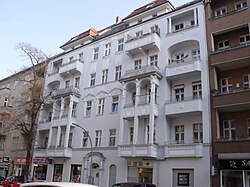 Emser Straße 102, Körnerpark
 Fuldastraße 45–46, Flughafenkiez
 Herrnhuter Weg 17, Rixdorf
 Isarstraße 3, Flughafenkiez
 Turmblock, Sonnenallee 125–33, Rixdorf
 Idealpassage, Fuldastraße 55–56, Flughafenkiez
 Schillerpromenade


.jpg)
.jpg)


 Blacksmith's shop, Richardplatz
 Blacksmith's shop, Richardplatz
 Villa Rixdorf, Richardplatz
 Backyard, Richardplatz 17
 Backyard, Richardplatz 3
 Bethlehem Church
 Bohemian duplex house, Richardstraße 36–37
 Bohemian house, Richardstraße 80
 Reformed Bethlehem parish, Richardstraße 97
 Belfry, Reformed Bethlehem Church
 Comenius Garden
 Hussite school building, Kirchgasse 5
 Bohemain house, Kirchgasse 6
 Cemetery Böhmischer Gottesacker


_Nebengebäude.jpg)


 Bürknerstraße 12–14, Reuterkiez
 Oderstraße 45, Schillerkiez
 Ossastraße 6, Reuterkiez
 Die Ringe, Rollberg
 Weiße Siedlung
 High-Deck-Siedlung
 Apostolic Nunciature, Hasenheide
 School entrance wing, Drorystraße, Rixdorf
 Estrel Berlin, Rixdorf

.jpg)
.jpg)


 Rathaus Neukölln (City Hall), Rixdorf
 Stadtbad Neukölln (public bath house), Rixdorf
 Stadtbad Neukölln (public bath house), Rixdorf
 Orangerie, Körnerpark
 Pump room kiosk, Richardplatz, Rixdorf
 Sonnenallee station, Rixdorf
 Chapel, Alter Friedhof St. Jacobi
 Dammwegsiedlung


.jpg)

 Alte Post (old post office), Rixdorf
 Kindle Ballrooms, Flughafenkiez
 Amtsgericht Neukölln (municipal court), Rixdorf
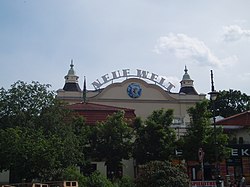 Neue Welt, Hasenheide, Schillerkiez
 Neuer Rollkrug, Flughafenkiez
 Hermannplatz U-Bahn station (U7)


.jpg)


 Passage, Rixdorf
 Banking house, Alfred-Scholz-Platz, Rixdorf
 Reichsbank building, Ganghoferstraße, Rixdorf
 Eisenwerk Franz Weeren, Körnerpark
 Industrial villa, Eisenwerk Franz Weeren, Körnerpark
 Hermannshof, Hermannstraße, Schillerkiez
 Niemann factory, Sonnenallee, Rixdorf
 Transformer station, Richardstraße, Rixdorf
 Neukölln water tower, Rollberg
 Geyer film factory, Reuterkiez
 Sudhaus, Kindl brewery, Rollberg
 Bergschloss-Brauerei, Schillerkiez
 Institute for Disinfection, Rixdorf
 Jacobs factory, High-Deck-Siedlung


.jpg)


_Pechstein,_(Johannes^)_Stroux,_Kraus,_Benedik,_Lederer,_(cropped).jpg)


-_Bild_1_(4-1384480-1).jpg)
.jpg)


.jpg)
.jpg)


 Anderlecht, Belgium (1955)
 Bat Yam, near Tel Aviv, Israel (1978)
 Boulogne-Billancourt, near Paris, France (1955)
 Çiğli, İzmir, Turkey (2005)
 Cologne, Germany (1967)
 Hammersmith and Fulham, London, United Kingdom (1955)
 Marino, near Rome, Lazio, Italy (1980)
 Pavlovsk-Pushkin, Saint Petersburg, Russia (1991)
 Prague 5 (Smíchov), Prague, Czech Republic (2005)
 Zaanstad, near Amsterdam, Netherlands (1955)


 Beijing, China
 Budapest, Hungary
 Buenos Aires, Argentina
 Jakarta, Indonesia
 Kyiv, Ukraine
 Los Angeles, United States
 Madrid, Spain
 Mexico City, Mexico
 Tashkent, Uzbekistan
 Tokyo, Japan
 Warsaw, Poland
 Windhoek, Namibia


 Benjamin Bilse, 1870
 Bilse'sche Kapelle, 1871
 Heinrich Littke-Carlsen, caricature, ca. 1890
 Gruß vom Rixdorfer, postcard, ca. 1899[note 90]
 Berlin nightlife and the schieber, caricature, 1912
 Gustav Schönwald, ca. 1905


 Hermannplatz, Donaukiez
 County Court
 County Court and City Hall
 Public bath house
 Buddy Bear Rixi at City Hall
 Volkspark Hasenheide in winter, 2013
 Hall of Honor, Lilienthalstraße cemetery, Hasenheide


_Buddy_Bär.jpg)


