Top Qs
Timeline
Chat
Perspective
India
Country in South Asia From Wikipedia, the free encyclopedia

Remove ads
India, officially the Republic of India,[j][19] is a country in South Asia. It is the seventh-largest country by area; the most populous country since 2023;[20] and, since its independence in 1947, the world's most populous democracy.[21][22][23] Bounded by the Indian Ocean on the south, the Arabian Sea on the southwest, and the Bay of Bengal on the southeast, it shares land borders with Pakistan to the west;[k] China, Nepal, and Bhutan to the north; and Bangladesh and Myanmar to the east. In the Indian Ocean, India is near Sri Lanka and the Maldives; its Andaman and Nicobar Islands share a maritime border with Myanmar, Thailand, and Indonesia.

.svg)
Modern humans arrived on the Indian subcontinent from Africa no later than 55,000 years ago.[25][26][27] Their long occupation, predominantly in isolation as hunter-gatherers, has made the region highly diverse.[28] Settled life emerged on the subcontinent in the western margins of the Indus river basin 9,000 years ago, evolving gradually into the Indus Valley Civilisation of the third millennium BCE.[29] By 1200 BCE, an archaic form of Sanskrit, an Indo-European language, had diffused into India from the northwest.[30][31] Its hymns recorded the early dawnings of Hinduism in India.[32] India's pre-existing Dravidian languages were supplanted in the northern regions.[33] By 400 BCE, caste had emerged within Hinduism,[34] and Buddhism and Jainism had arisen, proclaiming social orders unlinked to heredity.[35] Early political consolidations gave rise to the loose-knit Maurya and Gupta Empires.[36] Widespread creativity suffused this era,[37] but the status of women declined,[38] and untouchability became an organised belief.[l][39] In South India, the Middle kingdoms exported Dravidian language scripts and religious cultures to the kingdoms of Southeast Asia.[40]
In the 1st millennium, Islam, Christianity, Judaism, and Zoroastrianism became established on India's southern and western coasts.[41] In the early centuries of the 2nd millennium Muslim armies from Central Asia intermittently overran India's northern plains.[42] The resulting Delhi Sultanate drew northern India into the cosmopolitan networks of medieval Islam.[43] In south India, the Vijayanagara Empire created a long-lasting composite Hindu culture.[44] In the Punjab, Sikhism emerged, rejecting institutionalised religion.[45] The Mughal Empire ushered in two centuries of economic expansion and relative peace,[46] and left a rich architectural legacy.[47][48] Gradually expanding rule of the British East India Company turned India into a colonial economy but consolidated its sovereignty.[49] British Crown rule began in 1858. The rights promised to Indians were granted slowly,[50][51] but technological changes were introduced, and modern ideas of education and the public life took root.[52] A nationalist movement emerged in India, the first in the non-European British Empire and an influence on other nationalist movements.[53][54] Noted for nonviolent resistance after 1920,[55] it became the primary factor in ending British rule.[56] In 1947, the British Indian Empire was partitioned into two independent dominions,[57][58][59][60] a Hindu-majority dominion of India and a Muslim-majority dominion of Pakistan. A large-scale loss of life and an unprecedented migration accompanied the partition.[61]
India has been a federal republic since 1950, governed through a democratic parliamentary system. It is a pluralistic, multilingual and multi-ethnic society. India's population grew from 361 million in 1951 to over 1.4 billion in 2023.[62] During this time, its nominal per capita income increased from US$64 annually to US$2,601, and its literacy rate from 16.6% to 74%. A comparatively destitute country in 1951,[63] India has become a fast-growing major economy and a hub for information technology services, with an expanding middle class.[64] India has reduced its poverty rate, though at the cost of increasing economic inequality.[65] It is a nuclear-weapon state that ranks high in military expenditure. It has disputes over Kashmir with its neighbours, Pakistan and China, unresolved since the mid-20th century.[66] Among the socio-economic challenges India faces are gender inequality, child malnutrition,[67] and rising levels of air pollution.[68] India's land is megadiverse with four biodiversity hotspots.[69] India's wildlife, which has traditionally been viewed with tolerance in its culture,[70] is supported in protected habitats.
Remove ads
Etymology
Summarize
Perspective
According to the Oxford English Dictionary, the English proper noun "India" derives most immediately from the Classical Latin India, a reference to a loosely-defined historical region of Asia stretching from South Asia to the borders of China. Further etymons are: Hellenistic Greek India (Ἰνδία); Ancient Greek Indos (Ἰνδός), or the River Indus; Achaemenian Old Persian Hindu (an eastern province of the Achaemenid Empire); and Sanskrit Sindhu, or "river," but specifically the Indus river, and by extension its well-settled basin.[71] The Ancient Greeks referred to South Asians as Indoi, 'the people of the Indus'.[72]
The term Bharat (Bhārat; pronounced [ˈbʱaːɾət] ⓘ), mentioned in both Indian epic poetry and the Constitution of India,[73][74] is used in its variations by many Indian languages. A modern rendering of the historical name Bharatavarsha, which applied originally to North India,[75][76] Bharat gained increased currency from the mid-19th century as a native name for India.[73][77]
Hindustan ([ɦɪndʊˈstaːn] ⓘ) is a Middle Persian name for India that became popular by the 13th century,[78] and was used widely since the era of the Mughal Empire. The meaning of Hindustan has varied, referring to a region encompassing the northern Indian subcontinent (present-day northern India and Pakistan) or to India in its near entirety.[73][77][79]
Remove ads
History
Summarize
Perspective
Ancient India
Based on coalescence of Mitochondrial DNA and Y Chromosome data, it is thought that the earliest extant lineages of anatomically modern humans or Homo sapiens on the Indian subcontinent had reached there from Africa between 80,000 and 50,000 years ago, and with high likelihood by 55,000 years ago.[80][25][26][27] However, the earliest known modern human fossils in South Asia date to about 30,000 years ago.[26] Evidence for domestication of food crops and animals, construction of permanent structures, and storage of agricultural surplus appeared in Mehrgarh and other sites in Balochistan, Pakistan after 6500 BCE.[81] These gradually developed into the Indus Valley Civilisation,[82][81] the first urban culture in South Asia,[83] which flourished during 2500–1900 BCE in Pakistan and western India.[84] Centred around cities such as Mohenjo-daro, Harappa, Dholavira, and Kalibangan, and relying on varied forms of subsistence, the civilisation engaged robustly in crafts production and wide-ranging trade.[83]
During the period 2000–500 BCE, many regions of the subcontinent transitioned from the Chalcolithic cultures to the Iron Age ones.[85] The Vedas, the oldest scriptures associated with Hinduism,[86] were composed during this period,[87] and historians have analysed these to posit a Vedic culture in the Punjab region and the upper Gangetic Plain.[85] Most historians also consider this period to have encompassed several waves of Indo-Aryan migration into the subcontinent from the north-west.[86] The caste system, which created a hierarchy of priests, warriors, and free peasants, but which excluded indigenous peoples by labelling their occupations impure, arose during this period.[88] On the Deccan Plateau, archaeological evidence from this period suggests the existence of a chiefdom stage of political organisation.[85] In South India, a progression to sedentary life is indicated by the large number of megalithic monuments dating from this period,[89] as well as by nearby traces of agriculture, irrigation tanks, and craft traditions.[89]
Classical Sanskrit, a refined and standardised grammatical form emerged in the mid-1st millennium BCE and was codified in the Aṣṭādhyāyī ('Eight chapters') of Pāṇini.[m] Later, the best-known dramatist of Sanskrit, Kālidāsa, wrote in classical Sanskrit. The foundations of modern arithmetic were first described in classical Sanskrit.[n][91] The two major Sanskrit epics, the Mahābhārata and the Rāmāyaṇa, however, were composed in a range of oral storytelling registers called Epic Sanskrit which was used in northern India between 400 BCE and 300 CE, and roughly contemporary with classical Sanskrit.[92] Politically, around the 6th century BCE, the small states and chiefdoms of the Ganges Plain and the north-western regions had consolidated into 16 major oligarchies and monarchies that were known as the mahajanapadas.[93][94] The emerging urbanisation gave rise to non-Vedic religious movements, two of which became independent religions. Jainism came into prominence during the life of its exemplar, Mahavira.[95] Buddhism, based on the teachings of Gautama Buddha, attracted followers from many social classes; chronicling the life of the Buddha was central to the beginnings of recorded history in India.[96][97][98] In an age of increasing urban wealth, both religions held up renunciation as an ideal,[99] and both established long-lasting monastic traditions. By the 3rd century BCE, the kingdom of Magadha had annexed or reduced other states to emerge as the Maurya Empire.[100] The empire was once thought to have controlled most of the subcontinent except the far south. Still, its core regions are now thought to have been separated by large autonomous areas.[101][102] The Mauryan kings are known as much for their empire-building and determined management of public life as for Ashoka's renunciation of militarism and far-flung advocacy of the Buddhist dhamma.[103][104]
The Sangam literature of the Tamil language reveals that, between 200 BCE and 200 CE, the southern peninsula was ruled by the Cheras, the Cholas, and the Pandyas, dynasties that traded extensively with the Roman Empire and with West and Southeast Asia.[105][106] In North India, Hinduism asserted patriarchal control within the family, leading to increased subordination of women.[107][100] By the 4th and 5th centuries, the Gupta Empire had created a complex system of administration and taxation in the greater Ganges Plain; this system became a model for later Indian kingdoms.[108][109] Under the Guptas, a renewed Hinduism based on devotion, rather than the management of ritual, began to assert itself.[110] This renewal was reflected in a flowering of sculpture and architecture, which found patrons among an urban elite.[109]

 Colour lithograph, 1895, British Museum. Draupadi, the wife of all five Pandava brothers in the Mahabharata, is presented at a parcheesi game where Yudhishthira, the king of Hastinapura, had gambled away all material wealth, one of several instigating factors in the Mahabharata war.
 Cave 26, a Buddhist shrine, of the rock-cut Ajanta Caves

.jpg)

Medieval India
The Indian early medieval age, from 600 to 1200 CE, is defined by regional kingdoms and cultural diversity.[112] When Harsha of Kannauj, who ruled much of the Indo-Gangetic Plain from 606 to 647 CE, attempted to expand southwards, he was defeated by the Chalukya ruler of the Deccan.[113] When his successor attempted to expand eastwards, he was defeated by the Pala king of Bengal.[113] When the Chalukyas attempted to expand southwards, they were defeated by the Pallavas from farther south, who in turn were opposed by the Pandyas and the Cholas from still farther south.[113] No ruler of this period was able to create an empire and consistently control lands much beyond their core region.[112] During this time, pastoral peoples, whose land had been cleared to make way for the growing agricultural economy, were accommodated within caste society, as were new non-traditional ruling classes.[114] The caste system consequently began to show regional differences.[114]
In the 6th and 7th centuries, the first devotional hymns were composed in Tamil.[115] They were imitated all over India and led to both the resurgence of Hinduism and the development of all modern languages of the subcontinent.[115] Indian royalty, big and small, and the temples they patronised drew citizens in significant numbers to the capital cities, which became economic hubs as well.[116] Temple towns of various sizes began to appear everywhere as India underwent another urbanisation.[116] By the 8th and 9th centuries, the effects were felt in Southeast Asia, as South Indian culture and political systems were exported to lands that became part of modern-day Myanmar, Thailand, Laos, Brunei, Cambodia, Vietnam, Philippines, Malaysia, and Indonesia.[117] Indian merchants, scholars, and sometimes armies were involved in this transmission; Southeast Asians took the initiative as well, with many sojourning in Indian seminaries and translating Buddhist and Hindu texts into their languages.[117]
After the 10th century, Muslim Central Asian nomadic clans, using swift-horse cavalry and raising vast armies united by ethnicity and religion, repeatedly overran South Asia's north-western plains, leading eventually to the establishment of the Islamic Delhi Sultanate in 1206.[118] The sultanate was to control much of North India and to make many forays into South India. Although at first disruptive for the Indian elites, the sultanate largely left its vast non-Muslim subject population to its own laws and customs.[119][120]
By repeatedly repulsing Mongol raiders in the 13th century, the sultanate saved India from the devastation visited on West and Central Asia, setting the scene for centuries of migration of fleeing soldiers, learned men, mystics, traders, artists, and artisans from that region into the subcontinent, thereby creating a syncretic Indo-Islamic culture in the north.[121][122] The sultanate's raiding and weakening of the regional kingdoms of South India paved the way for the indigenous Vijayanagara Empire.[123] Embracing a strong Shaivite tradition and building upon the military technology of the sultanate, the empire came to control much of peninsular India,[124] and was to influence South Indian society for long afterwards.[123]

 Calligraphy on the Qutb Minar, built in the Delhi sultanate from 1199 CE to 1220 CE
 Relief on Vijayanagara King's palace throne platform, Hampi, Karnataka, 14th and 15th centuries CE
.jpg)


Early modern India
In the early 16th century, northern India, then under mainly Muslim rulers,[125] fell again to the superior mobility and firepower of a new generation of Central Asian warriors.[126] The resulting Mughal Empire did not stamp out the local societies it came to rule. Instead, it balanced and pacified them through new administrative practices[127][128] and diverse and inclusive ruling elites,[129] leading to more systematic, centralised, and uniform rule.[130] Eschewing tribal bonds and Islamic identity, especially under Akbar, the Mughals united their far-flung realms through loyalty, expressed through a Persianised culture, to an emperor who had near-divine status.[129]
The Mughal state's economic policies, deriving most revenues from agriculture[131] and mandating that taxes be paid in the well-regulated silver currency,[132] caused peasants and artisans to enter larger markets.[130] The relative peace maintained by the empire during much of the 17th century was a factor in India's economic expansion,[130] resulting in greater patronage of painting, literary forms, textiles, and architecture.[133] Newly coherent social groups in northern and western India, such as the Marathas, the Rajputs, and the Sikhs, gained military and governing ambitions during Mughal rule, which, through collaboration or adversity, gave them both recognition and military experience.[134] Expanding commerce during Mughal rule gave rise to new Indian commercial and political elites along the coasts of southern and eastern India.[134] As the empire disintegrated, many among these elites were able to seek and control their own affairs.[135]
By the early 18th century, with the lines between commercial and political dominance being increasingly blurred, a number of European trading companies, including the English East India Company, had established coastal outposts.[136][137] The East India Company's control of the seas, greater resources, and more advanced military training and technology led it to increasingly assert its military strength and caused it to become attractive to a portion of the Indian elite; these factors were crucial in allowing the company to gain control over the Bengal region by 1765 and sideline the other European companies.[138][136][139][140] Its further access to the riches of Bengal and the subsequent increased strength and size of its army enabled it to annexe or subdue most of India by the 1820s.[141] India was then no longer exporting manufactured goods as it long had, but was instead supplying the British Empire with raw materials. Many historians consider this to be the onset of India's colonial period.[136] By this time, with its economic power severely curtailed by the British parliament and having effectively been made an arm of British administration, the East India Company began more consciously to enter non-economic arenas, including education, social reform, and culture.[142]
 The dargah, or mausoleam of Sufi saint Salim Chisti, built by Mughal emperor, Akbar, in the early 17th century
 A distant view of the Taj Mahal from the Agra Fort, both built by Mughal emperor Shah Jahan in the late 17th century
 A two-mohur East India Company rule gold coin, issued in 1835, the obverse inscribed "William IIII, King"


Modern India
The appointment in 1848 of Lord Dalhousie as Governor General of the East India Company set the stage for changes essential to a modern state: the consolidation and demarcation of sovereignty, the surveillance of the population, and the education of citizens. Technological changes—among them, railways, canals, and the telegraph—were introduced not long after their introduction in Europe.[143][144][145][146] Disaffection with the company also grew during this time and set off the Indian Rebellion of 1857. Fed by diverse resentments and perceptions, including invasive British-style social reforms, harsh land taxes, and summary treatment of some wealthy landowners and princes, the rebellion rocked many regions of northern and central India and shook the foundations of Company rule.[147][148] After the rebellion was suppressed in 1858, the East India Company was disbanded, and the British government began to directly administer India. Proclaiming a unitary state and a gradual but limited British-style parliamentary system, the new rulers also protected princes and landed gentry as a feudal safeguard against future unrest.[149][150] In the decades following, public life gradually emerged all over India, leading eventually to the founding of the Indian National Congress in 1885.[151][152][153][154]
The rush of technology and the commercialisation of agriculture in the second half of the 19th century was marked by economic setbacks, and many small farmers became dependent on the whims of faraway markets.[155] There was an increase in the number of large-scale famines,[156] and, despite the risks of infrastructure development borne by Indian taxpayers, little industrial employment was generated for Indians.[157] However, commercial cropping, especially in the newly canalled Punjab, led to increased food production for internal consumption.[158] The railway network provided critical famine relief,[159] notably reduced the cost of moving goods,[159] and helped nascent Indian-owned industry.[158]
After World War I, in which approximately one million Indians served,[160] a new period began. It was marked by British reforms but also repressive legislation, by more strident Indian calls for self-rule, and by the beginnings of a nonviolent movement of non-co-operation led by Mahatma Gandhi.[161] During the 1930s, the British enacted slow legislative reform; the Indian National Congress won victories in the resulting elections.[162] The next decade was beset with crises: Indian participation in World War II, the Congress's final push for non-co-operation, and an upsurge of Muslim nationalism. All were capped by the advent of independence in 1947, but tempered by the partition of India into two states: India and Pakistan.[163]
India's constitution was adopted in 1950 and established a secular, democratic republic.[164] Economic liberalisation has created a large urban middle class and transformed India into a fast growing economy,[165][64] However, India has been hamstrung by persistent poverty, both rural and urban;[166][needs update] religious- and caste-related violence;[167] Maoist-inspired Naxalite insurgencies;[168] and separatism in Jammu and Kashmir and in Northeast India.[169][needs update] India has unresolved territorial disputes with China and with Pakistan.[170]
 A map of the British Raj from the Imperial Gazetteer of India, 1908
 Mahatma Gandhi leaves the Presidency Jail in Calcutta in April 1938, after interviewing political prisoners there.
 "Gandhi Bhawan at the Panjab University in Chandigarh. Commissioned by India's prime minister, Jawaharlal Nehru, and designed by the Swiss-French architect Le Corbusier, the city was built in the aftermath of India's 1947 partition and independence. The city's Capitol Complex is now a UNESCO World Heritage Site.


Remove ads
Geography
Summarize
Perspective
India accounts for the bulk of the Indian subcontinent, lying atop the Indian tectonic plate, and a part of the Indo-Australian Plate.[171] India's defining geologic processes began approximately 70 million years ago, when the Indian Plate, then part of the southern supercontinent Gondwana, began a north-eastward drift caused by seafloor spreading to its south-west, and later, south and south-east.[171] Simultaneously, the vast Tethyan oceanic crust, to its northeast, began to subduct under the Eurasian Plate.[171] The Indian continental crust, however, was obstructed and was sheared horizontally. Its lower crust and mantle slid under, but the upper layer piled up in sheets (or nappes) ahead of the subduction zone.[172] This created the orogeny, or process of mountain building, of the Himalayas.[173] The middle and stiffer layer continued to push into Tibet, causing crustal thickening of the Tibetan Plateau.[174] Immediately south of the emerging Himalayas, plate movement created a vast crescent-shaped trough that rapidly filled with river-borne sediment[175] and now constitutes the Indo-Gangetic Plain.[176] The original Indian plate makes its first appearance above the sediment in the ancient Aravalli range, which extends from the Delhi Ridge in a southwesterly direction. To the west lies the Thar Desert, the eastern spread of which is checked by the Aravallis.[177][178][179]
The remaining Indian Plate survives as peninsular India, the oldest and geologically most stable part of India. It extends as far north as the Satpura and Vindhya ranges in central India. These parallel chains run from the Arabian Sea coast in Gujarat in the west to the coal-rich Chota Nagpur Plateau in Jharkhand in the east.[180] To the south, the remaining peninsular landmass, the Deccan Plateau, is flanked on the west and east by coastal ranges known as the Western and Eastern Ghats;[181] the plateau contains the country's oldest rock formations, some over one billion years old. Constituted in such fashion, India lies to the north of the equator between 6° 44′ and 35° 30′ north latitude[o] and 68° 7′ and 97° 25′ east longitude.[182]
Major Himalayan-origin rivers that substantially flow through India include the Ganges and the Brahmaputra, both of which drain into the Bay of Bengal.[183] Important tributaries of the Ganges include the Yamuna and the Kosi. The Kosi's extremely low gradient, caused by long-term silt deposition, leads to severe floods and course changes.[184][185] Major peninsular rivers, whose steeper gradients prevent their waters from flooding, include the Godavari, the Mahanadi, the Kaveri, and the Krishna, which also drain into the Bay of Bengal;[186] and the Narmada and the Tapti, which drain into the Arabian Sea.[187]
India's coastline measures 7,517 kilometres (4,700 mi) in length; of this distance, 5,423 kilometres (3,400 mi) belong to peninsular India and 2,094 kilometres (1,300 mi) to the Andaman, Nicobar, and Lakshadweep island chains.[188] According to the Indian naval hydrographic charts, the mainland coastline consists of the following: 43% sandy beaches; 11% rocky shores, including cliffs; and 46% mudflats or marshy shores.[188] Coastal features include the marshy Rann of Kutch of western India and the alluvial Sundarbans delta of eastern India; the latter is shared with Bangladesh.[189] India has two archipelagos: the Lakshadweep, coral atolls off India's south-western coast; and the Andaman and Nicobar Islands, a volcanic chain in the Andaman Sea.[190]
 A panoramic view of the Garhwal and Kumaon Himalayas. Peaks rising above their surroundings in this view are, among others, Trisul, Nanda Devi, the highest peak entirely within India's borders, and Nanda Kot. The Tibetan Plateau lies behind these mountains, as does the part of the Indus-Yarlung suture zone, the contour along which the Indian Plate has welded to the Eurasian plate. Mount Kailas and Lake Manasarovar in the Tibet Trans-Himalaya—sacred in Hindu and Buddhist mythology—lie immediately behind to the right. The Indus and Yarlung Tsangpo (the upper Brahmaputra river), which mark the western and eastern limits of the Himalaya range, rise in the vicinity of the lake.
 The Ganges-Brahmaputra Delta in a European Sentinel-3B image. The Ganges and the eastern Indo-Gangetic Plain lie to the left, the Brahmaputra to the right.


Climate
The Indian climate is strongly influenced by the Himalayas and the Thar Desert, both of which drive the economically and culturally pivotal summer and winter monsoons.[192] The Himalayas prevent cold Central Asian katabatic winds from blowing in, keeping the bulk of the Indian subcontinent warmer than most locations at similar latitudes.[193][194] The Thar Desert plays a crucial role in attracting the moisture-laden south-west summer monsoon winds that, between June and October, provide the majority of India's rainfall.[192]
Four major climatic groupings predominate in India: tropical wet, tropical dry, subtropical humid, and montane.[195] Temperatures in India have risen by 0.7 °C (1.3 °F) between 1901 and 2018.[196] Climate change in India is often thought to be the cause. The retreat of Himalayan glaciers has adversely affected the flow rate of the major Himalayan rivers, including the Ganges and the Brahmaputra.[197] According to some current projections, the number and severity of droughts in India will have markedly increased by the end of the present century.[198]

 A dromedary in the Thar desert


Biodiversity
India is a megadiverse country, a term employed for 17 countries that display high biological diversity and contain many species exclusively indigenous, or endemic, to them.[199] India is the habitat for 8.6% of all mammals, 13.7% of bird species, 7.9% of reptile species, 6% of amphibian species, 12.2% of fish species, and 6.0% of all flowering plant species.[200][201] Fully a third of Indian plant species are endemic.[202] India also contains four of the world's 34 biodiversity hotspots,[69] or regions that display significant habitat loss in the presence of high endemism.[p][203]
India's most dense forests, such as the tropical moist forest of the Andaman Islands, the Western Ghats, and Northeast India, occupy approximately 3% of its land area.[204][205] Moderately dense forest, whose canopy density is between 40% and 70%, occupies 9.39% of India's land area.[204][205] It predominates in the temperate coniferous forest of the Himalayas, the moist deciduous sal forest of eastern India, and the dry deciduous teak forest of central and southern India.[206] India has two natural zones of thorn forest, one in the Deccan Plateau, immediately east of the Western Ghats, and the other in the western part of the Indo-Gangetic plain, now turned into rich agricultural land by irrigation, its features no longer visible.[207] Among the Indian subcontinent's notable indigenous trees are the astringent Azadirachta indica, or neem, which is widely used in rural Indian herbal medicine,[208] and the luxuriant Ficus religiosa, or peepul,[209] which is displayed on the ancient seals of Mohenjo-daro,[210] and under which the Buddha is recorded in the Pali canon to have sought enlightenment.[211]
Many Indian species have descended from those of Gondwana, the southern supercontinent from which India separated more than 100 million years ago.[212] India's subsequent collision with Eurasia set off a mass exchange of species. However, volcanism and climatic changes later caused the extinction of many endemic Indian forms.[213] Still later, mammals entered India from Asia through two zoogeographic passes flanking the Himalayas.[214] This lowered endemism among India's mammals, which stands at 12.6%, contrasting with 45.8% among reptiles and 55.8% among amphibians.[201] Among endemics are the vulnerable[215] hooded leaf monkey[216] and the threatened Beddome's toad[217][218] of the Western Ghats.
India contains 172 IUCN-designated threatened animal species, or 2.9% of endangered forms.[219] These include the endangered Bengal tiger and the Ganges river dolphin. Critically endangered species include the gharial, a crocodilian; the great Indian bustard; and the Indian white-rumped vulture, which has become nearly extinct by having ingested the carrion of diclofenac-treated cattle.[220] Before they were extensively used for agriculture and cleared for human settlement, the thorn forests of Punjab were mingled at intervals with open grasslands that were grazed by large herds of blackbuck preyed on by the Asiatic cheetah; the blackbuck, no longer extant in Punjab, is now severely endangered in India, and the cheetah is extinct.[221] The pervasive and ecologically devastating human encroachment of recent decades has critically endangered Indian wildlife. In response, the system of national parks and protected areas, first established in 1935, was expanded substantially. In 1972, India enacted the Wildlife Protection Act[222] and Project Tiger to safeguard crucial wilderness; the Forest Conservation Act was enacted in 1980 and amendments added in 1988.[223] India hosts more than five hundred wildlife sanctuaries and eighteen biosphere reserves,[224] four of which are part of the World Network of Biosphere Reserves; its eighty-nine wetlands are registered under the Ramsar Convention.[225]


_with_Indian_garden_lizard.jpg)


Remove ads
Government and politics
Summarize
Perspective
Politics
India is a parliamentary republic with a multi-party system.[227] It has six recognised national parties, including the Indian National Congress (generally, "the Congress") and the Bharatiya Janata Party (BJP), and over 50 regional parties.[228] The Congress is considered the ideological centre in Indian political culture;[229]the BJP is right-wing. From 1950 to the late 1980s, Congress held a majority in India's parliament. Afterwards, it increasingly shared power with the BJP [230] and with powerful regional parties, which forced multi-party coalition governments at the centre.[231]
In the general elections in 1951, 1957, and 1962, the Congress, led by Jawaharlal Nehru, won easy victories. On Nehru's death in 1964, Lal Bahadur Shastri briefly became prime minister; he was succeeded in 1966 by Nehru's daughter Indira Gandhi, who led the Congress to election victories in 1967 and 1971. Following public discontent with the state of emergency Indira Gandhi had declared in 1975, the Congress was voted out of power in 1977; Janata Party, which had opposed the emergency, was voted in. Its government lasted two years; Morarji Desai and Charan Singh served as prime ministers. After the Congress returned to power in 1980, Indira Gandhi was assassinated and succeeded by Rajiv Gandhi, who won comfortably in the elections later that year. A National Front coalition led by the Janata Dal in alliance with the Left Front won the 1989 elections, with the subsequent government lasting just under two years, and V.P. Singh and Chandra Shekhar serving as prime ministers.[232] In the 1991 Indian general election, the Congress, as the largest single party, formed a minority government led by P. V. Narasimha Rao.[233]
After the 1996 Indian general election, the BJP briefly formed a government; this was followed by United Front coalitions, which relied on external political support. Two prime ministers served during this period: H.D. Deve Gowda and I.K. Gujral. In 1998, the BJP formed a coalition—the National Democratic Alliance (NDA). Led by Atal Bihari Vajpayee, the NDA became the first non-Congress, coalition government to complete a five-year term.[234] In the 2004 Indian general elections, no party won an absolute majority. Still, the Congress emerged as the largest single party, forming another successful coalition: the United Progressive Alliance (UPA). It had the support of left-leaning parties and MPs who opposed the BJP. The UPA returned to power in the 2009 general election with increased numbers, and it no longer required external support from India's communist parties.[235] Manmohan Singh became the first prime minister since Jawaharlal Nehru in 1957 and 1962 to be re-elected to a consecutive five-year term.[236] In the 2014 general election, the BJP became the first political party since 1984 to win an absolute majority.[237] In the 2019 general election, the BJP regained an absolute majority. In the 2024 general election, a BJP-led NDA coalition formed a minority government. Narendra Modi, a former chief minister of Gujarat, is in his third term as the prime minister of India and has held the position since 26 May 2014.[238]
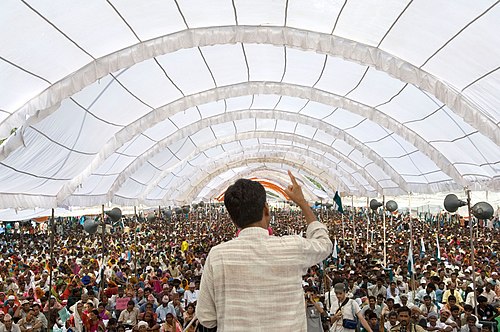 As part of Janadesh 2007, 25,000 pro–land reform landless people in Madhya Pradesh listen to Rajagopal P. V.[239]
 Indian prime minister Narendra Modi speaking at a conference on the "transformation of aspirational districts" on 5 January 2018
 Three farmers taking part in the Indian farmers' protest on 26 December 2020

.jpg)
.jpg)
Government
The Constitution of India was drafted by the Constituent Assembly of India with uncommon speed and absence of irregularities between 1946 and 1949.[240] The Government of India Act 1935 was used as a model and framework.[240] Long passages from the Act were included. The constitution describes a federal state with a parliamentary system of democracy.[240] The federal structure was conspicuous for the strength of the central government, which exclusively exercised control of defence, foreign affairs, railways, ports, and currency.[240] The President, the constitutional head of government, has reserve powers for taking over the administration of a state.[240] The central legislature has two houses: the Lok Sabha, whose delegates are directly elected by the people in general elections every five years, and the Rajya Sabha, whose members are nominated by the elected representatives in the states.[240] There are also features not to be found in the Act of 1935. The definition of fundamental rights is based on the Constitution of the United States, and the constitutional directives, or goals of endeavor, are based on the Constitution of Ireland.[241] An Indian institution recommended by the constitution is the panchayat or village committees.[241] Untouchability is illegal (Article 17) and caste distinctions are derecognized (Articles 15(2) and 16(2)).[241] The promulgation of the Indian constitution transformed India into a republic within the Commonwealth.[241]
The Prime Minister of India is the head of government and exercises most executive power.[242] Appointed by the president,[243] the prime minister is supported by the party or political alliance with a majority of seats in the lower house of parliament.[242] The executive of the Indian government consists of the president, the vice-president, and the Union Council of Ministers—with the cabinet being its executive committee—headed by the prime minister. Any minister holding a portfolio must be a member of one of the houses of parliament.[244] In the Indian parliamentary system, the executive is subordinate to the legislature; the prime minister and their council are directly responsible to the lower house of the parliament. Civil servants act as permanent executives and all decisions of the executive are implemented by them.[245]
India has a three-tier unitary independent judiciary[246] comprising the supreme court, headed by the Chief Justice of India, 25 high courts, and a large number of trial courts.[246] The supreme court has original jurisdiction over cases involving fundamental rights and over disputes between states and the centre and has appellate jurisdiction over the high courts.[247] It has the power to both strike down union or state laws which contravene the constitution[248] and invalidate any government action it deems unconstitutional.[249]
 Rashtrapati Bhavan, the official residence of the President of India, was designed by British architects Edwin Lutyens and Herbert Baker for the Viceroy of India, and constructed between 1911 and 1931 during the British Raj.[250]
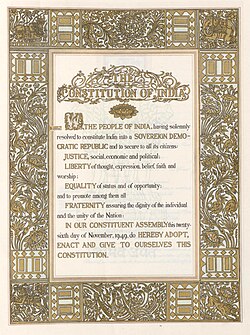 The original preamble of the Constitution of India in 1950.In 1976, during the tenure of Indian prime minister Indira Gandhi, the first sentence was changed to "Sovereign Socialist Secular Democratic Republic".
 US president Barack Obama addresses the members of both houses of the Parliament of India in New Delhi in November 2010.


Administrative divisions

India is a federal union comprising 28 states and 8 union territories.[12] All states, as well as the union territories of Jammu and Kashmir, Puducherry and the National Capital Territory of Delhi, have elected legislatures and governments following the Westminster system. The remaining five union territories are directly ruled by the central government through appointed administrators. In 1956, under the States Reorganisation Act, states were reorganised on a linguistic basis.[251] There are over a quarter of a million local government bodies at city, town, block, district and village levels.[252]
States
Union territories
Foreign relations
India became a republic in 1950, remaining a member of the Commonwealth of Nations.[253][254] India strongly supported decolonisation in Africa and Asia in the 1950s; it played a leading role in the Non-Aligned Movement.[255] After initial cordial relations, India suffered a military defeat to China in the Sino-Indian War of 1962.[256] Following this, in the Sino-Indian War of 1967 India achieved a military victory over China.[257]
India has had uneasy relations with its western neighbour, Pakistan. The two countries went to war in 1947, 1965, 1971, and 1999. Three of these wars were fought over the disputed territory of Kashmir. In contrast, the 1971 war followed India's support for the independence of Bangladesh.[258] After the 1965 war with Pakistan, India began to pursue close military and economic ties with the Soviet Union. By the late 1960s, the Soviet Union was its largest arms supplier.[259]
China's nuclear test of 1964 and threats to intervene in support of Pakistan in the 1965 war caused India to produce nuclear weapons.[260] India conducted its first nuclear weapons test in 1974 and carried out additional underground testing in 1998. India has signed neither the Comprehensive Nuclear-Test-Ban Treaty nor the Nuclear Non-Proliferation Treaty, considering both to be flawed and discriminatory.[261] India maintains a "no first use" nuclear policy and is developing a nuclear triad capability as a part of its "Minimum Credible Deterrence" doctrine.[262][263]
Since the end of the Cold War, India has increased its economic, strategic, and military cooperation with the United States and the European Union.[264] In 2008, a civilian nuclear agreement was signed between India and the United States. Although India possessed nuclear weapons at the time and was not a party to the Nuclear Non-Proliferation Treaty, it received waivers from the International Atomic Energy Agency and the Nuclear Suppliers Group, ending earlier restrictions on India's nuclear technology and commerce; India subsequently signed co-operation agreements involving civilian nuclear energy with Russia,[265] France,[266] the United Kingdom,[267] and Canada.[268]
 In the 1950s and 60s, India played a pivotal role in the Non-Aligned Movement.[269] From left to right: Gamal Abdel Nasser of United Arab Republic (now Egypt), Josip Broz Tito of Yugoslavia and Jawaharlal Nehru in Belgrade, September 1961.
 Indira Gandhi signed a treaty of friendship and cooperation with the Soviet Union in 1971. She is seen here leaving the National Museum in Helsinki, Finland, in 1983.
 Indian prime minister Manmohan Singh and French president Nicolas Sarkozy review the 221st Bastille Day military parade in Paris, July 2009. India's oldest regiment, the Maratha Light Infantry, founded in 1768, led the parade.[270]


.jpg)
Remove ads
Economy
Summarize
Perspective
According to the International Monetary Fund (IMF), the Indian economy in 2024 was nominally worth $3.94 trillion; it is the fifth-largest economy by market exchange rates and, at around $15.0 trillion, the third-largest by purchasing power parity (PPP).[16] With an average annual GDP growth rate of 5.8% over the past two decades, and reaching 6.1% during 2011–2012,[271] India is one of the world's fastest-growing economies.[272] However, it has a low per capita GDP, ranking 136th in the world in nominal terms and 125th adjusted for PPP.[16] The vast majority of Indians fall into the global low-income group based on average daily income.[273]
Until 1991, all Indian governments followed protectionist policies that were influenced by socialist economics. Widespread state intervention and regulation largely walled the economy off from the outside world. An acute balance of payments crisis in 1991 forced the nation to liberalise its economy;[274] since then, it has moved increasingly towards a free-market system[275][276] by emphasising both foreign trade and direct investment inflows.[277] India has been a member of World Trade Organization since 1 January 1995.[278]
The 522-million-worker Indian labour force is the world's second largest, as of 2017[update].[279] The service sector makes up 55.6% of GDP, the industrial sector 26.3% and the agricultural sector 18.1%. India's foreign exchange remittances of US$100 billion in 2022,[280] highest in the world, were contributed to its economy by 32 million Indians working in foreign countries.[281] In 2006, the share of external trade in India's GDP stood at 24%, up from 6% in 1985.[275] In 2008, India's share of world trade was 1.7%;[282] In 2021, India was the world's ninth-largest importer and the sixteenth-largest exporter.[283] Between 2001 and 2011, the contribution of petrochemical and engineering goods to total exports grew from 14% to 42%.[284] India was the world's second-largest textile exporter after China in the 2013 calendar year.[285]
Averaging an economic growth rate of 7.5% for several years before 2007,[275] India has more than doubled its hourly wage rates during the first decade of the 21st century.[286] Some 431 million Indians have left poverty since 1985; India's middle classes are projected to number around 580 million by 2030.[287] In 2024, India's consumer market was the world's third largest.[288] India's nominal GDP per capita increased steadily from US$308 in 1991, when economic liberalisation began, to US$1,380 in 2010, to an estimated US$2,731 in 2024. It is expected to grow to US$3,264 by 2026.[16]
 In 2019, 43% of India's total workforce was employed in agriculture.[289]
 India is the world's largest producer of milk, with the largest population of cattle. In 2018, nearly 80% of India's milk was sourced from small farms with herd size between one and two, the milk harvested by hand milking.[291]


Industries
The Indian automotive industry, the world's second-fastest growing, increased domestic sales by 26% during 2009–2010,[292] and exports by 36% during 2008–2009.[293] In 2022, India became the world's third-largest vehicle market after China and the United States, surpassing Japan.[294] At the end of 2011, the Indian IT industry employed 2.8 million professionals, generated revenues close to US$100 billion equalling 7.5% of Indian GDP, and contributed 26% of India's merchandise exports.[295]
The pharmaceutical industry in India includes 3,000 pharmaceutical companies and 10,500 manufacturing units; India is the world's third-largest pharmaceutical producer, largest producer of generic medicines, and supplies up to 50–60% of global vaccines demand, contributing up to US$24.44 billions in exports. India's local pharmaceutical market is estimated up to US$42 billion.[296][297] India is among the top 12 biotech destinations in the world.[298][299] The Indian biotech industry grew by 15.1% in 2012–2013, increasing its revenues from ₹204.4 billion (Indian rupees) to ₹235.24 billion (US$3.94 billion at June 2013 exchange rates).[300]
India's capacity to generate electrical power is 300 gigawatts, of which 42 gigawatts is renewable.[301] The country's usage of coal is a major cause of India's greenhouse gas emissions, but its renewable energy is competing strongly.[302][better source needed] India emits about 7% of global greenhouse gas emissions. This equates to about 2.5 tons of carbon dioxide per person per year, which is half the world average.[303][304] Increasing access to electricity and clean cooking with liquefied petroleum gas have been priorities for energy in India.[305]
 Mumbai, the centre of India's tertiary sector finance industry, also contributes to tourism. Shown here are the Taj Mahal Palace Hotel to the left and the Gateway of India.
 A tea garden in Sikkim. India, the world's second-largest producer of tea, is a nation of one billion tea drinkers, who consume 70% of India's tea output.
 A panorama of Bangalore, the centre of India's software development economy. In the 1980s, when the first multinational corporations began to set up centres in India, they chose Bangalore because of the large pool of skilled graduates in the area, in turn due to the many science and engineering colleges in the surrounding region.[306]
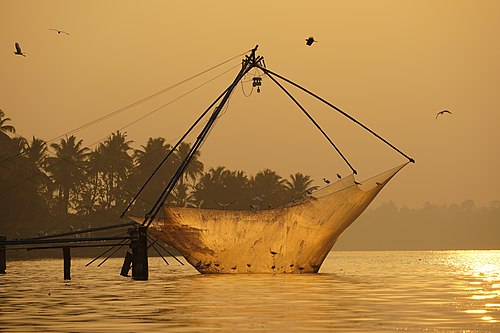 A Chinese fishing net being raised out of the water in Kochi. Fishing, which contributes 1.07% to India's total GDP,[307] supports the livelihood of over 28 million people, especially within the marginalized and vulnerable communities.[308] India is the third-largest fish producing country in the world, accounting for 7.96% of the global production.[307]


Remove ads
Demographics
Summarize
Perspective
With an estimated 1,428,627,663 residents in 2023, India is the world's most populous country.[13] 1,210,193,422 residents were reported in the 2011 provisional census report.[309] The median age was 28.7 in 2020.[279] Medical advances made in the last 50 years as well as increased agricultural productivity brought about by the "Green Revolution" have caused India's population to grow rapidly,[310] though India's decennial rates of growth are decreasing: ts population grew by 17.64% from 2001 to 2011,[311] compared to 21.54% growth in the previous decade (1991–2001).[311] The first post-colonial census, conducted in 1951, counted 361 million people.[312] The life expectancy at birth has increased from 49.7 years in 1970–1975 to 72.0 years in 2023.[313][314] The under-five mortality rate for the country was 113 per 1,000 live births in 1994 whereas in 2018 it reduced to 41.1 per 1,000 live births.[313]
The human sex ratio, according to the 2011 census, is 940 females per 1,000 males.[309] Female infanticide in India, and lately female foeticide, have created lop-sided gender ratios; the number of missing women in the country quadrupled from 15 million to 63 million during the period 1964–2014, faster than the population growth during the same period.[315] According to an Indian government study, an additional 21 million girls are unwanted and do not receive adequate care.[316] Despite a government ban on sex-selective foeticide, the practice has far from stopped.[317]
Migration from rural to urban areas has been an important dynamic in India's recent history. The number of people living in urban areas grew by 31.2% between 1991 and 2001.[318] In 2001, over 70% lived in rural areas.[319][320] The level of urbanisation increased further from 27.81% in the 2001 census to 31.16% in the 2011 census. The slowing down of the overall population growth rate was due to the sharp decline in the growth rate in rural areas since 1991.[321] In the 2011 census, there were 53 million-plus urban agglomerations in India. Among them Mumbai, Delhi, Kolkata, Chennai, Bengaluru, Hyderabad and Ahmedabad, in decreasing order by population.[322]
 The historical development of life expectancy in India from 1881 to 2023
 The child mortality rate in India from 1960 to 2023


Languages
Languages of India belong to several language families. The 2011 Census of India, the last conducted by the Indian government, gives the following breakdown:[323]
There are also small numbers of speakers of Tai–Kadai, Andamanese, and minor language families and isolates.[324]: 283
The official language of India's federal government was chosen by the Constituent Assembly of India in September 1949 after three years of debate between two opposing camps. The Hindi language protagonists wanted the Hindi in the Devanagari script to be the sole "national language" of India; the delegates from South India preferred English to have a place in the Constitution.[325][326] The compromise reached declared (i) Hindi to be the "official language" of India's federal government; (ii) English to be an associate official language for 15 years during which Hindi's formal lexicon would be developed; and (iii) the international form of the Hindu–Arabic numerals to be the official numerals.[325][326] The compromise resolution became articles 343–351 of India's constitution, which came into effect on 26 January 1950.[325][326] In 1965, when the 15 years were up, the Government of India announced that English would continue to be the "de facto formal language of India."[325][326]
The Eighth Schedule of India's Constitution also recognises 22 languages, including Hindi but not English, which the government is obligated to develop. These are sometimes called "scheduled languages." This list includes major regional languages, but also others—such as Sanskrit, which no longer has first language speakers in India, and Urdu, which is not region-specific—because of their value to India's cultural heritage.[327][328][329] In 1950, there were 14 scheduled languages: Assamese, Bengali, Gujarati, Hindi, Kannada, Kashmiri, Malayalam, Marathi, Oriya, Punjabi, Sanskrit, Tamil, Telugu and Urdu.[323] In the following decades constitutional amendments added others: Sindhi (1967), Nepali, Manipuri, and Konkani (1992), Maithili, Dogri, Santali and Bodo (2004), all now totaling 22.[323]
 The regions of first-language speech of the main languages of India
 The main languages of India by relative sizes of speakers
 On the reverse of each of India's paper money notes, the denomination is listed in a panel on the left in 15 languages, in addition to Hindi and English, which appear more prominently elsewhere. These are from top to bottom: 1.Assamese, 2.Bengali, 3.Gujarati, 4.Kannada, 5.Kashmiri, 6.Konkani, 7.Malayalam, 8.Marathi, 9.Nepali, 10.Oriya, 11.Punjabi, 12.Sanskrit, 13.Tamil, 14.Telugu, 15.Urdu.[330]


Religion
Religion in India is characterised by a diversity of beliefs and practices. Throughout India's history, religion has been an important part of its culture. The Indian subcontinent is the birthplace of four major world religions: Buddhism, Hinduism, Jainism, and Sikhism. India has the largest population of Hindus, Sikhs, and Jains, the third-largest population of Muslims (after Indonesia and Pakistan) and the ninth largest of Buddhists.[331] India also has the largest population of people adhering to both Zoroastrianism (Parsis and Iranis) and the Bahá'í Faith;[332] these religions are otherwise largely followed in Iran where they arose.
The Preamble to the Constitution of India declares India to be a secular state,[333][334] and freedom of religion to be a fundamental right ("... liberty of thought, expression, belief, faith, and worship.")[335] According to the 2011 census of India, 79.8% of the population of India follows Hinduism, 14.2% Islam, 2.3% Christianity, 1.7% Sikhism, 0.7% Buddhism and 0.4% Jainism. Several tribal religions are also present in India, such as Donyi-Polo, Sanamahism, Sarnaism, and Niamtre.

 A Jain woman making an offering at the feet of Bahubali Gomateswara at Shravanabelagola, Karnataka
 The exterior of St Judes Church, Chinnathurai, Kanyakumari district, Tamil Nadu. Christianity is believed to have been introduced to India by the late 2nd century by Syriac-speaking Christians.
 Interior of the Magen David Synagogue, Kolkata
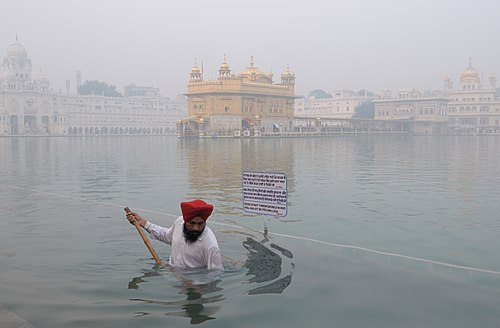 A Sikh pilgrim at the Harmandir Sahib—the Golden Temple—in Amritsar, Punjab, performing seva, or volunteer work, by helping clean the sacred pond


Education
The literacy rate in 2011 was 74.04%: 65.46% among females and 82.14% among males.[336] The rural-urban literacy gap, which was 21.2 percentage points in 2001, dropped to 16.1 percentage points in 2011. The improvement in the rural literacy rate is twice that of urban areas.[321] Kerala is the most literate state with 93.91% literacy; while Bihar the least with 63.82%.[336] In the 2011 census, about 73% of the population was literate, with 81% for men and 65% for women. This compares to 1981 when the respective rates were 41%, 53% and 29%. In 1951, the rates were 18%, 27% and 9%. In 1921, the rates 7%, 12% and 2%. In 1891, they were 5%, 9% and 1%,[337][338] According to Latika Chaudhary, in 1911 there were under three primary schools for every ten villages. Statistically, more caste and religious diversity reduced private spending. Primary schools taught literacy, so local diversity limited its growth.[339]
The education system of India is the world's second-largest.[340] India has over 900 universities, 40,000 colleges[341] and 1.5 million schools.[342] In India's higher education system, a significant number of seats are reserved under affirmative action policies for the historically disadvantaged. In recent decades India's improved education system is often cited as one of the main contributors to its economic development.[343][344]
 Children await school lunch in Rayka (also Raika), a village in rural Gujarat. The salutation Jai Bhim written on the blackboard honours the jurist, social reformer, and Dalit leader B. R. Ambedkar.
 The Madrasah of the Masjid-i-Ala mosque in Srirangapatna, Karnataka. The mosque was built in the period 1786–87, during the rule of Tipu Sultan.
 The Indian Institute of Technology, Roorkee, formerly the Thomason College of Civil Engineering, is the oldest engineering college in India.[345][346] It was founded as the College of Civil Engineering in 1847 during East India Company rule to train officers and surveyors employed in the construction of the Ganges Canal.[346][345]
.jpg)


Health
India bears a disproportionately large burden of the world's tuberculosis rates, with World Health Organization (WHO) statistics for 2022 estimating 2.8 million new infections annually, accounting for 26% of the global total.[347] It is estimated that approximately 40% of the population of India carry tuberculosis infection.[348]
In 2018 chronic obstructive pulmonary disease was the leading cause of death after heart disease. The 10 most polluted cities in the world are all in India with more than 140 million people breathing air 10 times or more over the WHO safe limit. In 2017, air pollution killed 1.24 million Indians.[349]
 Health workers about to begin another day of immunisation against infectious diseases in 2006. Eight years later, and three years after India's last case of polio, the World Health Organization declared India to be polio-free.[350]
.jpg)
Remove ads
Culture
Summarize
Perspective
Society
Caste: Although sometimes applied to other cultures and religions, caste is a uniquely Indian, and Hindu, social institution.[r] All Hindus fall broadly into four castes, or varnas: Brahmin, or priests, at the top; below them Kshatriya, or warriors; further below, Vaishya, or merchants and farmers; and at the bottom, Shudra, or the service class. Outside the caste system, and therefore of traditional Hinduism, lie people formerly called "outcastes" or "untouchables," and now scheduled caste (a term used in India's constitution) or Dalit, a later self-description of pride, meaning "broken" or "downtrodden". Each caste is further divided into sub-castes, or jatis, many of which are tied to occupations. The custom of endogamy, or marrying within one's subcaste, however, makes caste a hereditary label, not of one occupational choice, and has caused the caste system, therefore, to become entrenched.[352] The Constituent Assembly of India abolished untouchability in 1947,[353] the Republic of India did more formally in 1950, and India has since enacted other anti-discriminatory laws and social welfare initiatives related to caste. Still, caste-based inequality, discrimination, segregation, and violence persist.[354][355]
Multi-generational patrilineal joint families have been the norm in India, though nuclear families are becoming common in urban areas.[356] A very large majority of Indians have their marriages arranged by their parents or family elders.[357] Marriage is thought to be for life;[357] and the divorce rate is extremely low;[358] less than one in a thousand marriages end in divorce.[359] Many women marry before reaching 18, which is their legal marriageable age; child marriages are not uncommon, especially in rural areas; [360] In large parts of Hindu northern India, moreover, a form of territorial exogamy is observed in which a bride marries out of her natal village and her parents do not visit her in her married home; the annual rite raksha bandhan, during which married women return to their natal homes, has served both to affirm bonds with their natal families and offer a recourse in times of marital stress.[361] [362]

 A member of the Ramnami Samaj, a movement among Dalits, whose members worship the Hindu deity Rama and tattoo their bodies with his name

.jpg)

Visual art
India has a very ancient tradition of art, which has exchanged many influences with the rest of Eurasia, especially in the first millennium, when Buddhist art spread with Indian religions to Central, East and Southeast Asia, the last also greatly influenced by Hindu art.[363] Thousands of seals from the Indus Valley civilisation of the third millennium BCE have been found, usually carved with animals, but also some with human figures. The Pashupati seal, excavated in Mohenjo-daro, Pakistan, in 1928–29, is the best known.[364][365] After this there is a long period with virtually nothing surviving.[365][366] Almost all surviving ancient Indian art thereafter is in various forms of religious sculpture in durable materials, or coins. There was probably originally far more in wood, which is lost. In north India Mauryan art is the first imperial movement.[367][368][369]
In the first millennium CE, Buddhist art spread with Indian religions to Central, East and Southeast Asia, the last also greatly influenced by Hindu art.[370] Over the following centuries a distinctly Indian style of sculpting the human figure developed, with less interest in articulating precise anatomy than ancient Greek sculpture but showing smoothly flowing forms expressing prana ("breath" or life-force).[371][372] This is often complicated by the need to give figures multiple arms or heads, or represent different genders on the left and right of figures, as with the Ardhanarishvara form of Shiva and Parvati.[373][374]
Most of the earliest large sculpture is Buddhist, either excavated from Buddhist stupas such as Sanchi, Sarnath and Amaravati,[375] or is rock cut reliefs at sites such as Ajanta, Karla and Ellora. Hindu and Jain sites appear rather later.[376][377] In spite of this complex mixture of religious traditions, generally, the prevailing artistic style at any time and place has been shared by the major religious groups, and sculptors probably usually served all communities.[378] Gupta art, at its peak c. 300 CE – c. 500 CE, is often regarded as a classical period whose influence lingered for many centuries after; it saw a new dominance of Hindu sculpture, as at the Elephanta Caves.[379][380] Across the north, this became rather stiff and formulaic after c. 800 CE, though rich with finely carved detail in the surrounds of statues.[381] But in the South, under the Pallava and Chola dynasties, sculpture in both stone and bronze had a sustained period of great achievement; the large bronzes with Shiva as Nataraja have become an iconic symbol of India.[382][383]
Ancient paintings have only survived at a few sites, of which the crowded scenes of court life in the Ajanta Caves are some of the most important.[384][385] Painted manuscripts of religious texts survive from Eastern India from 10th century onwards, most of the earliest being Buddhist and later Jain. These significantly influenced later artistic styles.[386] The Persian-derived Deccan painting, starting just before the Mughal miniature, between them give the first large body of secular painting, with an emphasis on portraits, and the recording of princely pleasures and wars.[387][388] The style spread to Hindu courts, especially among the Rajputs, and developed a variety of styles, with the smaller courts often the most innovative, with figures such as Nihâl Chand and Nainsukh.[389][390] As a market developed among European residents, it was supplied by Company painting by Indian artists with considerable Western influence.[391][392] In the 19th century, cheap Kalighat paintings of gods and everyday life, done on paper, were urban folk art from Calcutta, which later saw the Bengal School of Art, reflecting the art colleges founded by the British, the first movement in modern Indian painting.[393][394]


 Krishna Fluting to the Milkmaids, Kangra painting, 1775–1785

.jpg)
_(cropped).jpg)
.jpg)


Mathematics
Significant mathematics began in India in the first millennium BCE. The Śulba Sūtras (literally, "Aphorisms of the Chords" in Vedic Sanskrit) (c. 700–400 BCE) contain the earliest extant verbal expression of the Pythagorean theorem (although very likely it had been known to the Old Babylonians.)[395][s] All mathematical works were orally transmitted until approximately 500 BCE; thereafter, they were transmitted both orally and in manuscript form. The oldest extant mathematical document produced on the Indian subcontinent is the birch bark Bakhshali Manuscript from the 7th century CE.[398][399]
In the classical period of Indian mathematics (400 CE to 1200 CE), important contributions were made by Aryabhata, Brahmagupta, Bhaskara II, Varāhamihira, and Madhava. The decimal number system in use today[400] was first recorded in Indian mathematics.[401] Indian mathematicians made early contributions to the study of the concept of zero as a number,[402] negative numbers,[403] arithmetic, and algebra.[404] Trigonometry[405] was further advanced in India, and the modern definitions of sine and cosine were developed there.[406] These mathematical concepts were transmitted to the Middle East, China, and Europe[404] A later landmark in Indian mathematics was the development of the series expansions for trigonometric functions (sine, cosine, and arc tangent) by mathematicians of the Kerala school in the 15th century CE. Their work, completed two centuries before the invention of calculus in Europe, provided the first example of a power series.[t][407] In the modern era Srinivasa Ramanujan made fundamental contributions to number theory.[408]
Music
India contains a wide array of musical practices, including many different folk musics from different regions. Indian classical music has Vedic origins, and split in the 13th century into the two main traditions of Hindustani and Carnatic music. Hindustani is associated with North India and more improvisational, featuring instruments such as the sitar and tabla, and Carnatic is South Indian and more focused on written compositions such as the kriti, while both styles contain common elements such as the raga melodic framework and tala rhythmic meter.[409] Indian music has influenced western genres, notably rock and jazz musicians during the 1960s counterculture.[410]
Filmi is music written for Indian cinema, generally composed by music directors and sung by playback singers. Modern Indian pop takes influences from classical, folk, and western pop music.[411]
 M. S. Subbulakshmi, Carnatic music vocalist, and the first Indian musician to perform at the United Nations in 1966, began her career singing in Tamil films.
 Carnatic music mridangam player Palghat Mani Iyer (left) at a concert with three violinists, from left to right: L. Vaidyanathan, L. Subramaniam, and L. Shankar.
 Allauddin Khan, a Hindustani classical music sarod player was also an influential teacher. Among his students were the sitarist Ravi Shankar, sarod player Ali Akbar Khan, and flutist Pannalal Ghosh.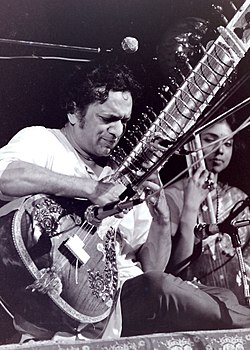
 Shehnai player Bismillah Khan (left) receives India's highest civilian honour, the Bharat Ratna, from president K. R. Narayanan in 2001.
.jpg)


.jpg)
Dance
Dance in India has drawn heavily from Indian classical dance traditions. Many of these in turn arose in temples or other religious contexts. Their sponsorship and promotion, however, has continued in secular, modern India. [412][u] India also has local and modern dance traditions.[412] Whether or not a dance is classical is determined by the Sangeet Natak Academi, the Indian government's organisation for performing arts.[v] Although more dances could perhaps meet the criteria for classical, the Akademi has chosen eight.[w] Some sources consider the dance-dramas Chhau of Jharkhand, West Bengal, and Odissa and Yakshagana of Karnataka to also belong to the classical tradition.[413] The best-known classical dance is Bharatnatyam, which began in the temple dances of Tamil devadasis.[412] Identified with "prostitutes and courtesans," their dancing was formally banned in 1947.[x] Concurrently, the dance was rehabilitated as a "pure" art form, with Rukmini Devi Arundale as a prominent figure. A devdasi who went on to attain national and international prominence was Thanjavur Balasaraswati.[412]
Local dance traditions vary widely across India. In addition to the dance-dramas Chhau and Yakshagana, they include dance-dramas Raslila of western Uttar Pradesh and Terukkuttu of Tamil Nadu; calendrical and festival dances such as the Bhangra of Punjab, especially at Vaisakhi, the onset of spring, and Garba of Gujarat during Navratri; and tribal or Adivasi dances, such as those of the Santal and Toda people, the latter, for example, in honour of the god Ön who brought buffalo to earth.[412]
Among 20th-century directions is the modern dance of Uday Shankar in which classical styles were employed but not adhered to rigidly. Examples are dance-dramas based on the ancient Indian animal fables, Panchatantra, and Nehru's mid-century meditation on Indian history, The Discovery of India.[412] Dance has been an essential aspect of Indian films from the first talkies of the 1930s. The individual and group dances of Bollywood, for example, show a broad range of influences, including classical, local, and Western popular dance.[412] Towards the end of the 20th century, innovations in British South Asian music and dance, such as Post-Bhangra, fed back into dance in India.[412]
 The Kathakali dance of Kerala
 The Bharatanatyam dance of Tamil Nadu
 The Kathak dance of northern India absorbed Persian and Central Asian influences during Mughal rule.
.jpg)

.jpg)
Clothing
From ancient times until the advent of the modern, the most widely worn traditional dress in India was draped.[415] For women it took the form of a sari, a single piece of cloth many yards long.[415] The sari was traditionally wrapped around the lower body and the shoulder.[415] In its modern form, it is combined with an underskirt, or Indian petticoat, and tucked in along the waist band for more secure fastening. It is also commonly worn with an Indian blouse, or choli, which serves as the primary upper-body garment, the sari's end—passing over the shoulder—covering the midriff and obscuring the upper body's contours.[415] For men, a similar but shorter length of cloth, the dhoti, has served as a lower-body garment.[416]
The use of stitched clothes became widespread after Muslim rule was established by the Delhi sultanate (c. 1300 CE) and continued by the Mughal Empire (c. 1525 CE).[417] Among the garments introduced during this time and still commonly worn are: the shalwars and pyjamas, both styles of trousers, and the tunics kurta and kameez.[417] Shalwars are atypically wide at the waist but narrow to a cuffed bottom. They are held up by a drawstring, which causes them to become pleated around the waist.[418] When the pants are cut quite narrow, on the bias, they are called churidars. The kameez is a long shirt or tunic.[419] Its side seams left open below the waistline.[420] The kurta is traditionally collarless and made of cotton or silk; it is worn plain or with embroidered decoration, such as chikankari; and typically falls to either just above or just below the wearer's knees.[421]
In the last 50 years, fashions have changed a great deal in India. Increasingly, in urban northern India, the sari is no longer the apparel of everyday wear, though they remain popular on formal occasions. The traditional shalwar kameez is rarely worn by younger urban women, who favour churidars or jeans. In office settings, ubiquitous air conditioning allows men to wear sports jackets year-round. For weddings and formal occasions, men in the middle and upper classes often wear bandhgala, or short Nehru jackets, with pants, with the groom and his groomsmen sporting sherwanis and churidars.[422]

 Women in sari at an adult literacy class in Tamil Nadu

_Cropped.jpg)


Cuisine
The foundation of a typical Indian meal is a cereal cooked plainly and complemented with savoury dishes.[424] The cooked cereal could be steamed rice; chapati, a thin unleavened bread;[425] the idli, a steamed breakfast cake; or dosa, a griddled pancake.[426] The savoury dishes might include lentils, pulses, vegetables, meat, poultry and fish commonly spiced with ginger and garlic, but also coriander, cumin, turmeric, cinnamon, cardamon and others.[424] In some instances, the ingredients may be mixed during the cooking process.[427] India has distinctive vegetarian cuisines, each a feature of the geographical and cultural histories of its adherents.[428] About 20% to 39% of India's population consists of vegetarians.[429][430] Although meat is eaten widely in India, the proportional consumption of meat in the overall diet is low.[431]
The most significant import of cooking techniques into India during the last millennium occurred during the Mughal Empire. Dishes such as the pilaf,[432][433] and cooking techniques spread into northern India from regions to its northwest.[434] To the simple yogurt marinade of Persia, onions, garlic, almonds, and spices began to be added in India.[434] Rice was partially cooked and layered alternately with the sauteed meat, the pot sealed tightly, and slow cooked according to another Persian cooking technique, to produce biryani,[434] a feature of festive dining in many parts of India.[435]
The diversity of Indian food served worldwide has been partially concealed by the dominance of Punjabi cuisine. The popularity of tandoori chicken—cooked in the tandoor oven, which had traditionally been used for baking bread in the rural Punjab and the Delhi region, especially among Muslims, but which is originally from Central Asia—dates to the 1950s, and was caused in large part by an entrepreneurial response among people from the Punjab who had been displaced by the 1947 partition.[428]
- A tandoor chef in the Turkman Gate, Old Delhi, makes Khameeri roti, a Muslim-influenced style of leavened bread.[y][437]
 South Indian vegetarian thali, or platter
 Machher jhol, a spicy fish curry eaten in eastern India, Nepal, and Bangladesh


Sports
Several traditional indigenous sports such as kabaddi, kho kho, pehlwani and gilli-danda, and also martial arts, such as Kalarippayattu and marma adi remain popular. Chess is commonly held to have originated in India as chaturaṅga;[441] There has been a rise in the number of Indian grandmasters.[442] Viswanathan Anand became the undisputed Chess World Champion in 2007 and held the status until 2013.[443] Parcheesi is derived from Pachisi another traditional Indian pastime, which in early modern times was played on a giant marble court by Mughal emperor Akbar.[444]
Cricket is the most popular sport in India.[445] India is one of the more successful cricket teams, having won two Cricket World Cups, two T20 World Cups, and three Champions Trophies. India has won a record eight field hockey gold medals in the summer Olympics.[446]

 A game of kabaddi in Bagepalli, Karnataka
 A street-corner game of pachisi in Pushkar, Rajasthan
 Indian hockey team, captained by Dhyan Chand (standing second from left), after winning the finals at the 1936 Summer Olympics – their third of six consecutive Olympic golds
 Gukesh Dommaraju, the reigning world chess champion,[448] receives India's highest sporting honour, the Dhyan Chand Award from India's president Droupadi Murmu, January 17, 2025.
 Indian cricket player Sachin Tendulkar, the highest run-getter in test cricket, playing a defensive stroke against Australia in Bangalore, 2010


Remove ads
See also
Notes
- Originally written in Sanskritised Bengali and adopted as the national anthem in its Hindi translation
- Written in a mixture of Sanskrit and Sanskritised Bengali
- "[...] Jana Gana Mana is the National Anthem of India, subject to such alterations in the words as the Government may authorise as occasion arises; and the song Vande Mataram, which has played a historic part in the struggle for Indian freedom, shall be honoured equally with Jana Gana Mana and shall have equal status with it."[5]
- According to Part XVII of the Constitution of India, Hindi in the Devanagari script is the official language of the Union, along with English as an additional official language.[1][6][7] States and union territories can have a different official language of their own other than Hindi or English.
- Not all the state-level official languages are in the eighth schedule and not all the scheduled languages are state-level official languages. For example, the Sindhi language is an 8th scheduled but not a state-level official language.
- Kashmiri and Dogri language are the official languages of Jammu and Kashmir which is currently a union territory and no longer the former state.
- According to Ethnologue, there are 424 living indigenous languages in India, in contrast to 11 extinct indigenous languages. In addition, there are 30 living non-indigenous languages.[10]
- Different sources give widely differing figures, primarily based on how the terms "language" and "dialect" are defined and grouped.
- "The country's exact size is subject to debate because some borders are disputed. The Indian government lists the total area as 3,287,260 km2 (1,269,220 sq mi) and the total land area as 3,060,500 km2 (1,181,700 sq mi); the United Nations lists the total area as 3,287,263 km2 (1,269,219 sq mi) and total land area as 2,973,190 km2 (1,147,960 sq mi)."[12]
- The Government of India also regards Afghanistan as a bordering country, as it considers all of Kashmir to be part of India.[24] However, this is disputed, and the region bordering Afghanistan is administered by Pakistan.
- "A Chinese pilgrim also recorded evidence of the caste system as he could observe it. According to this evidence the treatment meted out to untouchables such as the Chandalas was very similar to that which they experienced in later periods. This would contradict assertions that this rigid form of the caste system emerged in India only as a reaction to the Islamic conquest."[39]
- "All these achievements are dwarfed, though, by the Sanskrit linguistic tradition culminating in the famous grammar by Pāṇini, known as the Aṣṭhādhyāyī. The elegance and comprehensiveness of its architecture have yet to be surpassed by any grammar of any language, and its ingenious methods of stratifying out use and mention, language and metalanguage, and theorem and metatheorem predate key discoveries in western philosophy by millennia."[90]
- The northernmost point under Indian control is the disputed Siachen Glacier in Jammu and Kashmir; however, the Government of India regards the entire region of the former princely state of Jammu and Kashmir, including the Gilgit-Baltistan administered by Pakistan, to be its territory. It therefore assigns the latitude 37° 6′ to its northernmost point.
- A biodiversity hotspot is a biogeographical region which has more than 1,500 vascular plant species, but less than 30% of its primary habitat.[203]
- The 0% results from rounding to two decimal places.
- Caste is a form of social stratification characterised by endogamy, hereditary transmission of an occupation, ritual status in a hierarchy, and customary social interaction or exclusion defined by cultural notions of purity and pollution.[351]
- Ancient and medieval Indian mathematical works, all composed in Sanskrit usually consisted of two sections: sutras in which a set of rules or problems were stated with economy in verse, and a prose commentary that explained the problem in more detail and provided justification for the solution.[396][397]
- Apart from geometric series
- As per the Madras Devadasis (Prevention of Dedication) Act after agitation from the Indian middle and upper classes.[412]
- The Central Asian custom of buying bread outside the home accompanied the Mughals to India.[436]
Remove ads
References
Bibliography
External links
Wikiwand - on
Seamless Wikipedia browsing. On steroids.
Remove ads