Top Qs
Timeline
Chat
Perspective
Cambodian art
From Wikipedia, the free encyclopedia

Remove ads
The history of Cambodian art (Khmer: សិល្បៈខ្មែរ) stretches back centuries to ancient times, but the most famous period is undoubtedly the Khmer art of the Khmer Empire (802–1431), especially in the area around Angkor and the 12th-century temple-complex of Angkor Wat, initially Hindu and subsequently Buddhist. After the collapse of the empire, these and other sites were abandoned and overgrown, allowing much of the era's stone carving and architecture to survive to the present day. Traditional Cambodian arts and crafts include textiles, non-textile weaving, silversmithing, stone carving, lacquerware, ceramics, wat murals, and kite-making.

Beginning in the mid-20th century, a tradition of modern art began in Cambodia, though in the later 20th century both traditional and modern arts declined for several reasons, including the killing of artists by the Khmer Rouge. The country has experienced a recent artistic revival due to increased support from governments, NGOs, and foreign tourists.
In pre-colonial Cambodia, art and crafts were generally produced either by rural non-specialists for practical use or by skilled artists producing works for the Royal Palace. In modern Cambodia, many artistic traditions entered a period of decline or even ceased to be practiced, but the country has experienced a recent artistic revival as the tourist market has increased and governments and NGOs have contributed to the preservation of Cambodian culture.
Remove ads
Stone carving
Summarize
Perspective

Cambodia's best-known stone carving adorns the temples of Angkor, which are "renowned for the scale, richness and detail of their sculpture". In modern times, however, the art of stone carving became rare, largely because older sculptures survived undamaged for centuries (eliminating the need for replacements) and because of the use of cement molds for modern temple architecture. By the 1970s and 1980s, the craft of stone carving was nearly lost.[1]
During the late 20th century, however, efforts to restore Angkor resulted in a new demand for skilled stone carvers to replace missing or damaged pieces, and a new tradition of stone carving is arising to meet this need. Most modern carving is traditional-style, but some carvers are experimenting with contemporary designs. Interest is also renewing for using stone carving in modern wats. Modern carvings are typically made from Banteay Meanchey sandstone, though stone from Pursat and Kompong Thom is also used.[1]
 A corner relief with devatas; late 1100s to early 1200s AD (Bayon period); sandstone; Dallas Museum of Art (Texas, USA)
 A seated figure in a niche; 950-975 AD; made in the Bantey Srei style; Dallas Museum of Art


Remove ads
Murals
Summarize
Perspective
The most ancient mural paintings of any kind in Cambodia attributed to the 10th-11th century, are those of Prasat Neang Khmau, located south of Kor Ker, depicting scenes with Hindu themes.[2] However, little remains of them today. The earliest epigraphic evidence of painted scrolls appears inscription K. 285 dated to 1593 in Phnom Bakeng.[3] The oldest documented Buddhist paintings are dated to 1877, consist of 14 small paintings (1 x 1.20 m), on cloth, illustrating episodes of the Vessantara Jataka.[4] As in most Buddhist societies, stories from the lives of the Buddha are a common source of inspiration for the majority of paintings.
Because of destruction during recent war,[5][6] few historic wat murals remain in Cambodia. In the 1960s, art historians Guy and Jacqueline Nafilyan photographed 19th-century murals, providing a record of this lost cultural heritage. The best known surviving murals are at the Silver Pagoda in Phnom Penh, Wat Rajabo in Siem Reap province, and Wat Kompong Tralach Leu in Kompong Chhnang Province. In the last decade, wat murals have seen a resurgence.
 A mural of Gautama Buddha gaining nirvana; Wat Botum
 A Ramayana mural at Phnom Penh's Silver Pagoda (2)

.jpg)
.jpg)
Remove ads
Painted Scrolls
Preah Bot (Khmer: ព្រះបត), often called painted banners or scrolls, are paintings of Buddhist images on cloth incorporating a sewn tube at the top and base for inserting a wooden pole to hang the painting the keep it flat.[7] The making of a preah bot is imbedded in the concept of merit-making through the production of a modest representation of devotion and the spreading of Buddhism. In 1899, Adhémard Leclère, a French scholar-administrator, wrote that painted scrolls were hung in monasteries and terraces to share the Dharma.[8]
They are usually painted on cotton or silk. However, some old preah bot can also be found painted on roughly woven cloth. The centers of their production have historically been Phnom Penh and Battambang, followed by Siem Reap.[9] Preah bot are typically presented by lay people to monasteries during religious festivals, but they can also be found on display in private homes for festivals, weddings, and anniversaries of the deceased. They are further used in various religious ceremonies outside of monasteries and homes, including the setting up of the central pole of the village and ceremonial cutting of the top-knot of children.[10]
Textiles
Summarize
Perspective
_from_Cambodia,_Khmer,_1880-1910.jpg)

Silk weaving in Cambodia has a long history. The practice dates to as early as the late 13th century. According to Zhou Daguan's record, "None of the locals produces silk. Nor do the women know how to stitch and darn with a needle and thread. The only thing they can do is weave cotton from Kapok. Even then they cannot spin the yarn, but just use their hands to gather the cloth into strands.
They do not use a loom for weaving. Instead they just wind one end of the cloth around their waist, hang the other end over a window, and use a bamboo tube as a shuttle". Interestingly, Zhou mentioned that people from Siam brought silk production into Angkor, "In recent years people from Siam have come to live in Cambodia, and unlike the locals they engage in silk production. The mulberry trees they grow and the silkworms they raise all came from Siam. They themselves weave the silk into clothes made of a black patterned satiny silk".[citation needed]

Chong kiet is the Khmer ikat technique. To create patterns, weavers tie-dye portions of weft yarn before weaving begins.[11] Patterns are diverse and vary by region; common motifs include lattice, stars, and spots.

What's unique to Cambodian silk weaving is the use of uneven twill ground weave. This yields single or two-color fabrics, which are produced by weaving three threads so that the "color of one thread dominates on one side of the fabric, while the two others determine the color on the reverse side."[12] This produces a textile referred to as hol, as in sampot hol and hol pidan.The origins for the Khmer word hol are unknown, but sampot hol literally translates to "cloth patterned by the hol method."[13]
Three silk hol-patterned sampot chong kben and “a similarly-patterned silk shoulder cloth” were gifted along with Thai silks items to American President Franklin Pierce by Siamese King Mongkut for the 1856 Harris Treaty. The “uneven twill groundweave” affirms the garments were Khmer-made. Art historian Gillian Green notes it was common during this time for powerful Siamese officials to request similar silk garments from Khmer weavers in Cambodia. The refinement of both the hol weaving process and its patterns is revealed by these textiles. The poise and mastery demonstrated in creating the hol designs shows a long-practiced and polished talent that predates the mid-nineteenth century significantly. Khmer people living in the eastern part of present-day Thailand also utilize this uneven twill, unlike the Thais who weave hol in plain weave, demonstrating a practice learned long before modern borders. How far back it goes isn’t currently known, nor is the reason Khmers choose to weave “pictorial hangings” and silk sampots in uneven twill.[14]
Writer and archaeologist Lisa McQuail notes that King Mongkut describes the Thai silk items included in the Harris Treaty Gifts as “second quality,” likely because they were not as fine as the Khmer silks included. [15]

Traditionally, Cambodian textiles have employed natural dyes. Red dye comes from lac insect nests, blue dye from indigo, yellow and green dye from prohut bark, and black dye from ebony bark.[12]
Cambodia's modern silk-weaving centers are Takéo, Battambang, Beanteay Meanchey, Siem Reap and Kampot provinces. Silk-weaving has seen a major revival recently, with production doubling over the past ten years. This has provided employment for many rural women. Cambodian silk is generally sold domestically, where it is used in sampot (wrap skirts), furnishings, and pidan (pictorial tapestries), but interest in international trade is increasing.[12]
Cotton textiles have also played a significant role in Cambodian culture. Though today Cambodia imports most of its cotton, traditionally woven cotton remains popular. Rural women often weave homemade cotton fabric, which is used in garments and for household purposes. Krama, the traditional check scarves worn almost universally by Cambodians, are made of cotton.[16]
Remove ads
Non-textile weaving

Many Cambodian farmers weave baskets (Khmer: tbanh kantrak) for household use or as a supplemental source of income. Most baskets are made of thinly cut bamboo. Regions known for basketry include Siem Reap and Kampong Cham.[17] Mat weaving (tbanh kantuel) is a common seasonal occupation. They are most commonly made from reeds, either left a natural tan color or dyed in deep jewel tones. The region of Cambodia best known for mat weaving is the Mekong floodplain, especially around Lvea Em district. Mats are commonly laid out for guests and are important building materials for homes.[18] Wicker and rattan crafts (tbanh kanchoeu) made from dryandra trees are also significant. Common wicker and rattan products include walls, mats, furniture, and other household items.[19]
Remove ads
Lacquerware
Summarize
Perspective


In Cambodia, the earliest mention of lacquer (or chor mreak, or mreak, ម្រ័ក្ស in Khmer) is an inscription from the 10th century. King Jayavarman V (AD 968-1001) founded a "royal corporation" of kmuk (burnt leaves combined with lacquer) for use in a religious hall under the watch of a "chief of khmuk" and supported by the local economic income.[20][21]
The height of Cambodian traditional lacquerware (khmuk mreak khmer in Khmer) was between the 12th and 16th centuries; some examples of work from this era, including gilded Buddha images and betel boxes, have survived to the present day. Lacquerware was traditionally colored black using burnt wood, representing the underworld; red using mercury, representing the earth; and yellow using arsenic, representing the heavens. Lacquer on Angkorian stone dates to the 15th or 16th century,[22] though lacquer from what’s believed to be the 12th century is still detectable on the King Suryavarman II bas relief at Angkor Wat. [23]
The art of lacquerware in Cambodia had nearly faded into oblivion; few lacquer trees survived, and lacquer was unavailable in local markets as late as 1998. Those circumstances changed as new resin tree plantations have since been developed.[22]
Lacquer is collected between February and May from the dam kroeul (Melanorrhea laccifera) tree, which grows especially in Kratie and Kampong Thom provinces. There are three main ways Khmer lacquer is used: for pumice painting, for the protection of objects (called leap khmuk mreak), and for decoration. Decorative lacquer, or khmuk mreak leap lum in Khmer, is the most expensive and is combined with pheh, or ash, from sugar palm leaves (sleuk thnaut) or rice straw (cham boeung).[24] Khmers use this decorative lacquer on ceremonial holy religious items, music instruments, crowns/headdresses and masks, and for furniture . [25]

The non-profit Community First uncovered a 1990’s documentary from the Bophana Center where the Moi perform Chak Mreak, a dance showcasing the lacquer process, at Sambor Prei Kuk. [26]
Though having largely declined, the villages of Pralay and Trea's (Kampong Thom Province) traditional practice of lacquering betel boxes, bowls (for Buddhist monks and water), temple pillars, religious texts, and dance masks for Khol and monkey characters continues.[27] Called muk khmuk in Khmer, lacquer, paper mache, gold leaf, and enamel paint are used for lacquer mask-making. [28]
A lacquer training program for Cambodian children of Kandal province's Svay Andet pagoda was up-started in 2023 by the Ministry of Culture and Fine Arts. Lakhon Khol Wat Svay Andet was added to the UNESCO List of Intangible Cultural Heritage in Need of Urgent Safeguarding in 2018. Creating and restoring lacquer masks for Cambodian masked theater (Khol) will provide an income for the artists while preserving the ancient Lakhon Khol.[29]
Lacquer artisan brothers Eric and Thierry Stocker have maintained workshops in Siem Reap since 2008. First Angkor Artwork and now Stocker Studio, Cambodian artists are trained in gold and polychromy in addition to all-natural lacquerware. The brothers held some 100 resin trees in Kampong Thom in 2018. [30] [31] [32] A team from Stocker Studio treated a Pre Rup Buddha statue with gasoline mixed with lacquer in 2020. [33]
Designer and artist Lim Muy Theam teaches lacquer in his workshop on the grounds of his house turned-gallery. [34]
Remove ads
Blacksmithing


Archeological finds near Angkorian sites in the former Khmer empire have suggested a wide variety and quality of blacksmithing. Khmer swords became part of Khmer culture and literature through influences that were not only mythogical, as the Chandrahas sword represented in Angkor Wat and found in the Reamker or legendary as the sword that Preah Bath Ponhea Yath, who was the last king of the Angkorian Empire, drew out as he led a victorious battle against the Siamese invaders to take back the ancient Khmer capital in the 14th century.[35]
Blacksmithing in Cambodia is essentially linked to the needs of agriculture, and for that reasons, it remains one of the skills which survived best through the tragic years of the Khmer Rouges.[36] In this day, the vast majority of blacksmiths in Cambodia draws from the Cham minority. Recently, high-end quality blacksmithing has also emerged in Cambodia producing knives and swords in Khmer and Japanese styles.[37]
Remove ads
Silversmithing
Summarize
Perspective


Silversmithing in Cambodia dates back centuries. Archaeological excavations at Prey Veng and Banteay Meanchey Province uncovered ancient jewelry, including multiple silver items. Prohear, the archaeological site in Prey Veng, revealed silver jewelry from about 200 years B.C.[38]
Sixth century Buddhist monk Nagasena tells that people of Funan (1st-9th century) "make rings and bracelets of gold and vessels of silver." [39] About 700 years later, Zhou Daguan’s account of a 13th century procession at Angkor describes palace women emerging with “gilt and silver vessels from the palace” on top of many more “ornaments” of “special design,” the use of which he expressed were unknown to him. [40][41]

500 years later, a 19th century English traveler to Cambodia named Thomas Wallace Cox described “a silver cup” and a “silver box” shaped like a fish, holding a fragrant ointment used by “noblemen” for their nostrils and lips.[42]
The Royal Palace traditionally patronized silversmiths' workshops where a variety of items were fashioned, including weaponry, coins, ceremonial objects used in funerary and religious rituals, and betel boxes. Silversmiths remain concentrated at Kompong Luong, near the former royal capital Oudong, even today.[43]
During Cambodia's colonial period, artisans at the School of Fine Art produced celebrated silverwork, and by the late 1930s there were more than 600 silversmiths. Today, silver work is popular for boxes, jewelry, and souvenir items; these are often adorned with fruit, fire, and Angkor-inspired motifs. Men produce most of the forms for such work, but women often complete the intricate filigree.[43]
Silver betel nut boxes are considered high quality. The hip sla (“areca nut box") holds up to five smaller boxes containing the nut cutter, mortar, lime paste, and the bundled ingredients for chewing. Animal and fruit shapes are the most common, and all bear intricately designed foliage patterns, or kbach. [44]
Belly-chains, bracelets, and bangles of silver adorn the bodies of Khmers even today.[45]
Remove ads
Ceramics
Summarize
Perspective

Cambodian pottery traditions date to 5000 BCE. Ceramics were mostly used for domestic purposes such as holding food and water. There is no evidence that Khmer ceramics were ever exported, though ceramics were imported from elsewhere in Asia beginning in the 10th century. Ceramics in the shape of birds, elephants, rabbits, and other animals were popular between the 11th and 13th centuries.[46]
Potting traditionally was done either on a pottery wheel or using shaping tools such as paddles and anvils. Firing was done in clay kilns, which could reach temperatures of 1,000–1,200 °C, or in the open air, at temperatures of around 700 °C. Primarily green and brown glazes were used. In rural Cambodia, traditional pottery methods remained. Many pieces are hand-turned and fired on an open fire without glaze. The country's major center for pottery is Kompong Chhnang Province.[46]
In modern Cambodia, the art of glazed ceramics faded into oblivion: the technique of stoneware stop to be used around 14th century, at the end of Angkor era. Today this technique begin a slow revival through a Belgian ceramist who founded the Khmer Ceramics & Fine Arts Center, in Siem Reap, the organization lead vocational training and researches about this lost skill.
 Glazed pottery with brown slip; Bayon period, 12th century
 An owl-shaped lime pot; Angkorian era, 12th-13th century
 Ewer glazed stoneware; Angkorian era, 12th century
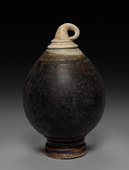
 A water jar, used as a container for water or food, Angkorian era
 Rabbit shaped glazed stoneware; Angkorian era, 11th-12th century


.jpg)

Kites
Cambodia's kite-making and kite-flying tradition, which dates back many centuries, was revived in the early 1990s and is now extremely popular throughout the country. Kites (Khmer: khleng ek) are generally flown at night during the northeast monsoon season. A bow attached to the kites resonates in the wind, producing a musical sound.[47]
Modern and contemporary visual arts
Summarize
Perspective

Cambodia's tradition of modern (representational) drawing, painting, and sculpture was established in the late 1940s at the School of Cambodian Arts (later called the University of Fine Arts), where it occupied much of the school's curriculum a decade later. These developments were supported by the government, which encouraged new areas of specialization (e.g. design and modern painting) at the school and purchased modern art for the Prime Minister's residences and for government buildings.[48]
Galleries opened in Phnom Penh during the 1960s, and cultural centers hosted exhibitions of modern paintings and provided art libraries. One important painter of the 1960s was Nhek Dim; he has become the painter of reference for modern painters.[48] During the subsequent Khmer Rouge era, many artists were killed and art production nearly ceased.[49]
After the fall of the Khmer Rouge, artists and professors returned the University of Fine Arts to rebuild arts training. Socialist Bloc governments sponsored the education of young art students in Poland, Bulgaria, the former Soviet Union, and Hungary during the late 1980s and early 1990s. Other local efforts aimed to re-establish workshops, collect documents, and preserve traditional knowledge.[49]
Though several galleries present changing exhibitions in Phnom Penh, the vast majority of artists cannot support themselves through exhibitions and sales of modern work. Artists generally earn income from Angkor-inspired art for tourists or from painting commercial signs and large reproductions that in the West would be mechanically produced.[49]
Several broad schools of art exist among modern Cambodian artists. Some artists, including Som Samai (a silversmith), An Sok (a mask-maker), and Chet Chan (a painter) follow colonial traditions to produce traditional Khmer art. Chhim Sothy's work is also derived from these traditions.[50] Many young artists who studied abroad in the 1980s, including Phy Chan Than, Soeung Vannara, Long Sophea, and Prom Sam An, have presented a modern Khmer art forms combining subjects from Khmer art with Western modernism. Other notable Cambodian artists include Leang Seckon, Pich Sopheap, Svay Ken, Asasax, Chhan Dina, Patrick Samnang Mey, Lam Soeung, and Chhorn Bun Son. During the 1990s, Cambodia saw the return of many members of the Khmer diaspora, including several internationally recognized artists. Among these are Marine Ky and Chath Piersath.[49]

Contemporary artists like FONKi have also revived street art including graffiti in Cambodia. FONKi, born in Paris to Khmer refugee parents and who grew up in Montreal, is a part of diaspora artists who have moved back to Cambodia to develop the local arts scene. His work can be seen in Phnom Penh at artists workspace FACTORY! and he also founded FT Gallery where Cambodian and international artists are able to display and sell their works.[51] They have also commissioned other artists from countries like Nepal to create custom murals and graffiti and aim to support new Cambodian talent as well as nurturing Phnom Penh's international reputation as a vibrant cultural hub in South East Asia.[51]
Remove ads
References
Works cited
Further reading
External links
Wikiwand - on
Seamless Wikipedia browsing. On steroids.
Remove ads