Top Qs
Timeline
Chat
Perspective
Vulcano (Sicily)
Complex stratovolcano in the Mediterranean From Wikipedia, the free encyclopedia

Remove ads
Vulcano is a complex stratovolcano in the Mediterranean. It is the eponymous volcanic complex comprising the island of Vulcano in the Aeolian archipelago. The origin of the word volcano is derived from the name of this volcanic island, which in turn owes its name to the Roman god of fire, volcanoes, and metalworking, Vulcan, who in classical Roman mythology resided on this island.[1]

Remove ads
Geology
This volcanic complex was created due to the African plate subducting under the Eurasian plate. Vulcano’s central peak is 386 meters above sea level. It is visible from the ground as a hill in the island's center, near Porto Levante. The slope’s composition is of various types (sandy landscape, porous pumice-type formations, and the presence of more glassy oxydian-type remnants). The vegetation cover decreases as altitude increases. Around half-way up the hill, only gorse grows; near the main crater, the ground is completely bare.[2]
Remove ads
Volcanic epochs
Summarize
Perspective
Volcanic activity at Vulcano can be split up into 8 different eruptive Epochs:
A 2025 study shows Vulcano has multiple magma chambers. The study integrated petrological and gas‑monitoring data to reconstruct the pre‑eruptive cycles of Vulcano. The study analysed clinopyroxene crystals from the 1888–90 La Fossa eruption and SO₂ flux records since 1978. This identified three different pulses of mafic magma (low silica) recharges—about 85–140, 16–35 and 2–7 years before an eruption. This estimates that 26–86 × 10⁶ m³ of magma intruded beneath the crater between 1978 and 2024. This pressurized the shallow magma reservoirs. The study describes Vulcano’s magma system as polybaric, with magma storage at 18.5–21 km depth, shoshonitic reservoirs at 17–12 km, latitic reservoirs at 12–8 km, latitic–trachytic reservoirs from roughly 7–8 km down to ~2 km, and small rhyolitic chambers shallower than 2 km. A latitic reservoir at around 4–5 km depth is currently degassing and is periodically recharged by deeper magmas. The study concludes that prolonged magma recharge and interaction among these reservoirs are key triggers for Vulcano‑style eruptions.[4]
Remove ads
Great Pit Crater
The main crater, about 500 metres (1,600 ft) in diameter, is named “Great Pit Crater”, and is also called the “Grand Crater”. The rim is located at an elevation of 386 metres (1,266 ft), and is surrounded by slopes leading to greater heights (Lentia Mountains).[5]
Other craters
In the vicinity of the Great Pit Crater, there are the remains of two other craters:
- Old Vulcano is located to the south: it includes the two peaks of Mount Saraceno and Mount Aria, which reach altitudes of around 500 metres (1,600 ft). This is the original volcanic edifice, still the highest in the entire complex.
- The Lentia, to the northwest, is much smaller: the Fossa crater was formed from the interior of this crater.
In addition to the Grand Crater, Old Vulcano, and the Lentia, there is a peripheral complex. Next to the island of Vulcano are the cones of Volcanello, joined to the island of Vulcano by an isthmus called the Isthmus of Vulcano.[2]
Remove ads
Recorded history
Summarize
Perspective
Vulcano in ancient times

Vulcano has produced half a dozen devastating eruptions over the past millennia. The Fossa crater has been active at irregular intervals since ancient times, as documented by classical writers, particularly Thucydides in the fifth century B.C. During this time period, records suggest the island produced eruptions that were audible as far as Sicily. After centuries of irregular eruptions, the Fossa crater began a prolonged phase of dormancy.[6]

In the second century B.C., next to the island of Vulcano, the new crater of Vulcanello emerged from the sea, which, erupting, gave rise to a small island located next to the mother island. The eruption causing the creation of Vulcanello, was also documented in antiquity in a dramatic style. The dormancy of the Great Crater was recorded as lasting until the sixth century A.C.[1]
Vulcano in modern times
Between 1727 and 1739, the activity of the Grand Crater resumed; following this eruptive awakening, the lava flow of fired stones (obsidian) was observed. Spilled ash fell on Lipari, Salina, Stromboli, and the Sicilian coast opposite. Further eruptions are also documented in 1771 and 1783.[6]

The last eruption occurred between 1888 and 1890. The latter was heralded in 1886 by a phreatic eruption (i.e., caused by steam formed as a result of water heating). The last eruptions in this series were of the Vulcano type: so-called bread crust bombs (solidified lava) and ash were catapulted from the Great Crater. An expedition of researchers was organized by the government. In particular, the eruption was documented by the famous seismologist Mercalli.[7]
Current Unrest

Since the time of the last violent eruption, only fumarole activity has been recorded volcanic exhalations consisting of the production of steam and volcanic gases. In the case of Vulcano, it is mainly sulfur, which, thanks to the action of bacteria, contributes to the formation of a colored patina on the surfaces of soil and stones.[8]
The activity of fumaroles has been documented for centuries and has continued in alternating phases to the present day. While it was very modest in the 1970s, there was increased activity at the turn of the 1980s and 1990s that raised serious concerns.[8]
On the beach at Porto Levante, the water and mud are heated by the heat of sulfur dioxide produced by the weaker fumaroles. This small coastal area has long been famous for bathing: mud baths on Vulcano have a reputation for benefiting the skin and having therapeutic effects.[9]
Starting in the summer of 2021 and that of September, there has been an increase in fumarole activity, with a rise in the temperature of the gases and the amount of CO2 and SO2 in them, as well as an increase in microseismic activity. For this reason, the Civil defense raised the volcanic alert level from green to yellow starting in October. Following a subsequent decrease in these phenomena, the alert level was returned to green in December 2023.[7]
In the fall of 2025, volcanic unrest increased again with strong gas emissions reported on October 15, 2025.[10]
Remove ads
Excursions
The ascents to the peaks of Vulcano are typically done on foot, starting from Porto Levante. Ascents to the Grand Crater for people in average physical condition typically do not require much effort nor a guide. Elderly people and people sensitive to sulfurous gases have complained about the difficulty of reaching the peak. It is frequently advised to avoid getting near the fumaroles. Before the descent back down to Porto Levante, there is an option to have a guided tour around the crater.[9]
Remove ads
Gallery
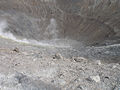 The Great Crater as seen from the rim
 View from the vicinity of Porto Levante
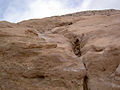 Slope in the vicinity of the crater
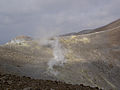 Fumarole, overview
 Fumarola, detail
 View from the edge of the crater
 Overview
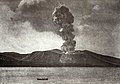 Eruption of 1890


.jpg)

.jpg)

See also
References
Wikiwand - on
Seamless Wikipedia browsing. On steroids.
Remove ads