Top Qs
Timeline
Chat
Perspective
Tokyu 2020 series
Japanese electric multiple unit train type From Wikipedia, the free encyclopedia

Remove ads
The Tokyu 2020 series (東急2020系, Tōkyū 2020-kei) is an electric multiple unit (EMU) commuter train type built by J-TREC and used by the Japanese private railway operator Tokyu Corporation in the Tokyo area since March 2018.[3] The 2020 series is used primarily on the Tokyu Den-en-toshi Line while its derivatives, the 3020 series (3020系, 3020-kei) and the 6020 series (6020系, 6020-kei), are used mainly on the Tokyu Meguro Line[4] and Tokyu Oimachi Line[5] respectively.
 | This article needs additional citations for verification. (April 2022) |
Remove ads
Design
The 2020 series trains were built by Japan Transport Engineering Company (J-TREC) as part of its "Sustina S24 Series" family of 20-metre-long four-door stainless steel cars.[6] The styling of the trains was overseen by Tanseisha, a company involved in designing commercial buildings along the Tokyu route.[3]
The classification "2020 series" for the trains was chosen to mark the year 2020 in which the Tokyo Olympics were scheduled to be held and in which Tokyu celebrated its 100th anniversary.[3]
Remove ads
Variants
- 2020 series: 10-car sets used on the Tokyu Den-en-toshi Line since March 2018
- 3020 series: 8-car (originally 6-car) sets used on the Tokyu Meguro Line since November 2019
- 6020 series: 5- and 7-car sets used on the Tokyu Oimachi Line since March 2018
2020 series
Summarize
Perspective

Details of the 2020 series were officially announced on 17 March 2017.[3] Three ten-car sets (30 vehicles) are scheduled to be delivered during fiscal 2017, entering service in spring 2018,[1] with further sets introduced over the following years.[3] The first trainset, 2121, was delivered from the J-TREC factory in Yokohama in late November 2017, and shown off to the media on 30 November 2017.[7] The second trainset, 2122, was delivered from the J-TREC factory in Niitsu, Niigata, in February 2018.[8]
The first sets entered service on 28 March 2018.[9]
Interior
Passenger accommodation consists of high-back longitudinal seats.[3] In addition to passenger information screens placed above the doorways and car ends, LCD screens are also located above the seats.[3] Security cameras are installed in the cars.[3]
To reduce dwell times, sets 2130 onward have six fewer seats in cars 4, 5, and 8.[10]: 1, 3
 2020 series interior view

Formation
The trains are formed as follows, with five motored ("M") cars and five non-powered trailer ("T") cars, and car 1 at the Shibuya end.[1]
Cars 3 and 9 each have two single-arm pantographs, and car 6 has one.[1]
Build histories
The manufacturers and delivery dates for the fleet are as shown below.
Remove ads
3020 series
Summarize
Perspective

On 26 March 2019, Tokyu Corporation announced the introduction of new 3020 series trains on their Meguro Line.[4] The first set of eight cars was delivered in April 2019.[15] A second set of eight cars was transferred from J-TREC in Yokohama to Nagatsuta in May 2019.[16] Trial runs on the Den-en-toshi Line began in June 2019.[17]
The first 3020 series set entered revenue service on 22 November 2019.[18][better source needed] Originally operating as 6-car sets, the fleet began operating as 8-car sets in April 2022.[19]
Service commenced on the Tōkyū Shin-Yokohama Line in March 2023. As of June 2023, the 3020 series lacks equipment needed in order to through run on the Sōtetsu Shin-Yokohama Line and associated through services. Tokyu plans to install the required equipment to enable Sotetsu through service in the near future.[20] Set 3121 had officially entered service along the Sotetsu network on 26 September 2023, over a half year later of the opening of the Sōtetsu-Tokyu Link Line.
Interior
Passenger accommodation consists of high-back seating.[4] The trains are also fitted with security cameras and air purifiers.[21]
 Interior view
 Wheelchair space (right)
 Passenger information displays


Formation
The trains are operated as eight-car sets. They were originally built as such, but were initially operated as six-car sets, with two cars per set stored until 2022, when platform doors were extended to fit 8-car trains as part of Tokyu Corporation's strategy to cope with high demand on the Meguro Line and for the opening of the Sōtetsu Tōkyū Link Line.[4][22] All three trainsets are distinguished with an "8-Cars" sticker located on the front window of the first and last cars, and are formed as follows:[2]
The "M1B" and "M1A" cars are each fitted with two single-arm pantographs.[2]
Initial 6-car formation
The original six-car formation was as follows:[2]
The "M1B" and "M1A" cars were each fitted with two single-arm pantographs.[2]
 6-car set on the Toei Mita Line in June 2021

Build histories
The manufacturers and delivery dates for the fleet are as shown below.
Remove ads
6020 series
Summarize
Perspective

Details of the 6020 series were officially announced on 12 October 2017.[5] The first set was delivered from the J-TREC factory in Yokohama in December 2017,[25] followed by a second in January 2018.[26] They entered revenue service from 28 March 2018.[9]
In both sets, car 3 was replaced by a new-build "Q Seat" car built in October 2018. The outgoing cars were subsequently used in 2020 series sets 2126 and 2127.[12] The Q Seat cars are usually arranged in longitudinal mode, but on specific evening express trains from Ōimachi to Nagatsuta, they are arranged in transverse mode and can be used only with a reservation by paying a small surcharge.[24]
 Q Seat car

5-car trains
.jpg)
On 28 February 2025, Tokyu announced its plans to procure eighteen 5-car 6020 series sets to replace all 9000 and 9020 series sets on local Ōimachi Line services.[27] Tokyu states that the new trains offer approximately 40% energy savings over the 9000 series sets and allow for quieter operation.[28] These sets feature "5 Cars" stickers on the front ends and blue stickers next to the train doors to distinguish them from the 7-car sets.[29] The first such set, 6151, was delivered to the Nagatsuta depot in March of that year.[30] The 5-car fleet entered revenue service on 2 July 2025.[31]
Interior
Passenger accommodation consists of high-back longitudinal seating throughout,[5] except car 3 in 7-car sets, which is a "Q Seat" car that features rotating pairs of seats that can be arranged in longitudinal mode or transverse mode.[24] Security cameras are installed in the cars.[5]
 Interior view
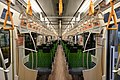 Interior view of a Q Seat car
 Rotating seat


Formations
7-car sets
The 7-car sets are formed as follows:[32]
Cars 3 and 6 are each fitted with two single-arm pantographs.[32]
5-car sets
The 5-car sets are formed as follows:[28]
Former formations
The 7-car sets were originally formed as follows:[33]
Cars 3 and 6 were each fitted with two single-arm pantographs.[33]
Build histories
The manufacturers and delivery dates for the fleet are as shown below.
Remove ads
Special liveries
On 10 April 2022, 3020 series set 3121 received a special livery to commemorate the 100th anniversary of Tokyu Corporation's founding.[34][35] A 2020 series set is also due to receive the commemorative livery from 17 April.[35]
On 17 April 2023, 3020 series set 3122 received a colorful rainbow Sustainable Development Goals (SDGs) livery.[20]
References
External links
Wikiwand - on
Seamless Wikipedia browsing. On steroids.
Remove ads