Top Qs
Timeline
Chat
Perspective
Sebastopol goose
Breed of goose From Wikipedia, the free encyclopedia

Remove ads
The Sebastopol is a breed of domestic goose, descended from the European Greylag goose.[1] First exhibited in England in 1860 under the name 'Sebastopol goose';[2] they were also referred to as Danubian geese, a name first used for the breed in Ireland in 1863.[3] 'Danubian' was used as a synonym in the 19th century; and only given precedence by Edward Brown after the turn of the 19th century.[4] The Sebastopol is a medium-sized goose with long, white curly feathers. The feathers of the neck are smooth and sometimes greyish brown. Crosses have produced all-grey, buff, and saddle back variants.[5][6] Feathers on the breast may be curly (frizzle) or smooth. The gander weighs 12-14 lbs while the goose weighs 10-12 lbs. The legs and shanks are orange and the eyes bright blue. Grey and buff coloured Sebastopol have brown eyes. On average, females produce 25-35 eggs per year.[7] Though domesticated breeds of geese generally retain some flight ability, Sebastopols cannot fly well due to the curliness of their feathers and have difficulty getting off the ground.[8][9] They need plenty of water to keep themselves clean, and to clean their sinuses (as do all waterfowl).[10]
In German, they are called Lockengans or Struppgans, meaning "curl-goose" and "unkempt goose".
Remove ads
History
It has been stated the breed was developed in Central Europe along the Danube and the Black Sea.[11][12] However, it is documented that the birds were originally met with in the Crimea and sent from the port of Sevastopol, as the name implies, and arrived in England in 1860.[2][13] By the 19th century they were found in all the countries surrounding the Black Sea. The alternate name Danubian reflected their prevalence around the river Danube.[14] They were originally bred to use their curly feathers in pillows and quilts.[15]
Remove ads
Breeding
Breeding over the last hundred years has increased the average weight of the birds by thirty per cent.[16] This occurred in America due to matings with Embden Geese made in the late 19th century.[17]
See also
Gallery
 Sebastopol goose and goslings
 White gosling
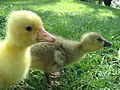 White and blue goslings
 Rare saddleback colour scheme
 Close up of saddleback back colouring
 Two white Sebastopols


References
Wikiwand - on
Seamless Wikipedia browsing. On steroids.
Remove ads