Top Qs
Timeline
Chat
Perspective
Pandora (moon)
Moon of Saturn From Wikipedia, the free encyclopedia

Remove ads
Pandora is an inner satellite of Saturn. It was discovered in 1980 from photos taken by the Voyager 1 probe and was provisionally designated S/1980 S 26.[5] In late 1985, it was officially named after Pandora from Greek mythology.[6] It is also designated as Saturn XVII.[7]
Pandora was thought to be an outer shepherd satellite of the F Ring. However, recent studies indicate that it does not play such a role, and that only Prometheus, the inner shepherd, contributes to the confinement of the narrow ring.[8][9] It is more heavily cratered than nearby Prometheus and has at least two large craters 30 kilometres (19 mi) in diameter. The majority of craters on Pandora are shallow as a result of being filled with debris. Ridges and grooves are also present on the moon's surface.[10]
The orbit of Pandora appears to be chaotic as a consequence of a series of four 118:121 mean-motion resonances with Prometheus.[11] The most appreciable changes in their orbits occur approximately every 6.2 years,[2] when the periapsis of Pandora lines up with the apoapsis of Prometheus and the moons approach to within about 1,400 kilometres (870 mi). Pandora also has a 3:2 mean-motion resonance with Mimas.[2]
From its very low density and relatively high albedo, it seems likely that Pandora is a very porous icy body. However, there is much uncertainty in these values, so this remains to be confirmed.
Remove ads
Gallery
 Voyager 2 image of Pandora (August 1981).
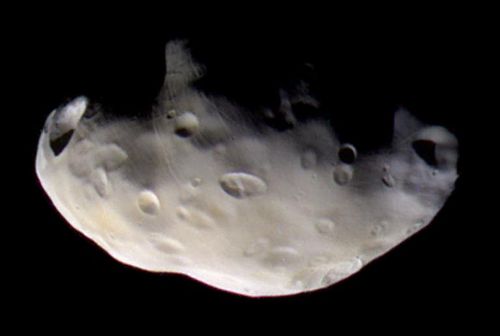 View of the moon, taken during September 2005 flyby by Cassini.
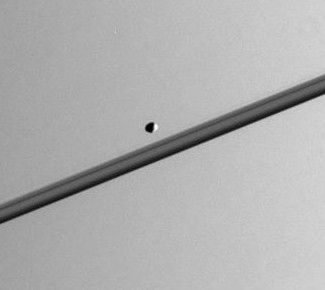 Pandora as seen from the Cassini probe in 2005; the rings of Saturn are in the background.
 Cassini captured this close view of Saturn's moon Pandora during the spacecraft's flyby on June 3, 2010.


_PIA_12690.png)
References
External links
Wikiwand - on
Seamless Wikipedia browsing. On steroids.
Remove ads