Top Qs
Timeline
Chat
Perspective
NGC 3913
Galaxy in the constellation Ursa Major From Wikipedia, the free encyclopedia

Remove ads
NGC 3913 is a spiral galaxy in the constellation of Ursa Major. Its velocity with respect to the cosmic microwave background for is 1,124±12 km/s, which corresponds to a Hubble distance of 54.1 ± 3.8 Mly (16.58 ± 1.17 Mpc).[1] However, three non redshift measurements give a much closer distance of 27.06 ± 14.19 Mly (8.297 ± 4.352 Mpc).[2] It was discovered by German-British astronomer William Herschel on 14 April 1785.[3] It was also observed by Lewis Swift on 8 May 1890, which resulted in the galaxy also being listed in the Index Catalogue as IC 740.[3]
The SIMBAD database lists NGC 3913 as an Active Galaxy Nucleus Candidate, i.e. it has a compact region at the center of a galaxy that emits a significant amount of energy across the electromagnetic spectrum, with characteristics indicating that this luminosity is not produced by the stars.[4]
Remove ads
NGC 3631 Group
According to A.M. Garcia, NGC 3913 is part of the NGC 3631 group (also known as LGG 241). This group includes at least 10 galaxies, including NGC 3631, NGC 3657, NGC 3718, NGC 3729, NGC 3972, NGC 3998, UGC 6251, UGC 6446, and UGC 6816.[5]
NGC 3631 is also a member of the M109 Group.
Supernovae
Two supernovae have been observed in NGC 3913:
- SN 1963J (Type Ia, mag. 13.7) was discovered by Fritz Zwicky and Paul Wild on 18 May 1963.[6][7]
- SN 1979B (Type Ia, mag. 16) was discovered by Leonida Rosino on 28 February 1979.[8][9]
Image gallery
 NGC 3913 imaged by the Hubble Space Telescope
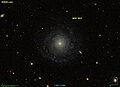 NGC 3913 imaged by SDSS


See also
References
External links
Wikiwand - on
Seamless Wikipedia browsing. On steroids.
Remove ads