Top Qs
Timeline
Chat
Perspective
Mary of Egypt
Egyptian grazer saint of Late antiquity From Wikipedia, the free encyclopedia

Remove ads
Mary of Egypt (Greek: Μαρία ἡ Αἰγυπτία; Coptic: Ϯⲁⲅⲓⲁ Ⲙⲁⲣⲓⲁ Ⲛⲣⲉⲙⲛ̀ⲭⲏⲙⲓ; Egyptian Arabic: مريم المصرية/ماريا المصرية; Amharic/Geez: ቅድስት ማርያም ግብፃዊት; Latin: Maria Aegyptiaca) was an Egyptian grazer saint, said to have dwelled in Byzantine-era Palestine in the 5th century AD (in late antiquity / Early Middle Ages).[3][4]
The hagiography The Life of Our Venerable Mother Mary of Egypt tells her life story through the framing device of her encounter with the hieromonk Zosimas of Palestine near the Jordan River. Mary recounts to Zosimas debauched life of lust so great she traveled from Alexandria to Jerusalem seeking to seduce pilgrims traveling to the Elevation of the Holy Cross. Arriving at the Church of the Holy Sepulchre she encounters the power of an icon of the Mary the mother of Jesus barring her entrance. She receives instructions to cross the Jordan River to seek glorious rest wandering the desert as an ascetic. Mary and Zosimas then part ways resolving to meet by the Jordan one year later so that Zosimas can administer Holy Communion; at this meeting Zosimas witnesses Mary walking on the water.[5][6]
The story concludes with Zosimas waiting one year hence to reunite only to find Mary's deceased body; after praying he receives divine instruction to provide her Christian burial. The hagiography then states that Zosimas told his fellow monks about Mary, who after his own death told the story to the text's credited author Sophronius, Patriarch of Jerusalem, in the 7th century.[5]
Later, in the 8th century the hagiography was read into the record at the Fourth Session of the historical Second Council of Nicaea, preserving it. The Council, debating whether to revive the practice of icon veneration amid Byzantine iconoclasm, heard Mary of Egypt's conversion as an argument for the virtues of icons.[7]
The Roman Martyrology of the Catholic Church, Synaxarion of Constantinople of Eastern Orthodox Church, and the Copto-Arabic Synaxarion of the Coptic Orthodox Church each list Mary of Egypt as a saint with a feast day.[8][9][10] The Martyrology characterizes her time in the desert as an act of penitence and mortification. In contrast, the Synaxarion of Constantinople emphasizes her time in the desert as spiritual elevation through self-control.[8][10]
The historicity of Mary of Egypt is uncertain and has been questioned by some historians.[11][12] Art historians further note that artists of Medieval and Renaissance Europe regularly conflated Mary of Egypt with Mary Magdalene.[13][14]
Remove ads
Life
Summarize
Perspective

According to tradition, Mary of Egypt was born somewhere in the Roman Province of Egypt, and at the age of twelve ran away from her parents to the city of Alexandria. There, she lived an extremely dissolute life.[15] In her Vita it states that she often refused the money offered for her sexual favors, as she was driven "by an insatiable and an irrepressible passion", and that she mainly lived by begging, supplemented by spinning flax.[5]
After seventeen years of this lifestyle, she traveled to Jerusalem for the Great Feasts of the Exaltation of the Holy Cross. She undertook the journey as a sort of "anti-pilgrimage", stating that she hoped to find in the pilgrim crowds at Jerusalem even more partners to sate her lust. She paid for her passage by offering sexual favors to other pilgrims, and she briefly continued her habitual lifestyle in Jerusalem. Her Vita relates that when she tried to enter the Church of the Holy Sepulchre for the celebrations, she was barred by an unseen force. Realizing this was because of her impurity, she was struck with remorse, and upon seeing an icon of the Theotokos (the Virgin Mary) outside the church, she prayed for forgiveness and promised to give up the world (i.e., become an ascetic). She attempted again to enter the church, and this time was able to go in. After venerating the relic of the True Cross, she returned to the icon to give thanks, and heard a voice telling her, "If you cross the Jordan, you will find glorious rest." She immediately went to the monastery of Saint John the Baptist on the banks of the River Jordan, where she received absolution and afterwards Holy Communion. The next morning, she crossed the Jordan eastwards and retired to the desert to live the rest of her life as a hermit in penitence. She took with her only three loaves of bread she had bought, and once she had eaten these, lived only on what she could find in the wilderness.[5][16]
Approximately one year before her death, she recounted her life to Zosimas of Palestine,[17] who encountered her in the desert. When he unexpectedly met her in the desert, she was completely naked and almost unrecognizable as human. She asked Zosimas to toss her his mantle to cover herself with, and then she narrated her life's story to him. She asked him to meet her at the banks of the Jordan on Holy Thursday of the following year, and to bring her Holy Communion. When he fulfilled her wish, she crossed the river to get to him by walking on the water, and received Holy Communion, telling him to meet her again in the desert the following Lent.[5]
The next year, Zosimas went to the same spot where he first met her, some twenty days' journey from his monastery. There, he found her lying dead; an inscription written in the sand next to her head stated that she had died the very night he had given her Communion, her incorrupt body miraculously transported to that spot. He buried her body with the assistance of a passing lion. On returning to his monastery, he related her life story to the other brethren, and it was preserved among them as oral tradition until it was written down by Sophronius.[5]
Remove ads
Date of death
There is disagreement among various sources regarding the dates of Mary's life. Some scholars doubt her existence, on the grounds of the similarity of her Vita to the stories of other "desert mothers": "[I]t is impossible to provide a chronology for the life of Mary, or even to establish her historicity."[12] The dates given above correspond to those in the Catholic Encyclopedia. The Bollandists place her death in 421, or 530 (see Prolog from Ohrid, 1 April). The only clue given in her Vita is the fact that the day of her repose was 1 April, which is stated to be Holy Thursday, meaning that Easter fell on 4 April that year.
Remove ads
Veneration
Summarize
Perspective
Iconography
In iconography, Mary of Egypt is depicted covered by her long hair or by the mantle she borrowed from Zosimas. She is often shown with the three loaves of bread she bought before her final journey into the desert.[18] Depictions in Russian and Greek icons preserved the tradition of depicting Mary of Egypt as gaunt and emaciated, but artists of Western Europe often conflated Mary of Egypt with Mary Magdalene and produced depictions that combined features of the two.[13][14]
 Fresco The Hermit Zosimus Giving a Cloak to Magdalene (1320s) by Giotto in the Magdalene Chapel in the Lower Basilica of Saint Francis of Assisi. Although the title and chapel are dedicated to Mary Magdalene, the story of Zosimus giving his cloak is from the hagiography of Mary of Egypt.
 Marie of Egypt (Saint-Germain l'Auxerrois).
 Illumination from the Dunois Master of Mary of Egypt being handed a cloak by Zosimas, French, 15th century (British Library)
 16th Century print by Maerten de Vos, S.I 804, Prints Department, Royal Library of Belgium
 Abbas Zosimas and Mary of Egypt, 17th century, from the collection of the Alexander S. Onassis Foundation
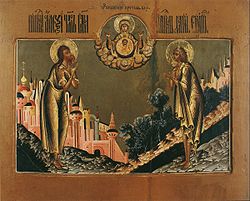 Patronal icon of Alexius of Rome and Mary of Egypt painted for the wedding of Tsar Alexei Mikhailovich and Maria Miloslavskaya in 1648.
 Carved wooden statuette (anonymous, 17th century) from the National Museum of Ecuador, Quito.
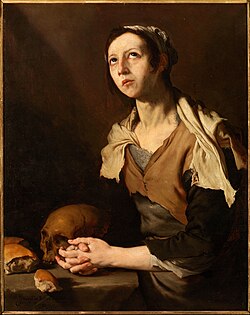 Mary of Egypt (1651) by Jusepe de Ribera from the collection of the Museo Civico Filangieri


.jpg)
.jpg)
.jpg)

Commemoration
Her feast day is kept by Orthodox Christians and Greek Catholics, according to the Fixed Cycle, on 1 April, and, according to the Moveable Cycle, on the fifth Sunday of Great Lent,[19] on which day it is customary for the priest to bless dried fruit after the Divine Liturgy. The Life of St Mary by Sophronius is appointed to be read during the Matins of the Great Canon of Andrew of Crete on the preceding Thursday, which is accompanied with a canon to her and Andrew sung after each ode of the Great Canon itself.[20]
The Coptic Orthodox Church commemorates Saint Mary of Egypt on Parmouti 6, which is 14 April in the Gregorian calendar.[21]
In the Roman Rite of the Catholic Church, Saint Mary of Egypt is commemorated on 1 April according to the 2004 Roman Martyrology (Ordinary Form) and on 2 April in the 1956 Roman Martyrology (Extraordinary Form].[22]
She is venerated by Anglicans and appears on the Episcopal Church liturgical calendar.[23]
In Italy, she became associated with the patronage of "fallen women" much like Mary Magdalene, to whom similar traits were associated.
Churches
There are a number of churches and chapels dedicated to Saint Mary of Egypt, among them:
 The Temple of Portunus, Rome, was preserved by being rededicated to Santa Maria Egiziaca in 872.
 Church of Santa Maria Egiziaca a Forcella, Naples founded in 1342 to house repenting prostitutes.[24]
 Church of Santa Maria Egiziaca a Pizzofalcone, Naples founded as a offshoot of the church at Forcella for a life closer to the cloistered ideal.[25]


Chapels
- Chapel of St. Mary of Egypt, Wawel Castle, Kraków, Poland
- Chapel in Church of the Holy Sepulchre in Jerusalem, commemorating the site of her conversion.
Relics

First-class relics of Saint Mary of Egypt are enshrined at the following churches:
- Church of Santa Maria Egiziaca a Forcella, Naples, Italy (a relic encased in a bust of the saint)[26]
- Sens Cathedral, Sens, France (right foot)[27]
- Church of Agios Dimitrios, Ampelokipi, Greece[28]
- Sretensky Monastery, Moscow, Russia (a particle from the right foot)[29]
- Cathedral of Christ the Saviour, Moscow, Russia[30]
- Novo-Tikhvin Monastery, Ekaterinburg, Russia[28]
- Church of Saint Demetrios of Thessaloniki, Moscow, Russia (a particle of the right foot)[31]
- Sacred Patriarchal and Stavropegial Orthodox Monastery of St. Irene Chrysovalantou, Astoria, Queens, New York[28]
- Saint Nicholas Russian Orthodox Monastery, Fort Myers, Florida, USA (particle)[32]
Icon of the Mother of God
Two icons of the Theotokos are claimed to be the very icon before which Mary of Egypt prayed for forgiveness. One is kept in the Chapel of Saint James the Just, located on the western parvis of the Church of Holy Sepulchre.[33] The other icon is located in the Cave of Saint Athanasios the Athonite, on the southern tip of Mount Athos.[34]
Cave
The cave believed to be the location where Mary of Egypt spent the rest her life following her conversion is a place of pilgrimage.[35][36]
Rosa Egipcíaca
Rosa Egipcíaca, an Afro-Brazilian religious mystic and formerly enslaved prostitute, renamed herself in 1798 to honour Saint Mary of Egypt.[37] Egipcíaca was the first black woman in Brazil to write a book, Sagrada Teologia do Amor Divino das Almas Peregrinas ("Holy Theology of Divine Love of the Pilgrim Souls"), that recorded her religious visions.[38]
Remove ads
Cultural references
Summarize
Perspective
In Goethe's Faust, Mary of Egypt is one of the three penitent saints who pray to the Virgin Mary for forgiveness for Faust. Her words are set by Mahler in his 8th Symphony, as the final saint's appeal to the Mater Gloriosa.
In Ben Jonson's play Volpone (1606) one of the characters uses the expression "Marry Gip". Commentators have taken this to mean "Mary of Egypt".[39]
Mary of Egypt is the subject of operas by Ottorino Respighi (Maria egiziaca), John Craton (Saint Mary of Egypt), and Sir John Tavener (Mary of Egypt). The Tavener opera was written in 1992 for the Aldeburgh Festival.
The Unknown Masterpiece (1831), a novella by Balzac, contains a long description of a portrait of Mary of Egypt "undressing in order to pay her passage to Jerusalem".
Nalo Hopkinson's science fiction novel, The Salt Roads, also features Mary of Egypt and takes a historical fiction approach to telling her story.
In John Berryman's Pulitzer Prize winning book of poetry, The Dream Songs, poem 47, subtitled "April Fool's Day, or, St. Mary of Egypt", recounts Mary of Egypt's walk across the River Jordan.
"Thrust back by hands of air from the sanctuary door" is the first line of Maria Aegyptiaca, a poem by John Heath-Stubbs about the saint (Collected Poems, p. 289).
Remove ads
See also
Notes
Further reading
External links
Wikiwand - on
Seamless Wikipedia browsing. On steroids.
Remove ads