Top Qs
Timeline
Chat
Perspective
List of vehicle speed records
From Wikipedia, the free encyclopedia
Remove ads
The following is a list of speed records for various types of vehicles. This list only presents the single greatest speed achieved in each broad record category; for more information on records under variations of test conditions, see the specific article for each record category. As with many world records, there may be some dispute over the criteria for a record-setting event, the authority of the organization certifying the record, and the actual speed achieved.
Remove ads
Land vehicles
 ThrustSSC, which has held the land speed record since 1997
 VeloX3, formerly the world's fastest human-powered vehicle
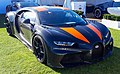 Bugatti Chiron Super Sport 300+, the fastest production car
 JCB Dieselmax, the fastest diesel car
 Buckeye Bullet 3, the fastest electric car
 Imagination, the fastest steam powered vehicle


.jpg)
- Average over 1 mile (1.6 km), with a flying start
- Average over 1 kilometre (0.62 mi), with a flying start
- Unpaced on a straight surface -0.6% grade;[11] average over 200 metres (660 ft), with flying start (For other cycling records, see cycling records)
- For vehicles powered directly by solar power, without batteries
Remove ads
Rail vehicles
 Lt. Col. John P. Stapp rides the rocket sled at Edwards Air Force Base
 The V150, the world's fastest wheeled train, on its record-breaking run
 Schienenzeppelin propeller-driven rail car
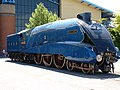 Mallard, the world's fastest steam train


Remove ads
Aircraft
Summarize
Perspective
Aircraft speed records are based on true airspeed, rather than ground speed.
 HTV-2 (artist rendering), the fastest uncrewed aerial vehicle
 North American X-15, the fastest piloted rocket-powered aircraft
 SR-71 Blackbird, the fastest piloted air-breathing aircraft
 Rare Bear, the fastest piston-engined aircraft
 Musculair 2, the fastest human-powered aircraft
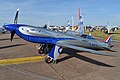 Rolls-Royce ACCEL, the fastest electric aircraft


_Rare_Bear_2014_Reno_Air_Races.jpg)


.jpg)
- Mach number depends on ambient temperature, and thus altitude, as well as speed; it is not a direct measure of speed.
- Over a 3-kilometer course
- Average speed over an out-and-return course of 500 km
Noted unofficial records
- Unofficial helicopter speed records by the Sikorsky X2 (460 km/h on 15 September 2010) and the Eurocopter X3 (472 km/h on 7 June 2013) would surpass this record if accepted.
- Greater speeds reportedly achieved by rigid airships, including 140.3 kilometres per hour (87.2 mph) by the American USS Macon (ZRS-5), are not recognized by the FAI, because these runs did not account for wind speed by flying a set course in both directions.[46]
Remove ads
Watercraft
 Model of Spirit of Australia, which holds the water speed record
 Vestas Sailrocket, the fastest wind-powered watercraft
 Decavitator, the fastest human-powered watercraft
 Omer 5, the fastest human-powered submarine
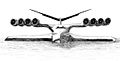 The "Caspian Sea Monster", the fastest ground-effect vehicle[a]


Remove ads
Spacecraft
Summarize
Perspective
In order to unambiguously express the speed of a spacecraft, a frame of reference must be specified. Typically, this frame is fixed to the body with the greatest gravitational influence on the spacecraft, as this is the most relevant frame for most purposes.[67] Velocities in different frames of reference are not directly comparable; thus the matter of the "fastest spacecraft" depends on the reference frame used.
Because of the influence of gravity, maximum velocities are usually attained when a spacecraft is close to its primary body: either just after launch, at a point of closest approach (periapsis), or during the early stages of atmospheric entry.
 Parker Solar Probe (artist rendering), fastest spacecraft relative to the Sun
 New Horizons (artist rendering), fastest spacecraft upon departing Earth


- Speed records in this class are generally reported by the spacecraft operator and not independently verified.
Remove ads
See also
References
Wikiwand - on
Seamless Wikipedia browsing. On steroids.
Remove ads