Top Qs
Timeline
Chat
Perspective
Garden cress
Species of edible herb From Wikipedia, the free encyclopedia

Remove ads
Cress (Lepidium sativum), sometimes referred to as garden cress (or curly cress) to distinguish it from similar plants also referred to as cress (from Old English cresse), is a rather fast-growing, edible herb.
Garden cress is genetically related to watercress and mustard, sharing their peppery, tangy flavour and aroma. In some regions, garden cress is known as mustard and cress, garden pepper cress, pepperwort, pepper grass, or poor man's pepper.[2][3]
This annual plant can reach a height of 60 cm (24 in), with many branches on the upper part. The white to pinkish flowers are only 2 mm (1⁄16 in) across, clustered in small branched racemes.[4][5]
When consumed raw, cress is a high-nutrient food containing substantial content of vitamins A, C and K and several dietary minerals.
Remove ads
In agriculture
Cultivation of cress is practical both on mass scales and on the individual scale. Garden cress is suitable for hydroponic cultivation and thrives in slightly alkaline water. In many local markets, the demand for hydroponically grown cress can exceed available supply, partially because cress leaves are not suitable for distribution in dried form, so they can only be partially preserved. Consumers commonly acquire cress as seeds or (in Europe) from markets as boxes of young live shoots.[6]
Edible shoots are typically harvested in one to two weeks after planting, when they are 5–13 cm (2–5 in) tall.[7]
Remove ads
Culinary uses
Summarize
Perspective
Garden cress is added to soups, sandwiches and salads for its tangy flavour.[7] It is also eaten as sprouts, and the fresh or dried seed pods can be used as a peppery seasoning (haloon).[6] In the United Kingdom, cut cress shoots are commonly used in sandwiches with boiled eggs and mayonnaise.[8][9][10]
Remove ads
Nutrition
Raw cress is 89% water, 6% carbohydrates (including 1% dietary fiber), 3% protein and less than 1% fat (table). In a 100-gram (3+1⁄2-ounce) reference quantity, raw cress supplies 134 kilojoules (32 kilocalories) of food energy and numerous nutrients in significant content, including vitamin K (516% of the Daily Value, DV), vitamin C (83% DV) and vitamin A (43% DV). Among dietary minerals, manganese levels are high (26% DV) while several others, including potassium and magnesium, are in moderate content (table).
Other uses
Garden cress, known as chandrashoor, and the seeds, known as aaliv or aleev in Marathi, or halloon[13] in India, are commonly used in the system of Ayurveda.[14] It is also known as asario in India[15] and the Middle East where it is prized as a medicinal herb, called habbat al hamra (literally red seeds) in Arabic.[16] In the Arabian Peninsula, the seeds are traditionally mixed with custard to make a hot drink.[17]
L. sativum is often used in experiments to teach biology to students in schools. The plant grows readily on damp paper or cotton, and its fast germination and development time makes it useful in demonstrating plant growth.[18][19]
Remove ads
Gallery
- Timelapse of garden cress sprouting.
 Young Lepidium sativum seedlings
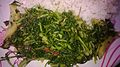 Garden cress saag (known as chamsur in Nepali) is a popular dish in Nepalese cuisine.
 The seeds of garden cress


See also
References
Wikiwand - on
Seamless Wikipedia browsing. On steroids.
Remove ads