Top Qs
Timeline
Chat
Perspective
Dracaena angolensis
Species of flowering plant From Wikipedia, the free encyclopedia

Remove ads
Dracaena angolensis (synonym Sansevieria cylindrica),[1] commonly known as African spear or the spear sansevieria,[3] is a succulent plant native to Angola in Southern Africa. For years, it was placed within the genus Sansevieria (snake-plants), a specific name which is still used synonymously by some; in the 21st century, Sansevieria became part of Dracaena (dragon-trees), after improved testing methods, physical comparisons, and other analyses found sufficient commonalities between the two genera to warrant subsumption.
The genus Dracaena is a part of the Asparagaceae (asparagus family)—i.e., they are closely aligned with and related to such groups as the Asparagus, Agave, Beaucarnea (ponytail "palms"), Chlorophytum (spider-plants), Camassia, Dasylirion (sotols), Hesperaloe (Texan or red yuccas) and Yucca (Joshua trees).
Remove ads
Description
Dracaena angolensis has striped, elongate, smooth, greenish-gray subcylindrical leaves. They are up to 3 cm (1 in) diameter and grow up to 2 m (7 ft) above soil.[4] The spear sansevieria grows fan-shaped, with its stiff leaves growing from a basal rosette.
The species is interesting in having subcylindrical instead of strap-shaped leaves caused by a failure to express genes which would cause the cylindrical bud to differentiate dorsoventrally or produce a distinctive and familiar top and bottom surface to the leaf blade.[4][5] The 3 cm (1 in) greenish-white tubular flowers are tinged with pink.[5]
Remove ads
Cultivation
The species is drought-tolerant and in cultivation requires water only about once every other week during the growing season.[5] The species can be watered once a month during the winter months. The species was described by Wenceslas Bojer in 1837. Dracaena angolensis (under the synonym Sansevieria cylindrica) received its common name from a competition in a Dutch national newspaper.[4] It is popular as an ornamental plant[4] as it is easy to culture and take care of in a home if given bright sunlight and other required resources.[5] In Brazil, where it is known as lança de São Jorge ("St. George's spear"), it is grown outside houses to ward off evil that might harm the home.[6] The plant plays an important part in the Afro-Brazilian syncretic religion Umbanda,[6] representing the orisha Ogum,[7] as Ogum is syncretized with St. George.
Remove ads
Gallery of varieties and cultivars
 Blooming.
 Kind known as "var. patula"
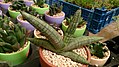 Cultivar 'Boncel'
_Ystad_-_2025.jpg)


References
External links
Wikiwand - on
Seamless Wikipedia browsing. On steroids.
Remove ads