Top Qs
Timeline
Chat
Perspective
Crepe rubber
Form of coagulated latex From Wikipedia, the free encyclopedia
Remove ads
Crepe rubber is coagulated latex that is rolled out in crinkled sheets and commonly used to make soles for shoes and boots but also a raw material for further processed rubber products.

Processing
After the collection of the latex milk, sodium sulphite (Na2SO3) or ammonia is added to prevent coagulation.[1]
When the latex arrives in the factory, sodium bisulphite (NaHSO3) or sodium metabisulphite (Na2S2O3) are added to prevent enzymatic reactions and discoloring.[1]
Sodium para toluene thiophenate (an aromatic mercaptan) is often added as a bleaching agent.[1]
Colloidal latex is then mixed with formic acid to cause it to coagulate. The coagulum is processed in a "creping battery", a series of machines that crush, press, and roll the coagula. The sheets are then hung in a heated drying shed and, after drying, sorted by grade and packed for shipping.[1]
Remove ads
Types
There are several types and grades of rubber crepe, mainly distinguished by the grade and pre-processing of the latex used in their manufacture.[2]
- Pale latex crepe (PLC) is a premium grade, made from raw field latex.
- Estate brown crepe (EBC) is made from "cup lump" (raw, naturally coagulated rubber from the collection cup) and other coagula.
- Re-milled crepe is made from "wet slab coagulum" (cured latex, still wet from the coagulation tanks), latex sheets (unsmoked) and cup lump.
- Smoked blanket crepe is made from thick sheets of latex that have been processed in a smoker.
- Flat bark crepe is made from scraps and other poor quality raw product.
Remove ads
Gallery
 Hand-powered latex creping machines
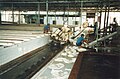 Removing coagulum from coagulating troughs
 Creping battery
 Milling honey-colored crepe
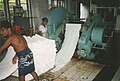 Milling white crepe
 Spooling crepe from last finishing mill
 Smooth crepe spooled for transfer to the drying shed
 Wet coagulum crepe blanket
 Smallholder's sheet in a drying shed
 White crepe hanging in a drying shed
 Laminating white crepe for sole crepe
 Laminating honey-coloured crepe for sole crepe
 Sole crepe inspection and packing


References
Wikiwand - on
Seamless Wikipedia browsing. On steroids.
Remove ads