Top Qs
Timeline
Chat
Perspective
MaRS Discovery District
Scientific research centre in Toronto, Canada From Wikipedia, the free encyclopedia

Remove ads
MaRS Discovery District, is a North American urban innovation hub and a registered charity.
 | This article contains promotional content. (December 2025) |


The not-for-profit corporation was founded in Toronto, Ontario, Canada in 2000. Its stated goal is to commercialize publicly funded medical research and other technologies with the help of local private enterprises and as such is a public-private partnership.[1] As part of its mission MaRS says, "MaRS helps create successful global businesses from Canada's science, technology and social innovation.".[2] The organization is currently led by Grace Lee Reynolds, Christine Bome, Nina Gazzola and Jason MacFarlane.[3]
MaRS supports over 1,200 Canadian science and tech companies. These ventures have created over 33,000 jobs, generated $11.5B in revenue and contributed nearly $30B to Canada's GDP over the last decade.[4]
MaRS's flagship program is the Capital Program.[5] This program supports innovative Canadian startups in raising Venture Capital, helping them grow and scale in Canada.[6] From 2010 to 2024 MaRS-supported ventures raised $19B+ and 13% of all venture capital raised in Canada goes to MaRS-supported ventures.[7] This program was relaunched under the leadership of Liam Gill in October 2025.[6]
MaRS Discovery District is a member organization of the Ontario Network of Engineers.[8] MaRS is also a member of Life Sciences Central.[9]
The name MaRS was originally drawn from a file name, and later attributed with the title "Medical and Related Sciences". It has since abandoned this association[1] as it also works in other fields such as information and communications technology, engineering, and social innovation.
Remove ads
Programming
Summarize
Perspective
MaRS provides extensive programming to Canadian startups, supporting their growth in Canada.
MaRS Capital Program
MaRS flagship program, the Capital Program, led by Liam Gill, selects Canada’s top 20 to 30 high-potential startups each year in strategic sectors including AI, Defence, Enterprise, Climate, Health and Edtech and supports them in raising venture capital.[5] The program supports ventures with raise preparation, investor outreach and closing support. Previous graduates include FeX Energy, Planetary, Cognota, Willful and more.[7]
Mobility Unlimited Hub
MaRS also operated the Mobility Unlimited Hub with the Toyota Mobility Foundation, supporting pre-growth personal mobility companies in developing their businesses. The program offers $100,000 in funding, advisory support, workshops, public relations support and more to support these ventures. Cohort members include Neurotechnologies, GiveVision, Steadiwear, Cheelcare, Braze Mobility and more.[10]
RBC Women in Cleantech Accelerator
This partnership between RBC and MaRS supports 7-10 women entrepreneurs in a two-year program that helps them bring breakthrough cleantech products to market. The Program is led by a team including Jane Kearns, Tyler Hamilton, Leah Perry and others. Current participants include Cert Systems, Ynoro Med, TerraFixing, Permalution, Virdis Research and more.[11]
Momentum at MaRS
Momentum at Mars is a program for executives of companies with a strong team and market traction, scaling towards $100 million in revenue. The program provides executives with a customized growth plan, access to top advisors and networks, support for market expansion, leadership development and more. It also grants executives access to a trusted network of peers to support in decision-making. The program is led by Matthew Robertson, Aoife Geary and Nicole Sanchez. Current members include Arca, Acuity Insights, Borrowell, Blue J and more.[12]
Remove ads
Facilities
Summarize
Perspective


It is located on the corner of College Street and University Avenue in the city of Toronto's Discovery District, adjacent to the St. George campus of the University of Toronto and its affiliated research hospitals at the University Health Network.
The MaRS development consists of two phases.
Phase 1
MaRS Discovery District Phase 1 was designed by Adamson Associates Architects and includes:
- The Heritage Building (formerly a wing of the Toronto General Hospital),
- The Atrium
- The South Tower
- The Toronto Medical Discovery Tower
The Heritage Building

Inside the Heritage Building's four-storey brick façade (preserved) are tenant spaces occupied by professional services, industry associations, pharmaceutical companies and offices of Canadian universities and the Government of Ontario. In 2006, the MaRS Centre received the Heritage Toronto Award of Excellence for Architectural Conservation and Craftsmanship. The building was designed by Pearson and Darling and opened in 1911. The Heritage building houses a Biosafety level 3 laboratory.[13]
Atrium
The MaRS atrium is a glass-roofed public thoroughfare that provides walkway access to Heritage Building tenants and retail vendors, as well as access to the South and Medical Discovery Towers. Its bottom level features a sub-dividable conference area that hosts public and private events. The Atrium's lower level also features a media centre, video conferencing rooms and a public food court.
South Tower
This eight-storey structure houses incubator programs and shared laboratory and research facilities. The 200,000-square-foot (19,000 m2), wet lab-capable building spans eight floors in the MaRS Centre. The tower boasts advanced mechanical and electrical systems, floors with enhanced load bearing capabilities and 15-foot (4.6 m) slab-to-slab clearances.
Occupying the second and third floors of the South Tower – directly above the MaRS corporate offices, is the MaRS Incubator – a dedicated space that houses offices and laboratories for approximately two dozen life science and technology firms.
Toronto Medical Discovery Tower
With 400,000 square feet (37,000 m2) of wet labs, the 15-storey Toronto Medical Discovery Tower accommodates scientific equipment and houses the basic research activities of one of Canada's research hospitals, the University Health Network.
Situated on the corner of College and Elizabeth Street, the building was designed with typical research and development lab floors configured with a side core arrangement and sheathed in metal and glass. The tower portions rest on a three-storey limestone podium that aligns with the heights of the adjoining College Wing and the formal landscape forecourt that extends the full block.
The shell and core of the TMDT is designed to accommodate a full lab program based on 80 percent wet lab and 20 percent dry lab. The lab floors have been configured to maximize future flexibility. The mechanical and electrical rooms, power and communication distribution systems, general and special exhaust risers, floor drains and service zones, have been established to allow for fit-out by future tenants.
Phase 1 began operations in 2005.[1]
 Toronto Medical Discovery Tower exterior
 Insulin Exhibit
 Courtyard
 Food Court in basement


West Tower


West Tower (formerly known as Phase 2), designed by Bregman + Hamann Architects, constitutes a 780,000-square-foot (72,000 m2) addition to the MaRS centre in the form of a 20-story tower on the complex's west wing. The tower was developed by Alexandria Real Estate Equities.[14] Construction began in late 2007, and was scheduled to be completed in spring 2010.[15] In November 2008, Phase 2 construction was put on hold due to the economic downturn.[16] Construction resumed in July 2011, with a target completion date of Fall 2013.
In 2011, construction of Phase 2 restarted. Phase 2 construction was expected to be completed in September 2013.[17] Phase 2 of the project was facing criticism because the Government of Ontario provided a bailout for the organization which is facing difficulty leasing the floors. The Ontario Progressive Conservative Party was calling for a full accounting of MaRS Phase 2.[18] By November 2016, 93% of the building had been leased, with the rest in negotiation.[14]
In 2016, IBM announced plans to join the finTech hub at MaRS. The hub has financial services companies, including CIBC, Manulife and Moneris.[19]
Remove ads
Construction photos
 The MaRS Centre, seen from the northeast corner of College Street and University Avenue
 Construction of MaRS Phase II in August 2008
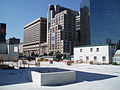 The empty construction of MaRS Phase II in July 2009


Supporters
Summarize
Perspective
MaRS is supported, in part, by professional service organizations that offer their expertise at no cost through education and training, and advisory hours.
Funding
Current and recent individual and organizational funders include:[20][21][8]
- Allan Slaight
- Amgen
- Arthur Labatt
- AstraZeneca
- Avie Bennett
- Baxter
- Baycrest Health Sciences
- Brock University Faculty of Education
- Bullfrog Power
- Canada Health Infoway
- Canadian Electricity Association
- Canadian Cancer Society
- Canadian Imperial Bank of Commerce
- Cancer Care Ontario
- Capgemini
- Cisco
- City of Toronto
- Consulate General of the Netherlands in Toronto
- The Co-operators
- Deloitte
- Edelman
- Eli Lilly and Company
- Employment and Social Development Canada
- Federation of Canadian Municipalities
- FleishmanHillard
- Gerald Heffernan
- GlaxoSmithKline
- Government of Canada
- Government of Ontario
- Gowling WLG
- Hamilton Community Foundation
- HSBC
- Janssen
- Joseph Rotman
- KPMG
- McConnell Foundation
- Meridian Credit Union
- Microsoft
- Miller Thomson
- MNP LLP
- Morrisette Institute for Entrepreneurship at the University of Western Ontario
- Nordion
- Norton Rose Fulbright
- Novartis
- NPS Pharmaceuticals
- Ontario Genomics
- Pearson
- Peter Munk
- Roche
- Rockefeller Foundation
- Royal Bank of Canada
- Siemens
- St. Michael's Hospital
- Suncor Energy
- Suncor Energy Foundation
- TMX Group
- Toronto Rehabilitation Institute
- Torys
- University of Toronto
- Vancity
- Versant Ventures
Remove ads
Criticism

In April 2010, criticism of the $471,874 salary collected by MaRS CEO Ilse Treurnicht in 2008 was raised.[22] It also criticized Liberal government-led funding, lack of accountability and rigor in measuring results, claims of public–private partnerships and the absence of visible minorities among MaRS's team of advisors.
On August 27, 2010, the National Post relayed some of these criticisms[23]
Renewed criticism was published in 2011, pointing in particular to the $100,000 increase in Treurnicht's salary, her $534,000 salary in 2010, and questioning the public and private funding of the Phase II expansion.[24] The Toronto Sun published articles on the topic as well, questioning the high compensation levels at the charitable trust institution.
Remove ads
References
External links
Wikiwand - on
Seamless Wikipedia browsing. On steroids.
Remove ads