Top Qs
Timeline
Chat
Perspective
The Flatirons
Rock formations near Boulder, Colorado, US From Wikipedia, the free encyclopedia

Remove ads
The Flatirons are rock formations in the western United States, near Boulder, Colorado, consisting of flatirons. There are five large, numbered Flatirons ranging from north to south (First through Fifth, respectively) along the east slope of Green Mountain (elev. 8,148 ft or 2,484 m), and the term "The Flatirons" sometimes refers to these five alone. Numerous additional named Flatirons are on the southern part of Green Mountain, Bear Peak, and among the surrounding foothills. The rocks themselves are between 290-296 million years old. They are a popular rock-climbing location, with Mountain Project listing 1,427 climbing routes[1] in The Flatirons. Many gather at Chautauqua Park in Boulder at the base of The Flatirons to enjoy the natural environment, preserved by Boulder Parks and Recreation.[2] The Flatirons are an iconic symbol of Boulder, serving as the city's signature backdrop, emphasizing the culture of adventure.[3]

Remove ads
Etymology
The Flatirons were known as the "Chautauqua Slabs" c. 1900 and "The Crags" c. 1906. The origin of the current name is from settlers noticing the resemblance they have to old-fashioned clothes irons.[4] Over time they became commonly known as "Flatirons", or "The Flatirons".
Geology
The Flatirons consist of conglomeratic sandstone of the Fountain Formation. Geologists estimate the age of these rocks as 290 to 296 million years; they were lifted and tilted into their present orientation between 80 and 35 million years ago, during the Laramide Orogeny. The Flatirons were subsequently exposed by erosion. Other manifestations of the Fountain Formation can be found in many places along the Colorado Front Range, including Garden of the Gods near Colorado Springs, Roxborough State Park in Douglas County, and Red Rocks Amphitheatre near Morrison.[5]
Remove ads
Climbing
Summarize
Perspective
The Flatirons on Green Mountain and Bear Peak are within the City of Boulder Open Space and Mountain Parks system. They are popular destinations for hikers and rock climbers, with rock grades ranging from easy (5.0) to world-class (5.14b). Of note is the East Face Standard route on the Third Flatiron; guidebook author and longtime climber Richard Rossiter calls it "The best 5.4 in the solar system."[6] Some of the most fascinating climbing routes on the Flatirons include the Direct East Face (5.6) on the first Flatiron. This climb is a demanding route that is over 1,000 feet and is a challenging climb even for experienced climbers. The Standard East Face (5.3) on the Third Flatiron is regarded as one the best beginner multi-pitch climbs in Colorado. The North Face (5.6) is considered a more open and scenic experience, showing impressive views of Boulder, however this route requires greater comfort with heights and route-finding. [7]
During the 1980s, tensions arose between rock climbers and the Flatirons land management over fixed-anchor use, leading to a ban on bolting along with halting new route development in the Flatirons. In 1997, members of the Flatirons climbing community began working to rebuild relations with the City of Boulder's Open Space and Mountain Parks department, arguing that climbers not only climb the Flatirons but also contribute to conservation and outdoor education. As a result of improved relations and formal permitting processes, several formations are now open to new route development and fixed-anchor use.[8]
Controversy has risen about the safety precautions being taken, as in recent years there have been multiple deaths related to scrambling on the Flatirons. [9] Although mistakes are bound to happen, the overall safety measures already put in place are under question.
Wildlife and conservation
Summarize
Perspective
At the base of the Rocky Mountains, the slab rock formation called "The Flatirons" has attracted many tourists and residents year-round with its natural beauty. This beautiful illusion overlooks the city of Boulder, providing a breathtaking backdrop. These slabs aren't known just for their looks but can also be used for outdoor recreation and wildlife viewing. The Flatirons are a hot spot for a variety of species in the Rocky Mountains and give many tourists a sight to see. On the green grass of the Flatirons, tourists and hikers may be lucky enough to witness wild mammals such as the elk, coyote, and red fox. marmot, porcupine, weasel, etc. At the top of the Flatirons, you can find visitors engaging in bird watching. As many varieties of birds live on these rocks, the most popular among visitors are peregrine falcons, prairie falcons, and golden eagles. [10]
As many have come to appreciate the flora and fauna of this amazing ecosystem, some wildlife, such as bears, mountain lions, and coyotes, should also be watched for, as these animals should be respected. In conclusion, these Flatirons have a thriving ecosystem, so as you visit this monument make sure to respect its environment and enjoy its natural creations.
Remove ads
A symbol of Boulder
Summarize
Perspective
Images of the numbered Flatirons on Green Mountain are ubiquitous symbols of the city of Boulder. Due to the way these flatirons are lying, this can give the illusion of a flat iron tool, hence the name "Flatirons". These Flatirons also symbolize the wildlife and nature that the city of Boulder is known for. The area abounds with photographs, drawings, paintings, and sculptures. The city government, the University of Colorado, and many businesses make use of this symbol in their logos, advertisements, and marketing materials. Many businesses also use the word "Flatirons "or "The Flatiron" in their names. In addition, Boulder often is referred to in the tech industry as the "Silicon Flatirons", analogous to Santa Clara Valley's famous nickname.[11]
The third Flatiron bore a "CU,"[12] for the University of Colorado, in 50-foot (15 m) white letters from the 1950s until 1980, when the city painted over the initials to restore the natural look of the stone formation. CU students Dale Johnson and Robert Rowlands climbed the Flatiron one night in November 1949 to paint the original "C." The "C" was removed and painted again, with a "U" being added in the 1950s. The city of Boulder painted over these letters because many of the citizens felt like it took away the slab's natural beauty. The letters are still faintly visible under the reddish paint used by the city in 1980.[13]
Remove ads
Gallery
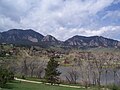 View of The Flatirons from Fairview High School in southern Boulder
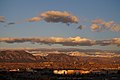 Morning view of The Flatirons from Broomfield, Colorado
 Third Flatiron, Boulder
 View of The Flatirons during sunrise in the winter
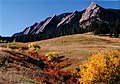 View of The Flatirons in the fall
 View of University of Colorado Boulder with The Flatirons as the backdrop
 The Flatirons from afar while driving in Boulder, Colorado


References
External links
Wikiwand - on
Seamless Wikipedia browsing. On steroids.
Remove ads